


To split or to lump? Classifying the central disorders of hypersomnolence
- PMID: 32193539
- PMCID: PMC7420691
- DOI: 10.1093/sleep/zsaa044
To split or to lump? Classifying the central disorders of hypersomnolence
Abstract
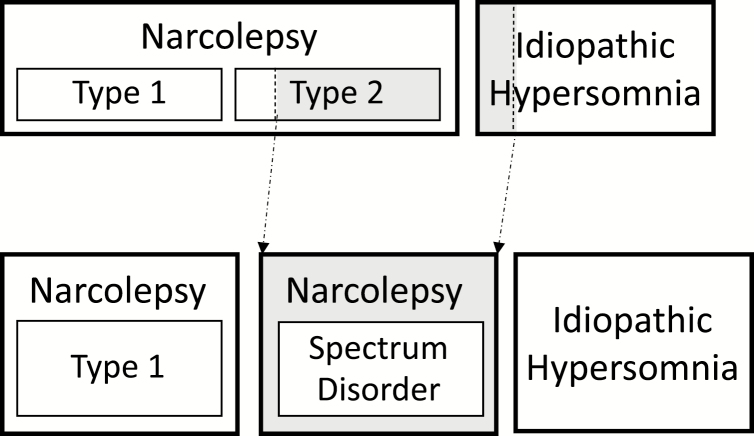
The classification of the central disorders of hypersomnolence has undergone multiple iterations in an attempt to capture biologically meaningful disease entities in the absence of known pathophysiology. Accumulating data suggests that further refinements may be necessary. At the 7th International Symposium on Narcolepsy, a group of clinician-scientists evaluated data in support of keeping or changing classifications, and as a result suggest several changes. First, idiopathic hypersomnia with long sleep durations appears to be an identifiable and meaningful disease subtype. Second, idiopathic hypersomnia without long sleep time and narcolepsy without cataplexy share substantial phenotypic overlap and cannot reliably be distinguished with current testing, and so combining them into a single disease entity seems warranted at present. Moving forward, it is critical to phenotype patients across a wide variety of clinical and biological features, to aid in future refinements of disease classification.
Keywords: classification; hypersomnolence; idiopathic hypersomnia; narcolepsy.
© Sleep Research Society 2020. Published by Oxford University Press on behalf of the Sleep Research Society.
Figures
Comment in
-
A patient's view on reclassifying idiopathic hypersomnia to narcolepsy type-3.Sleep. 2020 Oct 13;43(10):zsaa134. doi: 10.1093/sleep/zsaa134. Sleep. 2020. PMID: 32691069 No abstract available.
-
To split or to lump? Classifying the central disorders of hypersomnolence: sleep split requires epistemological tools and systematic data-driven conceptual analysis.Sleep. 2020 Sep 14;43(9):zsaa091. doi: 10.1093/sleep/zsaa091. Sleep. 2020. PMID: 32926158 No abstract available.
References
-
- Roth B. Narcolepsy and hypersomnia: review and classification of 642 personally observed cases. Schweiz Arch Neurol Neurochir Psychiatr. 1976;119(1):31–41. - PubMed
-
- Vernet C, et al.. Subjective symptoms in idiopathic hypersomnia: beyond excessive sleepiness. J Sleep Res. 2010;19(4):525–534. - PubMed
-
- American Academy of Sleep Medicine. International Classification of Sleep Disorders— 3rd ed. 2014.
-
- Mignot E, et al.. HLA DQB1*0602 is associated with cataplexy in 509 narcoleptic patients. Sleep. 1997;20(11):1012–1020. - PubMed
