


The Local and Peripheral Immune Responses to Stroke: Implications for Therapeutic Development
- PMID: 32193840
- PMCID: PMC7283378
- DOI: 10.1007/s13311-020-00844-3
The Local and Peripheral Immune Responses to Stroke: Implications for Therapeutic Development
Abstract
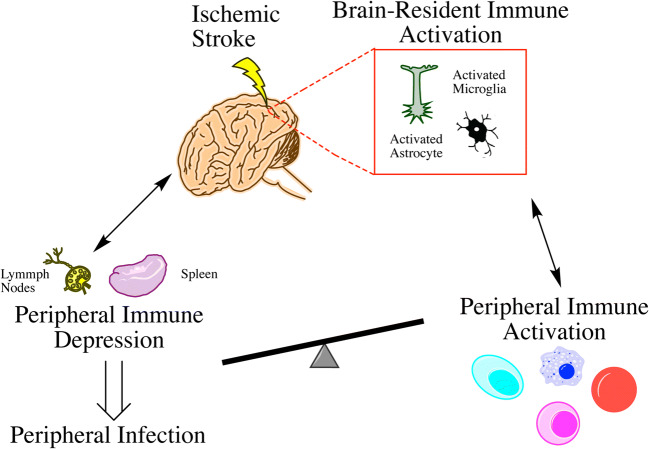
The immune response to stroke is an exciting target for future stroke therapies. Stroke is a leading cause of morbidity and mortality worldwide, and clot removal (mechanical or pharmacological) to achieve tissue reperfusion is the only therapy currently approved for patient use. Due to a short therapeutic window and incomplete effectiveness, however, many patients are left with infarcted tissue that stimulates inflammation. Although this is critical to promote repair, it can also damage surrounding healthy brain tissue. In addition, acute immunodepression and subsequent infections are common and are associated with worse patient outcomes. Thus, the acute immune response is a major focus of researchers attempting to identify ways to amplify its benefits and suppress its negative effects to improve short-term recovery of patients. Here we review what is known about this powerful process. This includes the role of brain resident cells such as microglia, peripherally activated cells such as macrophages and neutrophils, and activated endothelium. The role of systemic immune activation and subsequent immunodepression in the days after stroke is also discussed, as is the chronic immune responses and its effects on cognitive function. The biphasic role of inflammation, as well as complex timelines of cell production, differentiation, and trafficking, suggests that the relationship between the acute and chronic phases of stroke recovery is complex. Gaining a more complete understanding of this intricate process by which inflammation is initiated, propagated, and terminated may potentially lead to therapeutics that can treat a larger population of stroke patients than what is currently available. The immune response plays a critical role in patient recovery in both the acute and chronic phases after stroke. In patients, the immune response can be beneficial by promoting repair and recovery, and also detrimental by propagating a pro-inflammatory microenvironment. Thus, it is critical to understand the mechanisms of immune activation following stroke in order to successfully design therapeutics.
Keywords: Immune response; Infection; Inflammation; Ischemia; Stroke.
Figures
References
-
- Rayasam A, Hsu M, Hernández G, et al. Contrasting roles of immune cells in tissue injury and repair in stroke: The dark and bright side of immunity in the brain. Neurochem Int. 2017;107:104–116. - PubMed
-
- Chamorro A, Meisel A, Planas AM, Urra X, van de Beek D, Veltkamp R. The immunology of acute stroke. Nat Rev Neurol. 2012;8(7):401–410. - PubMed
-
- Lee S. Pathophysiology of Ischemic Stroke. 2017;(1).
-
- del Zoppo GJ, Schmid-Schönbein GW, Mori E, Copeland BR, Chang CM. Polymorphonuclear leukocytes occlude capillaries following middle cerebral artery occlusion and reperfusion in baboons. Stroke. 1991;22(10):1276–1283. - PubMed
-
- Gliem M, Mausberg AK, Lee JI, et al. Macrophages prevent hemorrhagic infarct transformation in murine stroke models. Ann Neurol. 2012;71(6):743–752. - PubMed
Publication types
MeSH terms
Grants and funding
LinkOut - more resources
Full Text Sources
Medical
