. 2020 Jun:213:116754.
doi: 10.1016/j.neuroimage.2020.116754. Epub 2020 Mar 16.

The 'Narcissus Effect': Top-down alpha-beta band modulation of face-related brain areas during self-face processing

Affiliations

The 'Narcissus Effect': Top-down alpha-beta band modulation of face-related brain areas during self-face processing

Elisabet Alzueta et al. Neuroimage. 2020 Jun.

Abstract

Self-related information, such as one's own face, is prioritized by our cognitive system. Whilst recent theoretical developments suggest that this is achieved by an interplay between bottom-up and top-down attentional mechanisms, their underlying neural dynamics are still poorly understood. Furthermore, it is still matter of discussion as to whether these attentional mechanisms are truly self-specific or instead driven by face familiarity. To address these questions, we used EEG to record the brain activity of twenty-five healthy participants whilst identifying their own face, a friend's face and a stranger's face. Time-frequency analysis revealed a greater sustained power decrease in the alpha and beta frequency bands for the self-face, which emerged at late latencies and was maintained even when the face was no longer present. Critically, source analysis showed that this activity was generated in key brain regions for self-face recognition, such as the fusiform gyrus. As in the Myth of Narcissus, our results indicate that one's own face might have the potential to hijack attention. We suggest that this effect is specific to the self and driven by a top-down attentional control mechanism, which might facilitate further processing of personally relevant events.

Keywords: Alpha-beta band; Attention; Fusiform gyrus; Self-face; Self-processing.


Figures

Fig. 1
Fig. 1
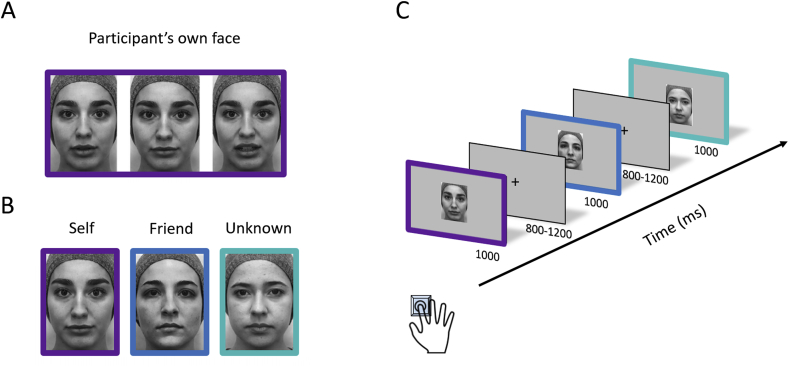
Experimental stimuli and procedure. (A) Examples of different stimulus variants for one face: the left-side image shows a neutral expression; the other two images show the same person articulating speech sounds. (B) Examples of face stimuli employed in each experimental condition: Self, Friend and Unknown face. (C) Sequential presentation of face stimuli during the task. Note: coloured frames are shown for illustrative purposes only; they were not presented during the experiment.
Fig. 2
Fig. 2
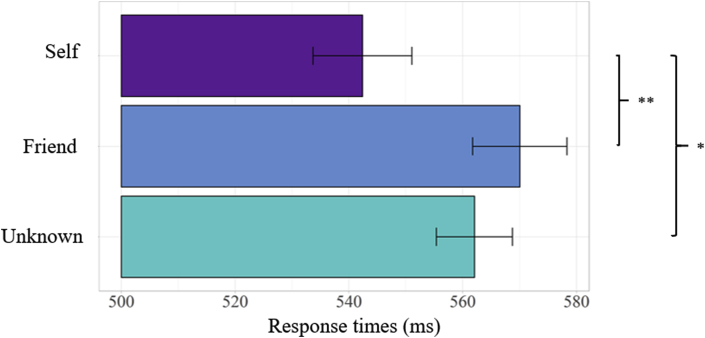
Mean response times on the facial recognition task. The figure illustrates the mean response times for the three conditions in milliseconds: Self, Friend, and Unknown faces. Error bars represent Cousineau-Morey confidence intervals ∗p ​< ​.05, ∗∗p ​< ​.01.
Fig. 3
Fig. 3
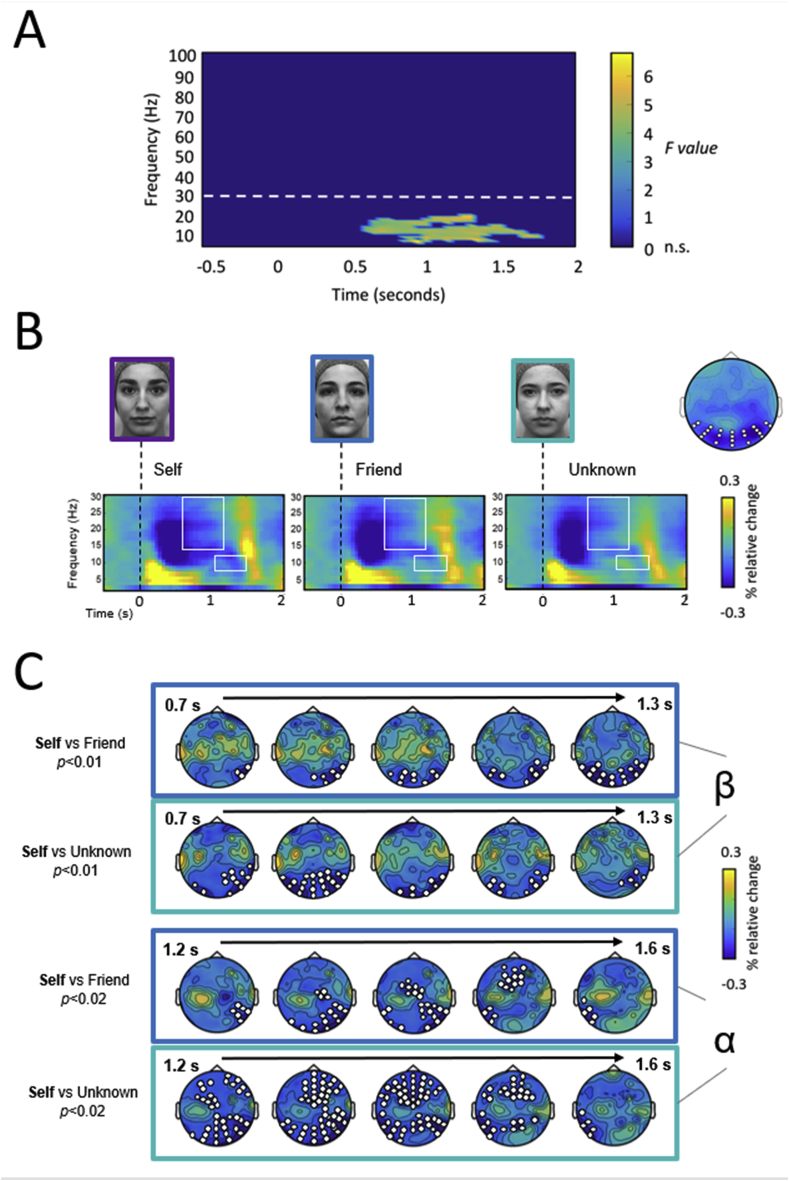
Top-down attentional modulation during self-face processing. (A) Time-frequency representation of the F-value collapsed across electrodes for all of the time-frequency ranges (−0.5 to 2 ​s, and 2.5–100 ​Hz). (B) Time-frequency power maps (from 2.5 to 30 ​Hz) of the three experimental conditions (Self, Friend and Unknown faces). These represent the average time-frequency activity of the group of electrodes showing the largest differences between conditions. The mean topography of all differences between conditions in the alpha-beta range is shown on the right side; selected electrodes employed to compute time-frequency maps are highlighted in white. Alpha and beta frequency bands exhibited a power suppression that was greater and more sustained after self-face presentation. White squares indicate time-frequency windows for significative clusters found in the observed data (beta: 0.7–1.3 ​s at 13–30 ​Hz; alpha: 1.2–1.6 ​s at 8–13 ​Hz). (C) Topographies of power differences in the alpha and beta bands between conditions. Electrodes for each cluster are highlighted in white.
Fig. 4
Fig. 4
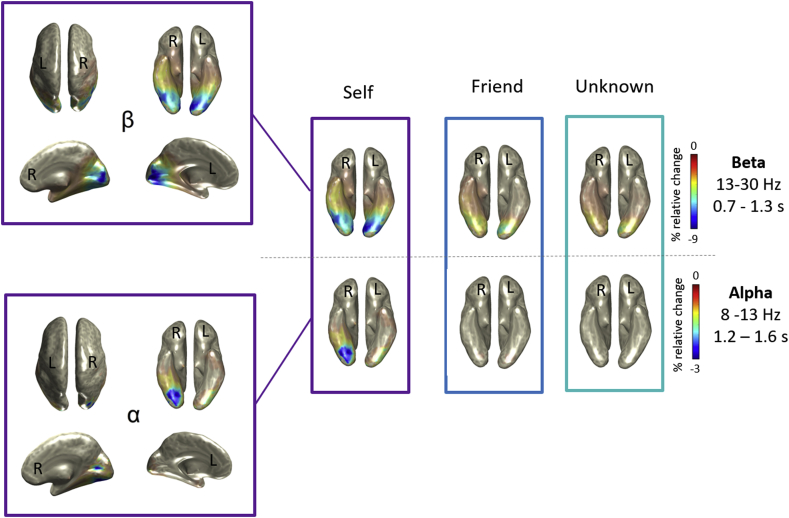
Brain regions underlying the attentional modulation induced by the self-face. The figure shows the neural generators of beta (top) and alpha band (bottom) power suppression for the three experimental conditions (Self, Friend and Unknown faces) during time ranges of interest (0.7–1.3 ​s for beta, and 1.2–1.6 ​s for alpha). The beta source was more broadly distributed over the entire visual cortex, whilst the alpha band was generated around face-related areas in the right hemisphere.
Fig. 5
Fig. 5
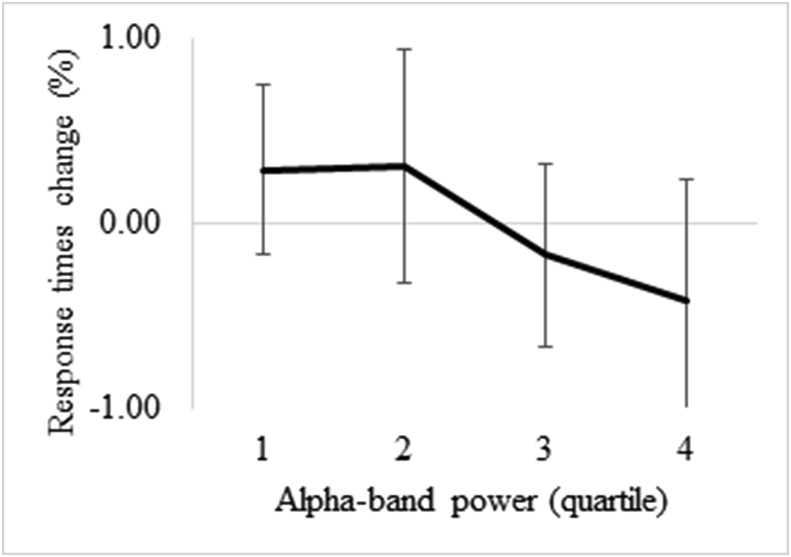
Relationship between alpha band power in face-related areas and response times in the subsequent trial. The figure illustrates the percentage change in response times for the different levels of alpha power in the time range between 1.2 and 1.6 ​s. Magnitude of alpha band power is represented in quartile bins, from lowest (1) to highest (4).

References

    1. Alexopoulos T., Muller D., Ric F., Marendaz C. I, me, mine: automatic attentional capture by self related stimuli. Eur. J. Soc. Psychol. 2012;42(6):770–779. doi: 10.1002/ejsp.1882. - DOI
    1. Alzueta E., Melcón M., Poch C., Capilla A. Is your own face more than a highly familiar face? Biol. Psychol. 2019;142:100–107. doi: 10.1016/J.BIOPSYCHO.2019.01.018. - DOI - PubMed
    1. Aron A., Fraley B. Relationship closeness as including other in the self: cognitive underpinnings and measures. Soc. Cognit. 1999;17(2):140–160. doi: 10.1521/soco.1999.17.2.140. - DOI
    1. Bauer M., Stenner M.-P., Friston K.J., Dolan R.J. Attentional modulation of alpha/beta and gamma oscillations reflect functionally distinct processes. J. Neurosci.: Off. J. Soc. Neurosci. 2014;34(48):16117–16125. doi: 10.1523/JNEUROSCI.3474-13.2014. - DOI - PMC - PubMed
    1. Bonnefond M., Jensen O. Gamma activity coupled to alpha phase as a mechanism for top-down controlled gating. PLOS ONE. 2015;10(6) doi: 10.1371/journal.pone.0128667. - DOI - PMC - PubMed

Publication types