Review
. 2020 Mar 3:11:210.
doi: 10.3389/fphar.2020.00210. eCollection 2020.

Current Status of Septic Cardiomyopathy: Basic Science and Clinical Progress

Affiliations
Review

Current Status of Septic Cardiomyopathy: Basic Science and Clinical Progress

Huan Lin et al. Front Pharmacol. .

Abstract

Septic cardiomyopathy (SCM) is a complication that is sepsis-associated cardiovascular failure. In the last few decades, there is progress in diagnosis and treatment despite the lack of consistent diagnostic criteria. According to current studies, several hypotheses about pathogenic mechanisms have been revealed to elucidate the pathophysiological characteristics of SCM. The objective of this manuscript is to review literature from the past 5 years to provide an overview of current knowledge on pathogenesis, diagnosis and treatment in SCM.

Keywords: diagnosis; heart failure; left ventricular ejection fraction; pathogenesis; sepsis; septic cardiomyopathy; treatment.


Figures

FIGURE 1
FIGURE 1
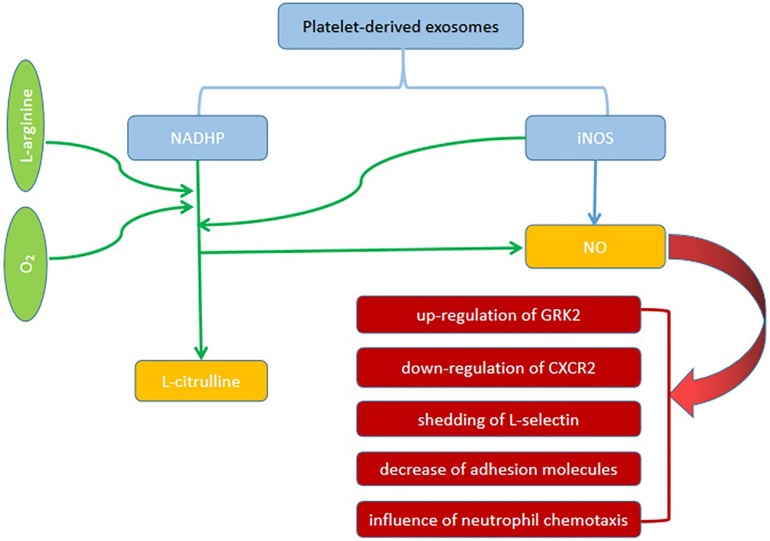
The roles of platelet-derived exosomes in SCM. Platelet-derived exosomes contain NADPH oxidase subunits similar to phagocytes can produce NO. Also, another component from exosomes, iNOS, can produce NO that is related to myocardial dysfunction in sepsis. NO can cause the up-regulation of GRK2, down-regulation of CXCR2, shedding of L-selectin, decrease in adhesion molecules, and influence of neutrophil chemotaxis.
FIGURE 2
FIGURE 2
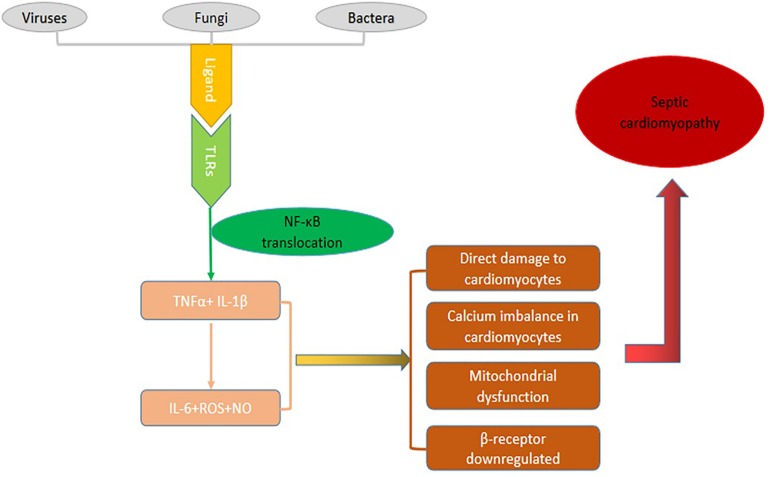
The pathogenic mechanism of SCM. Specific components called ligands of viruses, bacteria or fungi bind to TLRs then go through a series of cascade reactions that cause NF-κB to be transcribed into the nucleus, causing the expression of inflammatory factor genes and producing a large number of inflammatory mediators. These inflammatory factors can cause a series of direct damage to cardiovascular dysfunction, disequilibrium of calcium homeostasis, mitochondrial dysfunction, down regulated expression of β adrenaline receptor, and eventually lead to cardiac dysfunction.

References

    1. An R., Feng J., Xi C., Xu J., Sun L. (2018). miR-146a attenuates sepsis-induced myocardial dysfunction by suppressing IRAK1 and TRAF6 via targeting ErbB4 expression. Oxid. Med. Cell Longev. 2018:7163057. 10.1155/2018/7163057 - DOI - PMC - PubMed
    1. Ankawi G., Xie Y., Yang B., Xie Y., Xie P., Ronco C. (2019). What have we learned about the use of cytosorb adsorption columns? Blood Purif. 48 196–202. 10.1159/000500013 - DOI - PubMed
    1. Beesley S. J., Weber G., Sarge T., Nikravan S., Grissom C. K., Lanspa M. J., et al. (2018). Septic cardiomyopathy. Crit. Care Med. 46 625–634. 10.1097/CCM.0000000000002851 - DOI - PubMed
    1. Brouwer W. P., Duran S., Kuijper M., Ince C. (2019). Hemoadsorption with CytoSorb shows a decreased observed versus expected 28-day all-cause mortality in ICU patients with septic shock: a propensity-score-weighted retrospective study. Crit. Care 23:317. 10.1186/s13054-019-2588-1 - DOI - PMC - PubMed
    1. Cao C., Zhang Y., Chai Y., Wang L., Yin C., Shou S., et al. (2019). Attenuation of sepsis-induced cardiomyopathy by regulation of MicroRNA-23b is mediated through targeting of MyD88-mediated NF-kappaB activation. Inflammation 42 973–986. 10.1007/s10753-019-00958-7 - DOI - PubMed