Review
. 2020 May 1;20(3):foaa013.
doi: 10.1093/femsyr/foaa013.

An update on the diversity, ecology and biogeography of the Saccharomyces genus

Affiliations
Review

An update on the diversity, ecology and biogeography of the Saccharomyces genus

Haya Alsammar et al. FEMS Yeast Res. .

Abstract

Saccharomyces cerevisiae is the most extensively studied yeast and, over the last century, provided insights on the physiology, genetics, cellular biology and molecular mechanisms of eukaryotes. More recently, the increase in the discovery of wild strains, species and hybrids of the genus Saccharomyces has shifted the attention towards studies on genome evolution, ecology and biogeography, with the yeast becoming a model system for population genomic studies. The genus currently comprises eight species, some of clear industrial importance, while others are confined to natural environments, such as wild forests devoid from human domestication activities. To date, numerous studies showed that some Saccharomyces species form genetically diverged populations that are structured by geography, ecology or domestication activity and that the yeast species can also hybridize readily both in natural and domesticated environments. Much emphasis is now placed on the evolutionary process that drives phenotypic diversity between species, hybrids and populations to allow adaptation to different niches. Here, we provide an update of the biodiversity, ecology and population structure of the Saccharomyces species, and recapitulate the current knowledge on the natural history of Saccharomyces genus.

Keywords: Saccharomyes genus; biodiversity; yeast ecology; yeast hybrids.


Figures

Figure 1.
Figure 1.
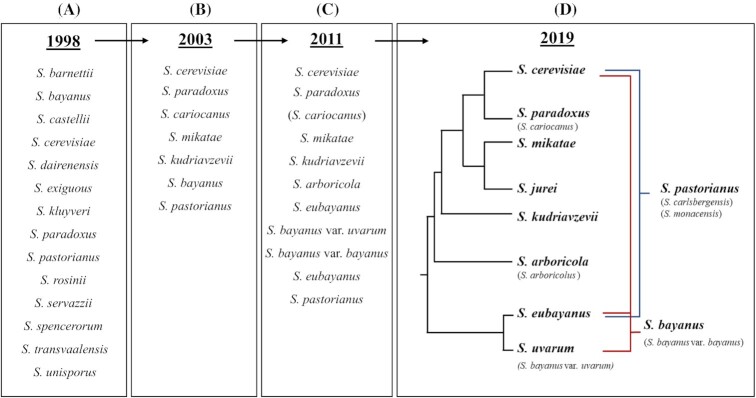
The genus Saccharomyces taxonomic rearrangements. The panels show the main changes in the Saccharomyces species taxonomy within the sensu stricto group over the years. A) In 1998, 14 species were included in the ‘sensu stricto’ group (Vaughan-Martini and Martini 1998). B) In 2003, several species were reclassified and removed abolishing the group names ‘sensu stricto’ and ‘sensu lato’ (Kurtzman and Robnett 2003). Wild species previously isolated were confirmed as distinct Saccharomyces species using molecular and genetic hybridization methods, adding S. mikatae, S. kudriavzevii and S. cariocanus to the group (Naumov et al. 2000b). C) From the year 2003 to 2011 further novel species were discovered from nature and other species were reclassified (Naumov ; Wang and Bai ; Libkind et al. 2011). D) Now, the Saccharomyces genus consists of eight species and two natural hybrids (Boynton and Greig ; Naseeb et al. 2017). Previous taxonomical names of the species are in parenthesis.
Figure 2.
Figure 2.
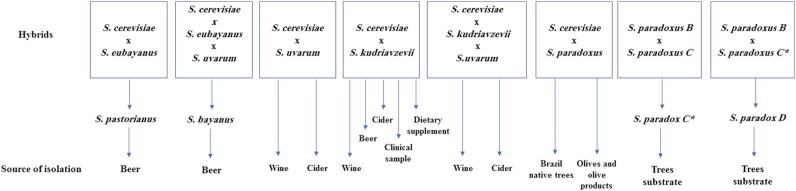
Common Saccharomyces hybrids and the source of their isolation. Saccharomyces may hybridize forming double or triple hybrids that are of industrial significance. Most of the known hybrids are associated with domestication activities and a few strains isolated from non-fermentation environments.
Figure 3.
Figure 3.
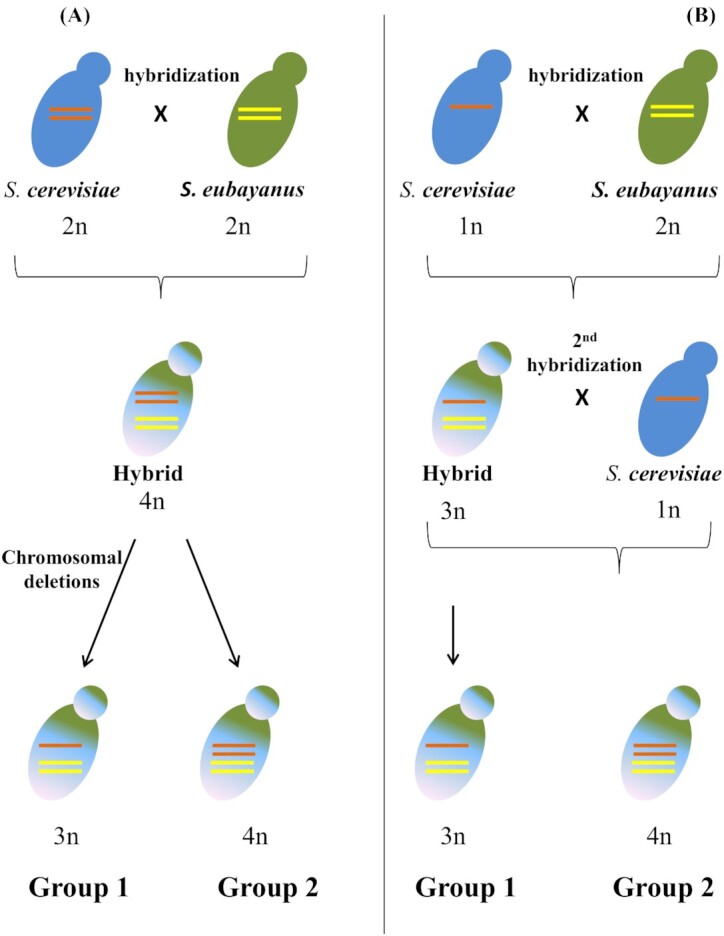
Origin of S. pastorianus group 1 and group 2 strains based on two theories. (A) hybridization between diploid S. cerevisiae and S. eubayanus followed by chromosomal deletions in the S. cerevisiae sub- genome of group 1 strains. (B) The hybridization of a haploid S. cerevisiae and a diploid S. eubayanus lead to a triploid hybrids (3n) followed by a second hybridization event in group 2 strains (4n) (Figure adapted from Okuno et al. (2016).

References

    1. Almeida P, Barbosa R, Zalar Pet al. .. A population genomics insight into the Mediterranean origins of wine yeast domestication. Mol Ecol. 2015;24:5412–27. - PubMed
    1. Almeida P, Goncalves C, Teixeira Set al. .. A Gondwanan imprint on global diversity and domestication of wine and cider yeast Saccharomyces uvarum. Nat Commun. 2014;5:4044. - PMC - PubMed
    1. Alsammar HF, Naseeb S, Brancia LBet al. .. Targeted metagenomics approach to capture the biodiversity of Saccharomyces genus in wild environments. Env Microbiol Rep. 2019;11:206–14. - PMC - PubMed
    1. Alsammar HF. Environmnetal Genomics of the Saccharomyces sensu stricto Group. Thesis, The University of Manchester, UK, Manchester, 2018.
    1. Baker E, Wang B, Bellora Net al. .. The genome sequence of Saccharomyces eubayanus and the domestication of lager-brewing yeasts. Mol Biol Evol. 2015;32:2818–31. - PMC - PubMed

Publication types