. 2020 Apr 2;106(4):438-452.
doi: 10.1016/j.ajhg.2020.02.013. Epub 2020 Mar 19.

De Novo Frameshift Variants in the Neuronal Splicing Factor NOVA2 Result in a Common C-Terminal Extension and Cause a Severe Form of Neurodevelopmental Disorder

Affiliations

De Novo Frameshift Variants in the Neuronal Splicing Factor NOVA2 Result in a Common C-Terminal Extension and Cause a Severe Form of Neurodevelopmental Disorder

Francesca Mattioli et al. Am J Hum Genet. .

Abstract

The neuro-oncological ventral antigen 2 (NOVA2) protein is a major factor regulating neuron-specific alternative splicing (AS), previously associated with an acquired neurologic condition, the paraneoplastic opsoclonus-myoclonus ataxia (POMA). We report here six individuals with de novo frameshift variants in NOVA2 affected with a severe neurodevelopmental disorder characterized by intellectual disability (ID), motor and speech delay, autistic features, hypotonia, feeding difficulties, spasticity or ataxic gait, and abnormal brain MRI. The six variants lead to the same reading frame, adding a common proline rich C-terminal part instead of the last KH RNA binding domain. We detected 41 genes differentially spliced after NOVA2 downregulation in human neural cells. The NOVA2 variant protein shows decreased ability to bind target RNA sequences and to regulate target AS events. It also fails to complement the effect on neurite outgrowth induced by NOVA2 downregulation in vitro and to rescue alterations of retinotectal axonal pathfinding induced by loss of NOVA2 ortholog in zebrafish. Our results suggest a partial loss-of-function mechanism rather than a full heterozygous loss-of-function, although a specific contribution of the novel C-terminal extension cannot be excluded.

Keywords: C-terminal part; KH domains; NOVA2; alternative splicing; autism; de novo mutations; intellectual disability.


Conflict of interest statement

A.T., G.D., and Y.C.S. are employees of GeneDx.

Figures
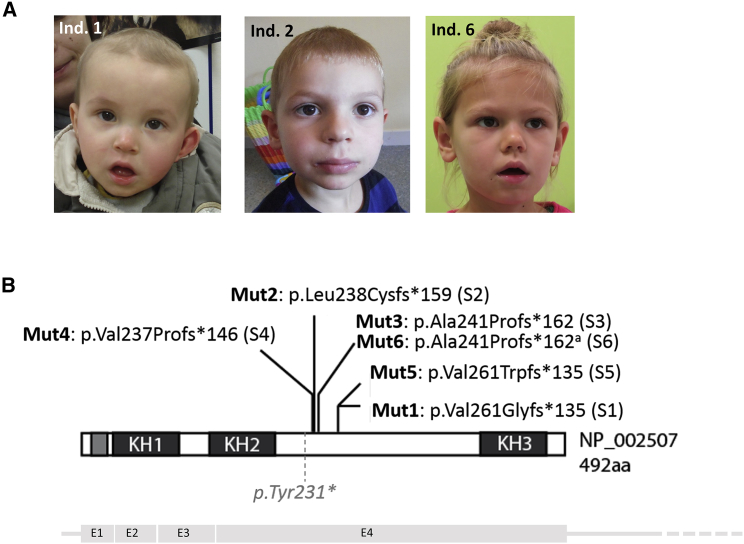
Figure 1
Figure 1
Frameshift Variants in NOVA2 Identified in Individuals with ID (A) Pictures of individuals 1 (S1), 2 (S2), and 6 (S6). (B) Schematic representation of NOVA2 protein showing consequences of the frameshift variants identified in the six affected individuals reported here (subjects S1 to S6). p.Tyr231 indicates a non-existing truncating variant we made for the need of the study. The four coding exons (E1-4) are represented below the protein.
Figure 2
Figure 2
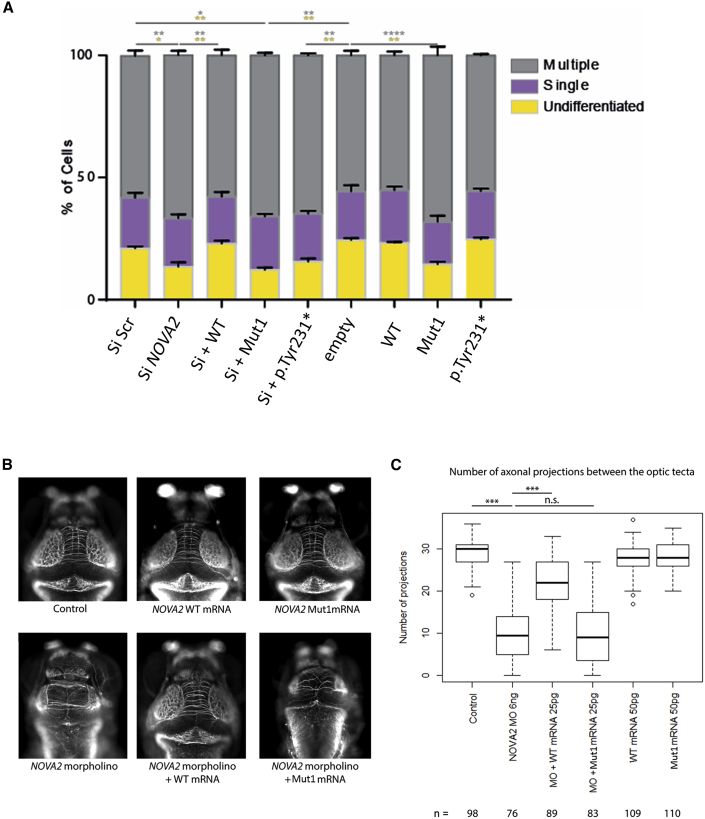
NOVA2 Downregulation Affects Neurite Outgrowth In Vitro and Leads to Decreased Number of Inter-tecta Axonal Tracts in Zebrafish In Vivo (A) NOVA2 downregulation using siRNA affects neurite outgrowth. Neuro2A cells were transfected with different combinations of NOVA2 constructs (wild-type WT, Val261Glyfs135 alias Mut1 or p.Tyr231) and siRNAs together with the GFP-reporter Venus. 48 h after treatment, cells were stained against GFP and tubulin and counterstained with DAPI. Histograms represent the percentage of transfected cells with either multiple similar sized processes (gray), a single neurite (purple), or round undifferentiated cells without processes (yellow). Data are represented as mean ± SEM. Two-way ANOVA with Tukey’s multiple comparison test. n = 3 independent experiments. p < 0.05, ∗∗p < 0.01, ∗∗∗∗p < 0.0001, gray asterisks for differences in cells with multiple processes and yellow asterisks for undifferentiated cells. (B) Top panel: Representative images of dorsal views of control, wild-type, and Mut1 NOVA2 mRNA-injected larva at 4 days post-fertilization stained with anti-acetylated tubulin (AcTub). Bottom panel: In vivo complementation assay. Representative images of dorsal views of morpholino (MO)-injected, MO+WT RNA-injected, and MO+Mut1 RNA-injected larva at 4 days post-fertilization stained with anti-acetylated tubulin (AcTub). (C) Boxplots of inter-tecta axonal tracts’ count after acetylated Tubulin staining of 4 dpf control larva and larva injected with 6 ng of nova1 morpholino (MO), 6 ng of nova1 MO+25 pg of WT NOVA2 mRNA, 6 ng of nova1 MO+25 pg of Mut1 NOVA2 mRNA, 50 pg of WT NOVA2 mRNA, 50 pg of Mut1 NOVA2 mRNA. A t test was performed between pairs of conditions. p value < 0.001 are indicated by ∗∗∗. n.s.: non-significant. n: number of larvae per condition.
Figure 3
Figure 3
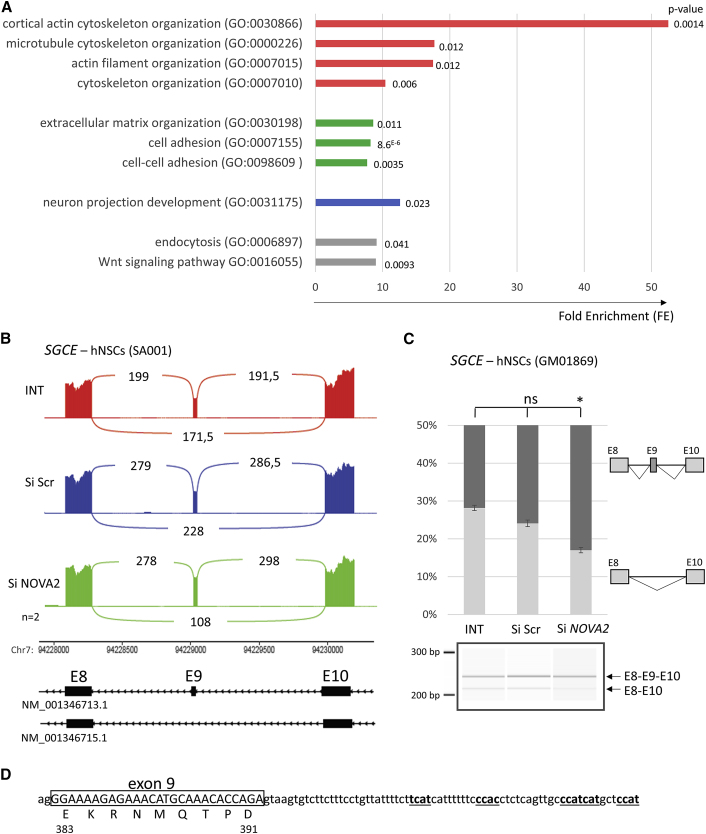
Transcriptomic Analysis in Human Neural Stem Cells (hNSCs) after NOVA2 Inactivation (A) Enrichment of GO terms (Biological Process and Molecular Function, analyzed using DAVID) for the genes with differential alternative splicing (AS) events identified in human neuronal precursors (hNSCs – SA001) after NOVA2 inactivation. Fold enrichement (FE) and p value are also indicated. (B) Sashimi plot established from RNA-seq data representing the AS of SGCE exon 9 (GenBank: NM_001346713.1). The number of reads supporting the existence of each exon-exon junction is indicated as an average between data from the two independent series of hNSCs treated with INTERFERin only (in red), with scramble siRNA (in blue) or with NOVA2 siRNA (in green) during 48 h. (C) Confirmation of the consequences of NOVA2 inactivation on SGCE splicing in another hNSC cell line (GM01869), treated with the transfecting agent only (INT) or transfected with Scramble (si Scr) or NOVA2 (siNOVA2) siRNA. The RT-PCR products obtained were analyzed by migration on a 2,100 Bioanalyzer instrument (Agilent Technology). Experiments were done in triplicates. The error bars indicate the SEM. Kruskal-Wallis’ ANOVA with Dunn’s multiple comparison test was performed p < 0.05, ns: non-significant. (D) Sequence of SGCE exon9-intron9 junction with indicated potential NOVA2 binding sequences YCAY (in bold and underlined).
Figure 4
Figure 4
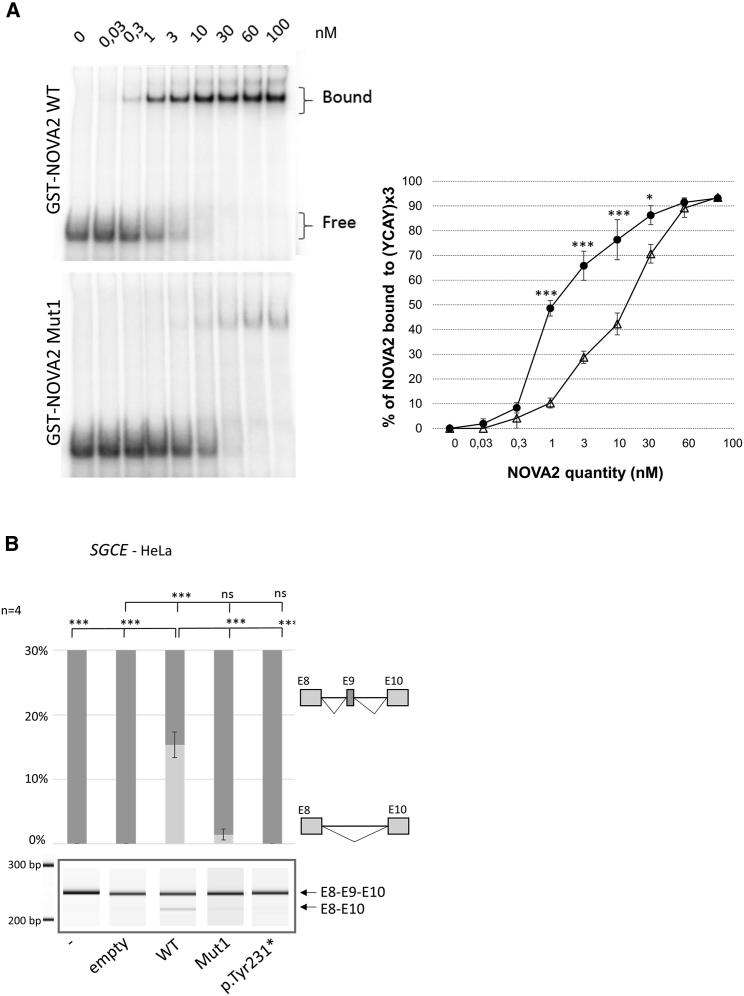
Decreased Ability of the Mut1 Variant NOVA2 Protein to Bind Target RNA Sequences (YCAYx3) and to Regulate Target Alternative Splicing (AS) Events (A) Binding ability of NOVA2 WT and p.Val261Glyfs135 (Mut1) variant proteins to NOVA2-target sequence YCAY 3×. Left panel, gel-shift assays of the indicated amount of purified recombinant WT or Mut1 GST-NOVA2 with 10 pM of uniformly [αP32] internally labeled in vitro transcribed RNAs containing three UCAY binding sites for NOVA proteins. Right panel, gel-shift quantification. Error bars standard error mean (SEM) of three independent experiments. Student’s t test, p < 0.5, ∗∗∗p < 0.001. (B) Effect of overexpression of wild-type (WT) or variant (Mut1 or p.Tyr231) NOVA2 proteins on splicing of SGCE exon 9 in HeLa cells. The RT-PCR products obtained were analyzed by migration on a 2,100 Bioanalyzer instrument (Agilent Technology). Four series of experiments were analyzed. The error bars indicate the SEM. Brown-Forsythe and Welch’s ANOVA with Holm-Sidak’s multiple comparisons ∗∗∗p < 0.001, p < 0.05, ns: non-significant.

References

    1. Ule J., Ule A., Spencer J., Williams A., Hu J.-S., Cline M., Wang H., Clark T., Fraser C., Ruggiu M. Nova regulates brain-specific splicing to shape the synapse. Nat. Genet. 2005;37:844–852. - PubMed
    1. Jensen K.B., Dredge B.K., Stefani G., Zhong R., Buckanovich R.J., Okano H.J., Yang Y.Y., Darnell R.B. Nova-1 regulates neuron-specific alternative splicing and is essential for neuronal viability. Neuron. 2000;25:359–371. - PubMed
    1. Ule J., Jensen K.B., Ruggiu M., Mele A., Ule A., Darnell R.B. CLIP identifies Nova-regulated RNA networks in the brain. Science. 2003;302:1212–1215. - PubMed
    1. Yang Y.Y., Yin G.L., Darnell R.B. The neuronal RNA-binding protein Nova-2 is implicated as the autoantigen targeted in POMA patients with dementia. Proc. Natl. Acad. Sci. USA. 1998;95:13254–13259. - PMC - PubMed
    1. Buckanovich R.J., Yang Y.Y., Darnell R.B. The onconeural antigen Nova-1 is a neuron-specific RNA-binding protein, the activity of which is inhibited by paraneoplastic antibodies. J. Neurosci. 1996;16:1114–1122. - PMC - PubMed

Publication types

MeSH terms