


Undiscovered Roles for Transthyretin: From a Transporter Protein to a New Therapeutic Target for Alzheimer's Disease
- PMID: 32197355
- PMCID: PMC7139926
- DOI: 10.3390/ijms21062075
Undiscovered Roles for Transthyretin: From a Transporter Protein to a New Therapeutic Target for Alzheimer's Disease
Abstract
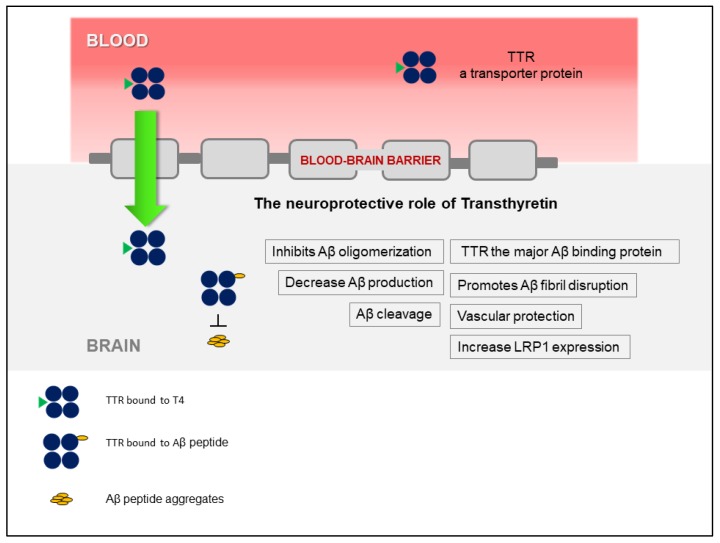
Transthyretin (TTR), an homotetrameric protein mainly synthesized by the liver and the choroid plexus, and secreted into the blood and the cerebrospinal fluid, respectively, has been specially acknowledged for its functions as a transporter protein of thyroxine and retinol (the latter through binding to the retinol-binding protein), in these fluids. Still, this protein has managed to stay in the spotlight as it has been assigned new and varied functions. In this review, we cover knowledge on novel TTR functions and the cellular pathways involved, spanning from neuroprotection to vascular events, while emphasizing its involvement in Alzheimer's disease (AD). We describe details of TTR as an amyloid binding protein and discuss its interaction with the amyloid Aβ peptides, and the proposed mechanisms underlying TTR neuroprotection in AD. We also present the importance of translating advances in the knowledge of the TTR neuroprotective role into drug discovery strategies focused on TTR as a new target in AD therapeutics.
Keywords: Alzheimer’s disease; TTR tetrameric stability; amyloid diseases; angiogenesis; blood–brain barrier; cerebrospinal fluid protein; neuroprotection; transport protein; transthyretin.
Conflict of interest statement
The authors declare no conflict of interest.
Figures
References
-
- Soprano D.R., Herbert J., Soprano K.J., Schon E.A., Goodman D.S. Demonstration of transthyretin mRNA in the brain and other extrahepatic tissues in the rat. J. Biol. Chem. 1985;260:11793–11798. - PubMed
Publication types
MeSH terms
Substances
Grants and funding
LinkOut - more resources
Full Text Sources
Medical
Research Materials
Miscellaneous
