. 2020 Mar 20;21(1):248.
doi: 10.1186/s12864-020-6640-y.

Phylogenetic relationship between Australian Fusarium oxysporum isolates and resolving the species complex using the multispecies coalescent model

Affiliations

Phylogenetic relationship between Australian Fusarium oxysporum isolates and resolving the species complex using the multispecies coalescent model

Saidi R Achari et al. BMC Genomics. .

Abstract

Background: The Fusarium oxysporum species complex (FOSC) is a ubiquitous group of fungal species readily isolated from agroecosystem and natural ecosystem soils which includes important plant and human pathogens. Genetic relatedness within the complex has been studied by sequencing either the genes or the barcoding gene regions within those genes. Phylogenetic analyses have demonstrated a great deal of diversity which is reflected in the differing number of clades identified: three, five and eight. Genetic limitation within the species in the complex has been studied through Genealogical Concordance Phylogenetic Species Recognition (GCPSR) analyses with varying number of phylogenetic 'species' identified ranging from two to 21. Such differing views have continued to confuse users of these taxonomies.

Results: The phylogenetic relationships between Australian F. oxysporum isolates from both natural and agricultural ecosystems were determined using three datasets: whole genome, nuclear genes, and mitochondrial genome sequences. The phylogenies were concordant except for three isolates. There were three concordant clades from all the phylogenies suggesting similar evolutionary history for mitochondrial genome and nuclear genes for the isolates in these three clades. Applying a multispecies coalescent (MSC) model on the eight single copy nuclear protein coding genes from the nuclear gene dataset concluded that the three concordant clades correspond to three phylogenetic species within the FOSC. There was 100% posterior probability support for the formation of three species within the FOSC. This is the first report of using the MSC model to estimate species within the F. oxysporum species complex. The findings from this study were compared with previously published phylogenetics and species delimitation studies.

Conclusion: Phylogenetic analyses using three different gene datasets from Australian F. oxysporum isolates have all supported the formation of three major clades which delineated into three species. Species 2 (Clade 3) may be called F. oxysporum as it contains the neotype for F. oxysporum.

Keywords: Phylogenomics; Recombination; Sequencing; Species delimitation; Taxonomy.


Conflict of interest statement

The authors declare that they have no competing interests.

Figures
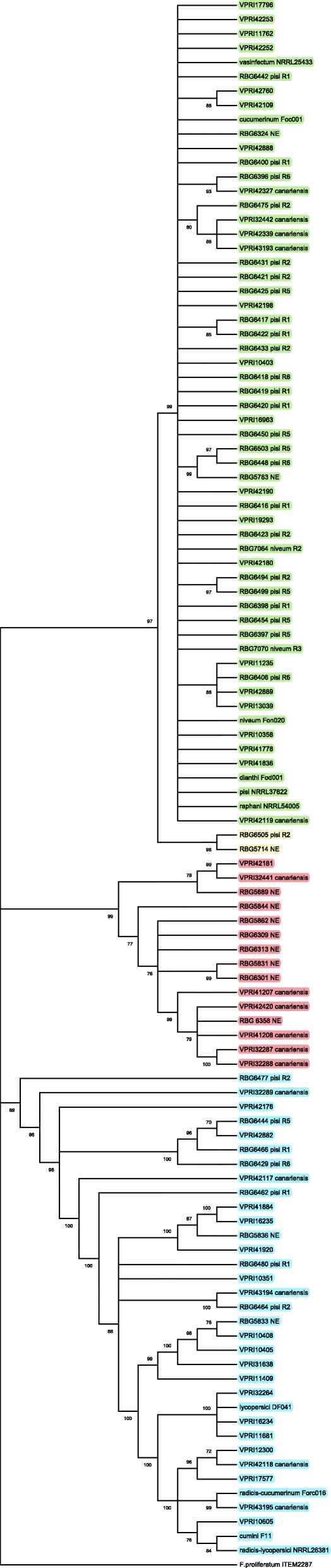
Fig. 1
Fig. 1
Maximum likelihood consensus tree with bootstrap node support of > 70% was inferred from conserved mitochondrial genome sequence of Fusarium oxysporum isolates used in the study and 10 reference isolates (NRRL25433, Foc001, Fon020, Fod001, NRRL37622, NRRL54005, DF041, Forc016, F11, NRRL26381) from Brankovics et al. [23] using MEGA X with 1000 bootstrap replications. The best nucleotide substitution model, HKY + G + I was used. The four phylogenetic clades identified within the FOSC are highlighted in different shades. Isolates coloured red, green, blue and yellow belong to Clades 1, 2, 3 and 4 respectively. The tree is rooted to Fusarium proliferatum (ITEM2287)
Fig. 2
Fig. 2
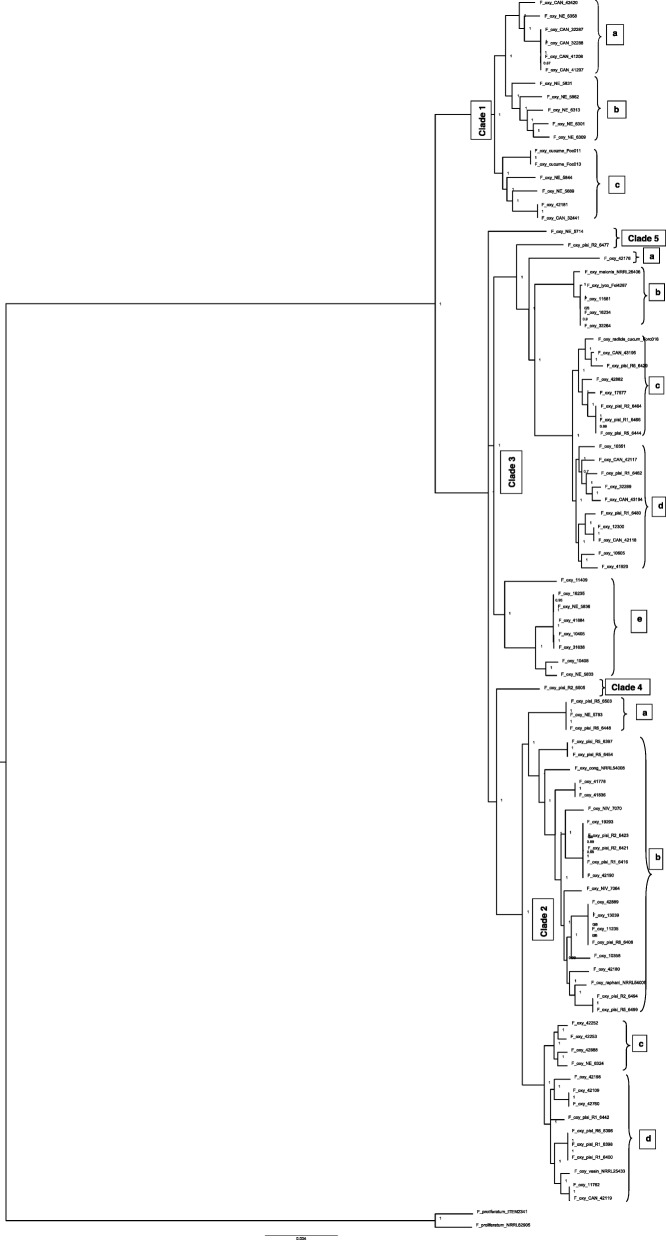
Phylogenetic analysis of whole genome of Fusarium oxysporum isolates used in the current study and eight reference isolates (NRRL25433, NRRL54005, NRRL54008, NRRL26406, Forc016, Fol4287, Foc013 and Foc011) included from GenBank using Roary: Pan Genome pipeline. Six thousand eight hundred genes were found to be conserved across all the isolates including the outgroup, Fusarium proliferatum (ITEM2341 and NRRL62905). The protein sequences for these genes were aligned using Multiple Alignment FAST Fourier Transform (MAFFT) [46] and then clustered into orthologous groups. A Maximum Likelihood tree was generated using FastTree [47] with the General Time Reversal (GTR) substitution model. FastTree used the Shimodaira-Hasegawa (SH) test for three alternate topologies for every split and each split was sampled 1000 times. The five phylogenetic clades and sub-clades identified within the FOSC are marked
Fig. 3
Fig. 3
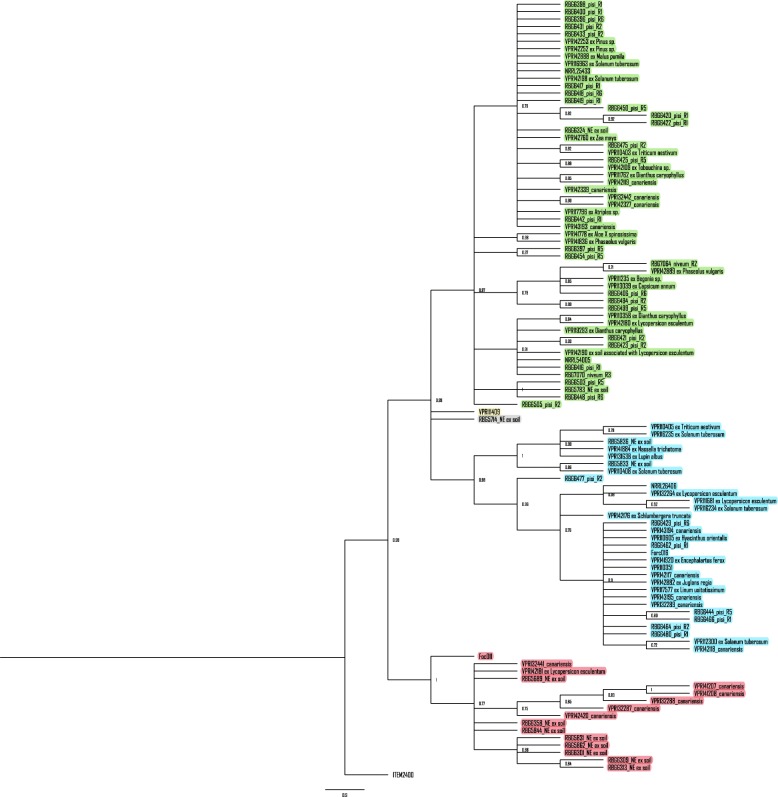
Maximum likelihood consensus tree with bootstrap node support of > 70% was inferred from the nuclear gene dataset (concatenated multi-locus DNA sequences of tub2, cal, mtSSU, RPB1, RPB2, Tef1-α, TEF3 and Top1) of Fusarium oxysporum isolates used in the current study and five reference isolates (NRRL26406, NRRL54005, NRRL25433, Forc016 and Foc011) from Brankovics et al. [23] using MEGA X with 1000 bootstrap replications. The tree is rooted to Fusarium proliferatum (ITEM2400). The host species from which the Australian VPRI isolates were isolated from are shown on the tree. The five phylogenetic clades identified within the FOSC are highlighted in different shades. Isolates coloured red, green, blue, yellow and grey belong to Clades 1, 2, 3, 4 and 5 respectively
Fig. 4
Fig. 4
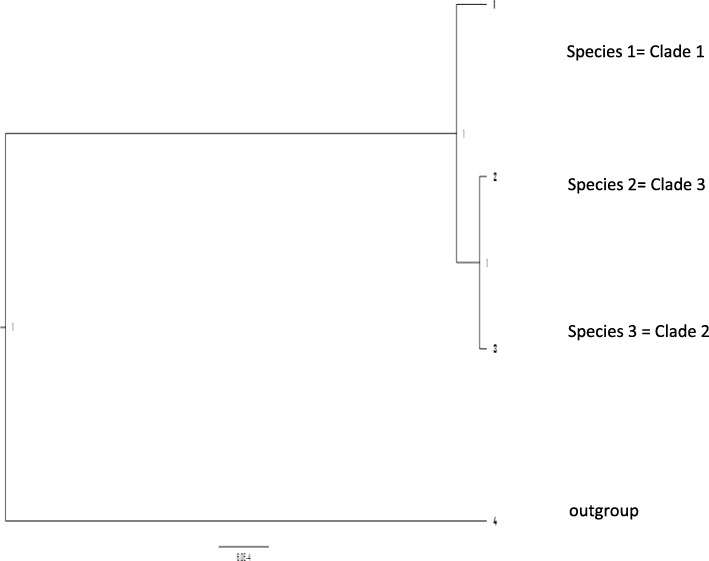
Species tree estimation of Fusarium oxysporum isolates using multispecies coalescent (MSC) model in *BEAST. Nuclear gene dataset with eight loci (tef1-α, tef3, RPB1, RPB2, cal, tub2, top1 and mtSSU) were used in the analysis. Numbers above branches indicate node support as posterior probabilities. The number of species correlates to the number of concordant clades (1, 2, and 3) in the phylogenies. Species denoted as 4 is the outgroup, Fusarium proliferatum (ITEM2400)

References

    1. Dean R, Van Kan JA, Pretorius ZA, Hammond-Kosack KE, Di Pietro A, Spanu PD, et al. The top 10 fungal pathogens in molecular plant pathology. Mol Plant Pathol. 2012;13(4):414–430. doi: 10.1111/j.1364-3703.2011.00783.x. - DOI - PMC - PubMed
    1. Baayen RP. Diagnosis and detection of host-specific forms of Fusarium oxysporum. EPPO Bulletin. 2000;30:489–491. doi: 10.1111/j.1365-2338.2000.tb00935.x. - DOI
    1. Lievens B, Rep M, Thomma BP. Recent developments in the molecular discrimination of formae speciales of Fusarium oxysporum. Pest Manag Sci. 2008;64(8):781–788. doi: 10.1002/ps.1564. - DOI - PubMed
    1. Kuldau GA, Yates IE. Evidence for Fusarium endophytes in cultivated and wild plants. In: Bacon CW, Jr White JF, editors. Microbial Endophytes. New York: Marcel Dekker Inc.; 2000. pp. 85–117.
    1. Fravel D, Olivain C, Alabouvette C. Fusarium oxysporum and its biocontrol. New Phytol. 2003;157(3):493–502. doi: 10.1046/j.1469-8137.2003.00700. - DOI - PubMed

LinkOut - more resources