Review
. 2020 May 29;432(12):3525-3546.
doi: 10.1016/j.jmb.2020.03.009. Epub 2020 Mar 19.

The Still Dark Side of the Moon: Molecular Mechanisms of Lunar-Controlled Rhythms and Clocks

Affiliations
Review

The Still Dark Side of the Moon: Molecular Mechanisms of Lunar-Controlled Rhythms and Clocks

Gabriele Andreatta et al. J Mol Biol. .

Abstract

Starting with the beginning of the last century, a multitude of scientific studies has documented that the lunar cycle times behaviors and physiology in many organisms. It is plausible that even the first life forms adapted to the different rhythms controlled by the moon. Consistently, many marine species exhibit lunar rhythms, and also the number of documented "lunar-rhythmic" terrestrial species is increasing. Organisms follow diverse lunar geophysical/astronomical rhythms, which differ significantly in terms of period length: from hours (circalunidian and circatidal rhythms) to days (circasemilunar and circalunar cycles). Evidence for internal circatital and circalunar oscillators exists for a range of species based on past behavioral studies, but those species with well-documented behaviorally free-running lunar rhythms are not typically used for molecular studies. Thus, the underlying molecular mechanisms are largely obscure: the dark side of the moon. Here we review findings that start to connect molecular pathways with moon-controlled physiology and behaviors. The present data indicate connections between metabolic/endocrine pathways and moon-controlled rhythms, as well as interactions between circadian and circatidal/circalunar rhythms. Moreover, recent high-throughput analyses provide useful leads toward pathways, as well as molecular markers. However, for each interpretation, it is important to carefully consider the, partly substantially differing, conditions used in each experimental paradigm. In the future, it will be important to use lab experiments to delineate the specific mechanisms of the different solar- and lunar-controlled rhythms, but to also start integrating them together, as life has evolved equally long under rhythms of both sun and moon.

Keywords: hormones; lunar rhythms; physiology; proteome; transcriptome.


Figures

Unlabelled Image
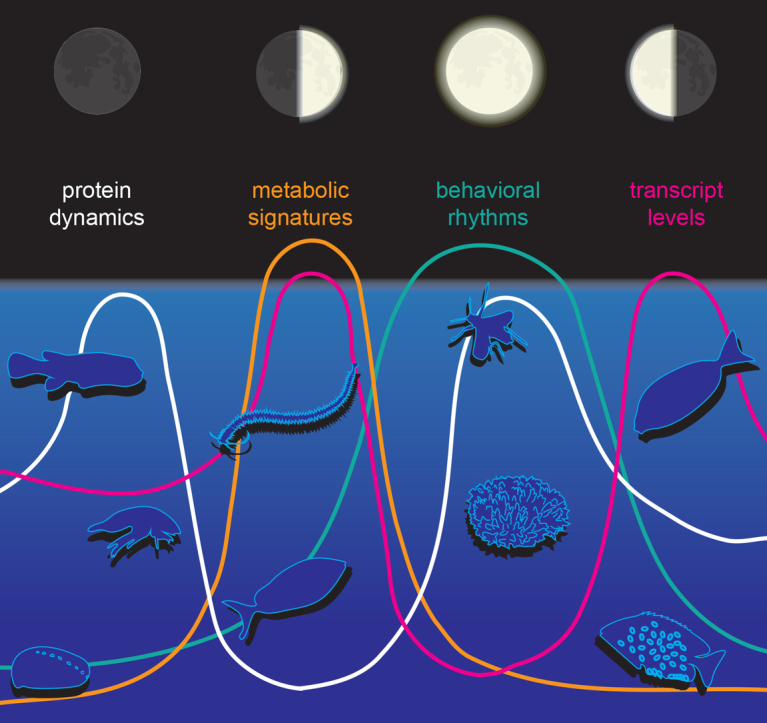
Graphical abstract
Figure 1
Figure 1
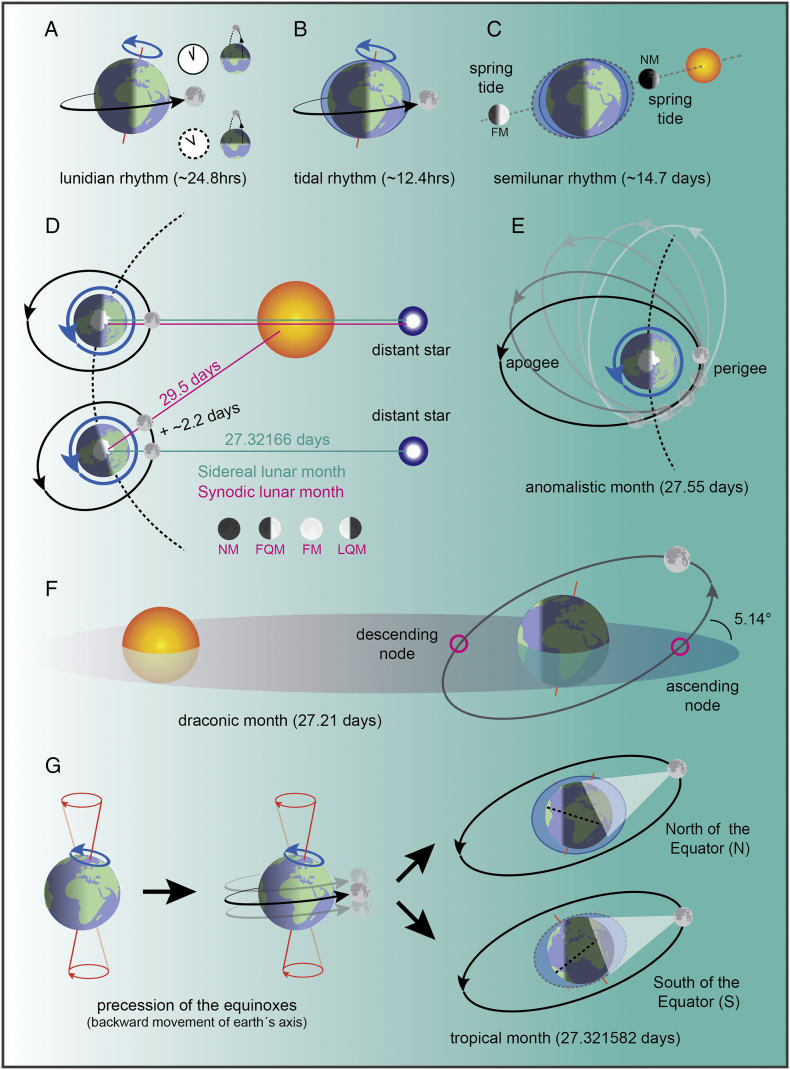
Schematized representations of the known astronomical and geophysical rhythms dictated by the moon. (A) Lunidian rhythm, the period between two consecutive maximal heights of the moon in the sky (meridian transits). (B) Tidal rhythm: water levels increase twice every day in two opposite sites on earth, with one being the closest to our satellite. (C) Semilunar rhythm: the alignment of moon, earth and sun potentiate tidal variations, creating spring (during FM and NM) and neap (during FQM and LQM) tides cycles. (D) Synodic and sidereal months. The first gives rise to the known lunar phases: NM, FQM, FM, and LQM or third quarter moon. (E) Anomalistic month. (F) Draconic month. The plane described by moon's orbit is inclined (5.14°) compared to the plane on which the sun and the earth lay, and the two planes cross in two points called nodes (purple circles). (G) Tropical month: the clockwise rotation of earth's axis affects moon's relative trajectory in the sky (declination). Thus, periodically, the moon faces a more northern or southern portion of earth relative to the Equator, and this affects both moonlight intensity and tides. Moonlight depicted in the figure is a reflection of sunlight. The sun was purposely left away from the scheme for the sake of clarity. For further details, see text. Sources: [5,6]; https://en.wikipedia.org/wiki/Lunar_month;https://www.youtube.com/watch?v=jWCBhVfeAQU;https://www.youtube.com/watch?v=Z6DpPQ8QdLg;https://www.youtube.com/watch?v=adzx547ptck;http://www.antikythera-mechanism.gr/faq/astronomical-questions/what-are-the-different-months;https://moonblink.info/Eclipse/why/months;https://www.slideshare.net/RAFIULALAM006/month-57977849).
Figure 2
Figure 2
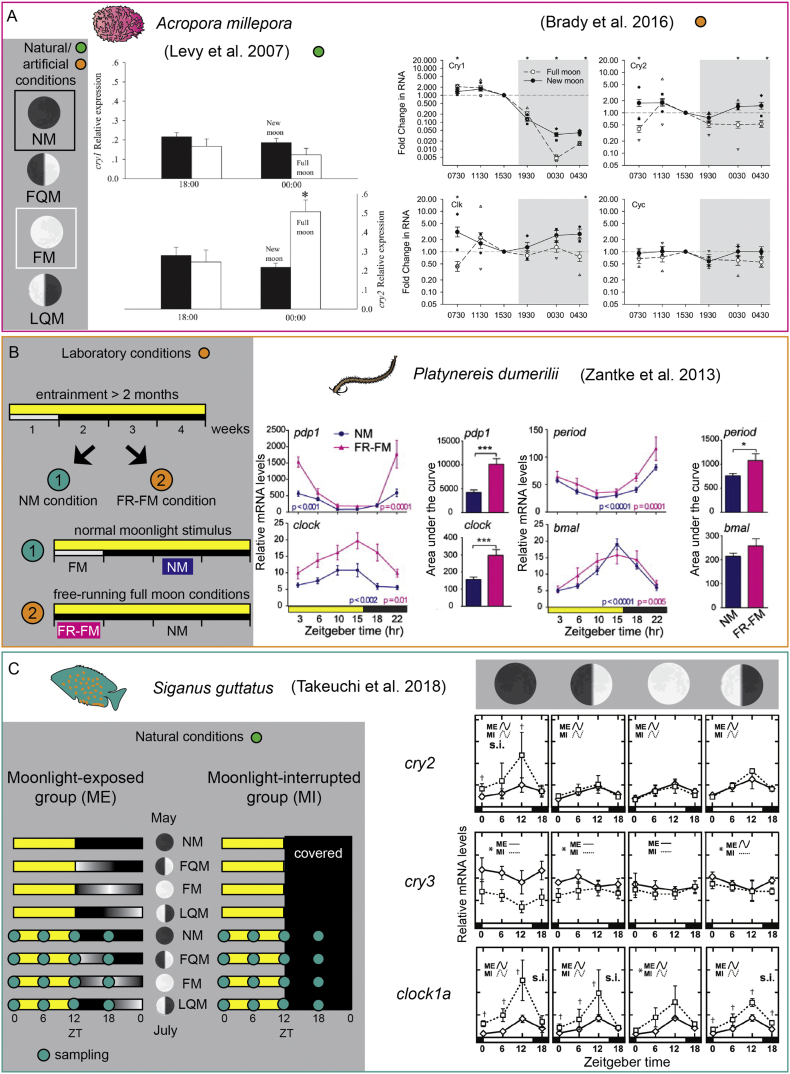
Circadian clock genes expression is affected by the lunar cycle or laboratory conditions mimicking moonlight cues. Gray areas on the left of each panel describe the environmental conditions or laboratory experimental settings employed. Green circles indicate experiments conducted under natural conditions, whereas orange circles refer to artificial (lab) experimental conditions. (A) The expression of A. millepora cry1, cry2, clk, and cyc is influenced by the lunar cycle. (B) Expression of a set of clock genes in P. dumerilii is regulated by an endogenous circalunar clock, as shown by experiments under lunar free-running conditions (absence of artificial moonlight cue at night). (C) Altered night illumination affect the expression of clock genes in a lunar phase-dependent manner in S. guttatus. For references, see [[26], [27], [28], [29]].
Figure 3
Figure 3
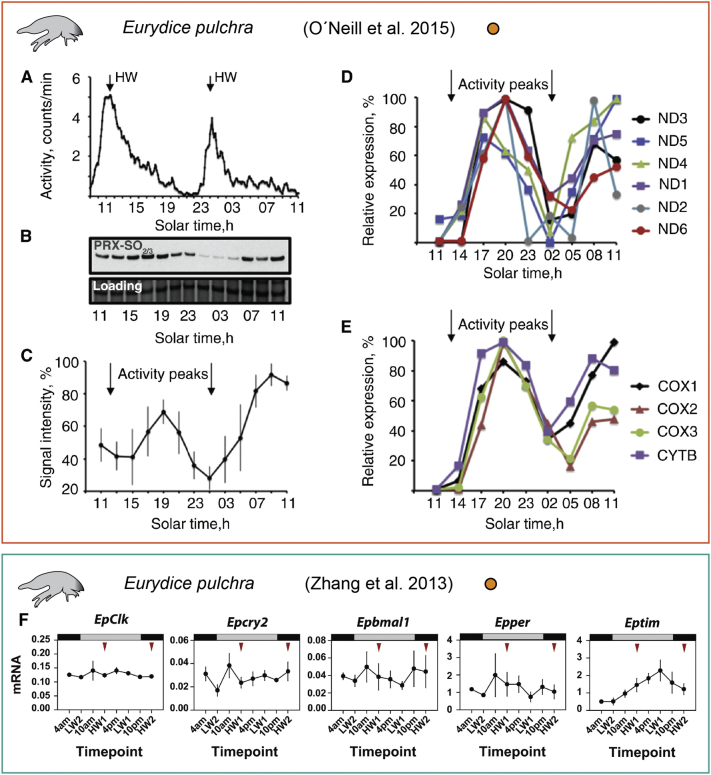
Tidal activity rhythm in E. pulchra generates antisense tidal cycles of metabolism but is independent from classical clock genes oscillation. (A) Swimming activity pattern of Eurydice specimens shows a period of 12.5 h in free-running conditions, with maxima during predicted high water (HW). (B) Representative western blot of overoxidized peroxiredoxin. (C) Relative intensity of overoxidized head peroxiredoxin. (D and E) Relative expression of mitochondrially-encoded genes (ND = NADH dehydrogenase subunits, COX = cytochrome oxidase subunits; CYTB = cytochrome B) under free-running laboratory conditions. (F) None of Eurydice circadian clock genes exhibit a tidal rhythm at the transcript level, and curiously, only tim shows a clear circadian profile (red arrows show the time of expected high water). For references, see [10,54]. Orange circles: artificial (lab) conditions.
Figure 4
Figure 4
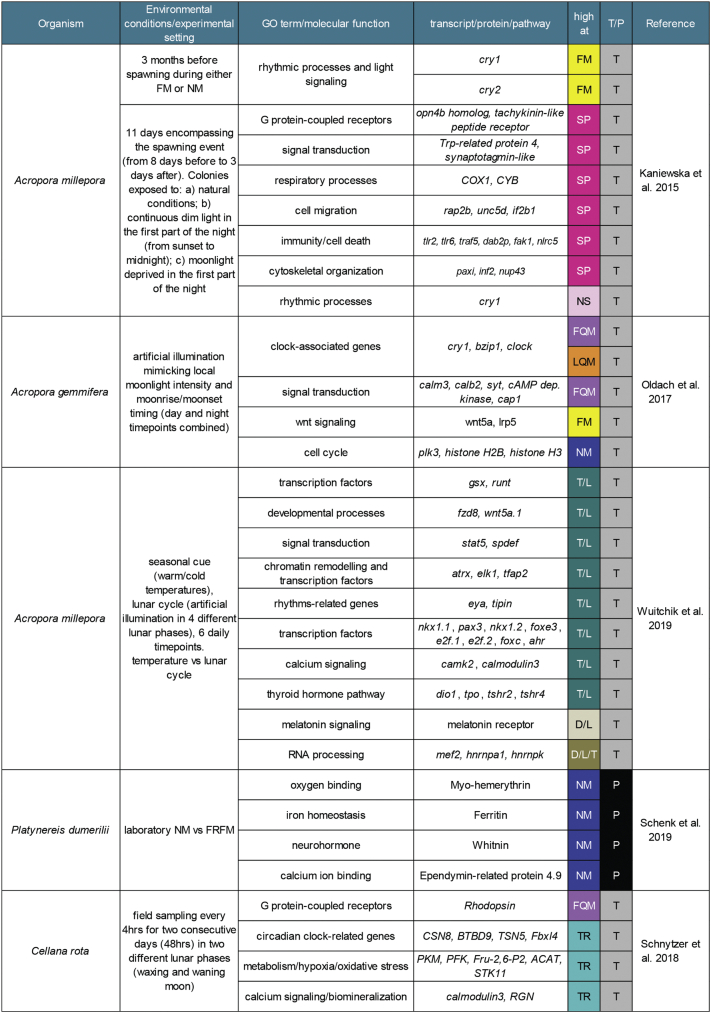
Summary table showing the experimental conditions, the main findings, and patterns of a sample of the high-throughput analysis reviewed. NM = new moon; FQM = first quarter moon; FM = full moon; LQM = last quarter moon; SP = spawning; NS = not spawning; T/L = regulated by the interaction between temperature and lunar cycle; D/L = regulated by the interaction between daily and lunar cycles; D/L/T = regulated by the interaction among daily, lunar, and temperature cues; TR = tidally regulated; T = transcript; P = protein. For references, see [57,79,86,89,91].

References

    1. Fox H.M. Lunar periodicity in reproduction. Proc. Biol. Sci. 1924;95:523–550. doi: 10.1098/rspb.1924.0004. - DOI
    1. Tessmar-Raible K., Raible F., Arboleda E. Another place, another timer: marine species and the rhythms of life. BioEssays. 2011;33:165–172. doi: 10.1002/bies.201000096. - DOI - PMC - PubMed
    1. Raible F., Takekata H., Tessmar-Raible K. An overview of monthly rhythms and clocks. Front. Neurol. 2017;8:1–14. doi: 10.3389/fneur.2017.00189. - DOI - PMC - PubMed
    1. Brugler M.R., Aguado M.T., Tessler M., Siddall M.E. The transcriptome of the Bermuda fireworm Odontosyllis enopla (Annelida: Syllidae): a unique luciferase gene family and putative epitoky-related genes. PLoS One. 2018;13 doi: 10.1371/journal.pone.0200944. - DOI - PMC - PubMed
    1. Coughenour C.L., Archer A.W., Lacovara K.J. Tides, tidalites, and secular changes in the earth–moon system. Earth-Science Rev. 2009;97:59–79. doi: 10.1016/j.earscirev.2009.09.002. - DOI

Publication types

LinkOut - more resources