Review
. 2020 Mar 20;29(155):190102.
doi: 10.1183/16000617.0102-2019. Print 2020 Mar 31.

Shared mechanisms of multimorbidity in COPD, atherosclerosis and type-2 diabetes: the neutrophil as a potential inflammatory target

Affiliations
Review

Shared mechanisms of multimorbidity in COPD, atherosclerosis and type-2 diabetes: the neutrophil as a potential inflammatory target

Michael J Hughes et al. Eur Respir Rev. .

Abstract

Multimorbidity is increasingly common and current healthcare strategies are not always aligned to treat this complex burden of disease. COPD, type-2 diabetes mellitus (T2D) and cardiovascular disease, especially atherosclerosis, occur more frequently together than expected, even when risk factors such as smoking, obesity, inactivity and poverty are considered. This supports the possibility of unifying mechanisms that contribute to the pathogenesis or progression of each condition.Neutrophilic inflammation is causally associated with COPD, and increasingly recognised in the pathogenesis of atherosclerosis and T2D, potentially forming an aetiological link between conditions. This link might reflect an overspill of inflammation from one affected organ into the systemic circulation, exposing all organs to an increased milieu of proinflammatory cytokines. Additionally, increasing evidence supports the involvement of other processes in chronic disease pathogenesis, such as cellular senescence or changes in cellular phenotypes.This review explores the current scientific evidence for inflammation, cellular ageing and cellular processes, such as reactive oxygen species production and phenotypic changes in the pathogenesis of COPD, T2D and atherosclerosis; highlighting common mechanisms shared across these diseases. We identify emerging therapeutic approaches that target these areas, but also where more work is still required to improve our understanding of the underlying cellular biology in a multimorbid disease setting.


Conflict of interest statement

Conflict of interest: M.J. Hughes reports grants from Wellcome Trust, during the conduct of the study. Conflict of interest: H.M. McGettrick has nothing to disclose. Conflict of interest: E. Sapey reports grants from Wellcome Trust, British Lung Foundation, Medical Research Council, NIHR and Dunhill Trust, outside the submitted work.

Figures
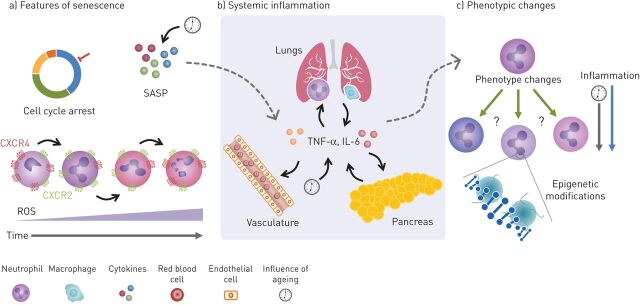
FIGURE 1
FIGURE 1
Potential common inflammatory mechanisms between COPD, type-2 diabetes mellitus (T2D) and cardiovascular disease (CVD). a) Senescence is described as changes that result in cell-cycle arrest and is associated with a senescence-associated secretory phenotype (SASP). The SASP leads to increases in inflammatory cytokines both locally and systemically (dotted arrow). This process in neutrophils, while slightly different to typical senescence, might be characterised by increases in chemokine receptor CXCR4 and decreases in CXCR2. This may change the way neutrophils behave and contribute to the damage seen in these diseases. These changes are also associated with increased reactive oxygen species (ROS) production, causing an oxidant imbalance and increasing damage. b) Inflammatory cytokines released by lung epithelial cells and immune cells can enter circulation from the lung in COPD. Likewise, these cytokines can also be released by immune cells in the pancreas in T2D and from endothelium and plaques in CVD. Increases of these cytokines also occur with age and can influence the cytokine milieu, leading to potential changes in neutrophil phenotype (dotted arrow). c) Changes in neutrophil subpopulations (or cell phenotype) caused by inflammation may also play a role in the crosstalk between COPD, CVD and T2D by contributing to tissue damage. There is also some evidence to suggest epigenetic changes may perpetuate the disease state causing long-term maladaptive changes to cellular phenotype and function, influenced by both inflammation and ageing. TNF: tumour necrosis factor; IL: interleukin.
FIGURE 2
FIGURE 2
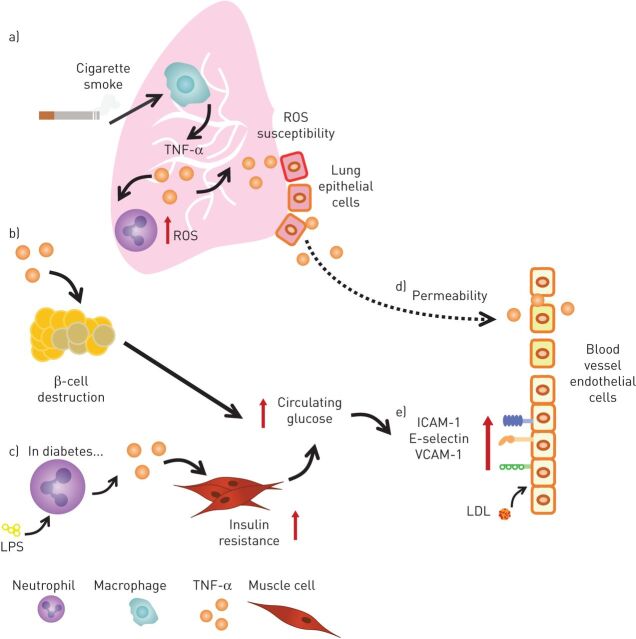
A summary of the multiple influences of tumour necrosis factor (TNF)-α across COPD, type-2 diabetes mellitus (T2D) and atherosclerosis. TNF-α is produced by multiple cell types in various compartments of the body. a) Cigarette smoke increases TNF-α production by alveolar macrophages, leading to enhanced reactive oxygen species (ROS) production by neutrophils and increased ROS susceptibility of lung epithelial cells. b) From the perspective of T2D, circulating TNF-α can cause β-cell destruction that in turn leads to increases in blood glucose levels. c) Enhanced TNF-α production by neutrophils exposed to lipopolysaccharide (LPS) in patients with diabetes promotes insulin resistance, which also increases blood glucose levels. Both the mechanisms in b and c lead to glucose-driven adhesion molecule expression in the vasculature. d) TNF-α also increases vascular permeability and in COPD this can be from either TNF-α produced in circulation or diffusion of pulmonary TNF-α. e) In the vasculature, TNF-α increases adhesion molecules, such as intracellular adhesion molecule (ICAM)-1, E-selectin and vascular adhesion molecule (VCAM)-1, increasing the likelihood of immune cell infiltration. It also causes the promotion of low-density lipoprotein (LDL) uptake by endothelial cells.
FIGURE 3
FIGURE 3
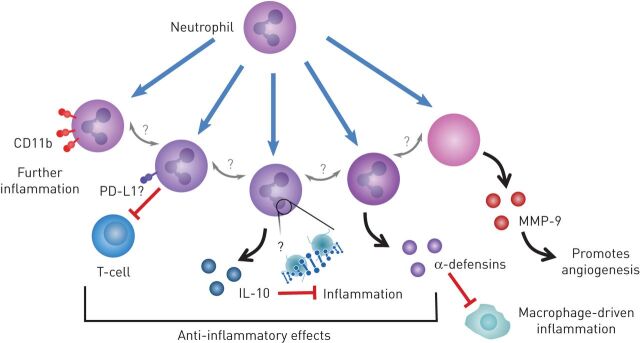
Neutrophil phenotypes can be altered, and these changes may impact the pathogenesis of other diseases. Several neutrophil phenotypes are described showing the plasticity of the neutrophil. Increasing surface expression of CD11b has been linked with further inflammation and therefore a proinflammatory phenotype. Several anti-inflammatory phenotypes have also been described: the suppression of T-cell function; the release of an anti-inflammatory cytokine interleukin (IL)-10; and the release of α-defensins shown to inhibit macrophage-driven inflammation by preventing mRNA translation. Neutrophils also release matrix metallopeptidase (MMP)-9, which contributes to matrix remodelling and promotes angiogenesis impacting on vascular remodelling in disease. This shows a broad array of inflammatory functions by the neutrophil. PD-L1: programmed-death ligand 1.

References

    1. Palladino R, Tayu Lee J, Ashworth M, et al. Associations between multimorbidity, healthcare utilisation and health status: evidence from 16 European countries. Age Ageing 2016; 45: 431–435. doi: 10.1093/ageing/afw044 - DOI - PMC - PubMed
    1. Barnett K, Mercer SW, Norbury M, et al. Epidemiology of multimorbidity and implications for health care, research, and medical education: a cross-sectional study. Lancet 2012; 380: 37–43. doi: 10.1016/S0140-6736(12)60240-2 - DOI - PubMed
    1. Lee CTC, Mao IC, Lin CH, et al. Chronic obstructive pulmonary disease: a risk factor for type 2 diabetes. A nationwide population-based study. Eur J Clin Invest 2013; 43: 1113–1119. - PubMed
    1. Mullerova H, Agusti A, Erqou S, et al. Cardiovascular comorbidity in COPD: systematic literature review. Chest 2013; 144: 1163–1178. doi: 10.1378/chest.12-2847 - DOI - PubMed
    1. Laniado-Laborín R. Smoking and chronic obstructive pulmonary disease (COPD). Parallel epidemics of the 21 century. Int J Environ Res Public Health 2009; 6: 209–224. doi: 10.3390/ijerph6010209 - DOI - PMC - PubMed

MeSH terms

Substances