. 2020 Mar 20;11(1):1490.
doi: 10.1038/s41467-020-15210-2.

Polycyclic aromatic chains on metals and insulating layers by repetitive [3+2] cycloadditions

Affiliations

Polycyclic aromatic chains on metals and insulating layers by repetitive [3+2] cycloadditions

Alexander Riss et al. Nat Commun. .

Erratum in

Abstract

The vast potential of organic materials for electronic, optoelectronic and spintronic devices entails substantial interest in the fabrication of π-conjugated systems with tailored functionality directly at insulating interfaces. On-surface fabrication of such materials on non-metal surfaces remains to be demonstrated with high yield and selectivity. Here we present the synthesis of polyaromatic chains on metallic substrates, insulating layers, and in the solid state. Scanning probe microscopy shows the formation of azaullazine repeating units on Au(111), Ag(111), and h-BN/Cu(111), stemming from intermolecular homo-coupling via cycloaddition reactions of CN-substituted polycyclic aromatic azomethine ylide (PAMY) intermediates followed by subsequent dehydrogenation. Matrix-assisted laser desorption/ionization (MALDI) mass spectrometry demonstrates that the reaction also takes place in the solid state in the absence of any catalyst. Such intermolecular cycloaddition reactions are promising methods for direct synthesis of regioregular polyaromatic polymers on arbitrary insulating surfaces.


Conflict of interest statement

The authors declare no competing interests.

Figures

Fig. 1
Fig. 1. Conceptual route for the reported synthesis of polyaromatic azaullazine chains.
The thermally induced head-to-tail coupling of 1 was observed on Au(111), Ag(111), h-BN/Cu(111), as well as in the solid state. Bottom: Reactive PAMY species 1a as potential intermediates with affinity towards the cyano moiety, yielding intermolecular head-to-tail cycloaddition product 2a. Subsequent dehydrogenation affords polyaromatic azaullazine chains 2.
Fig. 2
Fig. 2. Head-to-tail coupling of 1 on a Au(111) substrate held at 600 K.
ac STM images of monomeric, dimeric, and trimeric species. df Bond-resolved AFM images of the monomer, dimer, and trimer shown in ac. The images show the formation of an imidazole ring via cycloaddition of the –CN group of one monomer towards the phenanthridinium-derived azomethine ylide moiety of another monomer. gi Chemical structures of the monomer, dimer, and trimer. The formed imidazole ring is highlighted in blue color. j Overview STM image shows a coexistence of covalently coupled (yellow solid circle) and noncovalently assembled (green dotted and red dashed circles) motifs. k Reaction scheme showing head-to-tail polymerization of 1 upon imidazole ring formation. Scan parameters: (ab) Sample bias VS = 20 mV, tunneling current setpoint I = 5 pA; (c) VS = 20 mV, I = 20 pA; (df) VS = 0 V, oscillation amplitude AOSC = 40 pm, constant height; (j) VS = 20 mV, I = 5 pA. Frequency shift ranges, dark to bright: (d) −10.2 to 6.7 Hz; (e) −10.1 to 3.1 Hz; (f) −9.9 to 7.2 Hz.
Fig. 3
Fig. 3. Theoretical modeling of a dimer on Au(111).
(a) Top and (b) side views of the DFT-relaxed geometry of a dimer (as shown in Fig. 2h). One of the carbon atoms adjacent to the N-atom of the phenanthridinium moiety has two hydrogen atoms, pointing upwards and downwards, respectively. Furthermore, one of the phenyl rings of the right monomer (marked with red arrows in ac) is bending upwards due to steric repulsions between the monomer units. c The simulated AFM image of the dimer shows a bright (more repulsive) contrast for the protruding hydrogen atom and the upwards-bending phenyl ring, in agreement with the contrast observed in the experimental image (Fig. 2e).
Fig. 4
Fig. 4. Head-to-tail coupling of 1 on Ag(111) held at 520 K.
a Overview STM image after deposition of 1 onto a Ag(111) substrate held at 520 K shows polymerization towards one-dimensional molecular chains. (b) STM and (c) bond-resolved AFM image of a pentamer recorded with a CO-functionalized tip shows formation of imidazole rings between the monomer units—analogous to the coupling observed on Au(111). Red arrows highlight brightly imaged phenyl rings bending upwards due to steric repulsion. The terminal cyano group of the pentamer shown in b and c is cleaved off. Such loss of –CN has repeatedly been observed on Ag(111). Scan parameters: (a), (b) VS = 100 mV, I = 10 pA, (c) VS = 0 V, AOSC = 80 pm, constant height. Frequency shift range: (c) −4.5 to 1.0 Hz.
Fig. 5
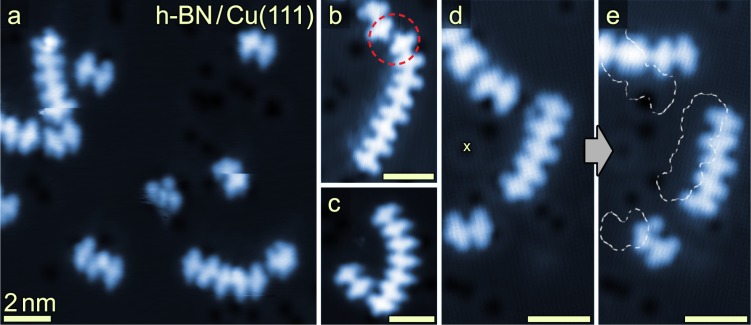
Fig. 5. Oligomerization on h-BN/Cu(111) after deposition of 1 onto the surface held at 500 K.
a STM overview image shows coupled molecular units, analogous to the cycloaddition products observed on Au(111) and Ag(111). Unidentified species are also observed, cf. image’s center and Table 1. b, c Close-up STM images reveal the formation of chains of up to eight monomer units. Non-covalent aggregation with antiparallel alignment of the –CN dipoles of a dimer and an octamer is marked by a red dashed circle in b. d STM image of oligomer chains. e After application of a voltage pulse (VS = −2.5 V, I = 100 pA, t = 1 s) at the position marked with a yellow cross in d a shift of the positions of the chains is observed. The chains remain intact and each chain is shifted as a whole. The positions of the chains before the voltage pulse are marked with white dashed traces (data in a, ce recorded after post-annealing the sample to 580 K). Scan parameters: (a) VS = 1.10 V, I = 50 pA, (b) VS = 0.66 V, I = 60 pA, (c) VS = 1.0 V, I = 50 pA; (d), (e) VS = 1.7 V, I = 24 pA.
Fig. 6
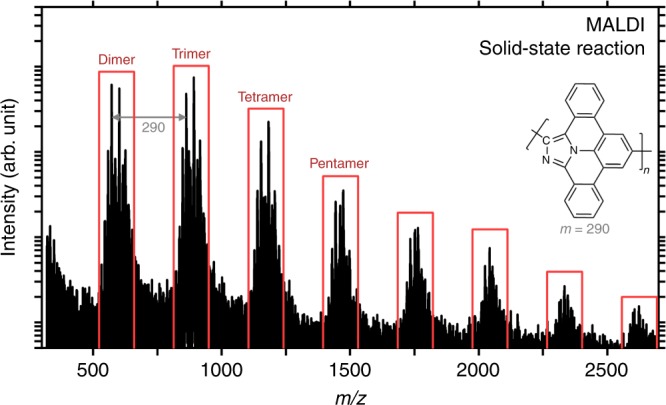
Fig. 6. Solid state oligomerization of 1.
The MALDI-ToF mass spectrum after thermal annealing of 1 to 520 K for 72 h under vacuum (10−2 to 10−1 mbar) shows distinct peak groups indicative of intermolecular coupling upon formation of oligomers (dimers, trimers, tetramers, etc.). The separation of 290 m/z between these peak groups corresponds to the mass of one monomer unit (C21N2H10, chemical structure in the inset).
Fig. 7
Fig. 7. DFT reaction study of the dimerization step of 1a.
Top and side views of 1a and 2a-type dimers on (a) Au(111), (b) Ag(111), and (c) h-BN. d The computed reaction energies show that the reaction step is endothermic on Au(111) and Ag(111) and slightly exothermic on h-BN. e Maximum oligomer lengths observed experimentally on Au(111), Ag(111), and h-BN/Cu(111).

References

    1. Chen L, Hernandez Y, Feng X, Müllen K. From nanographene and graphene nanoribbons to graphene sheets: chemical synthesis. Angew. Chem. Int. Ed. 2012;51:7640–7654. doi: 10.1002/anie.201201084. - DOI - PubMed
    1. Dutta S, Pati SK. Novel properties of graphene nanoribbons: a review. J. Mater. Chem. 2010;20:8207. doi: 10.1039/c0jm00261e. - DOI
    1. Yagmurcukardes M, Peeters FM, Senger RT, Sahin H. Nanoribbons: From fundamentals to state-of-the-art applications. Appl. Phys. Rev. 2016;3:041302. doi: 10.1063/1.4966963. - DOI
    1. Llinas JP, et al. Short-channel field-effect transistors with 9-atom and 13-atom wide graphene nanoribbons. Nat. Commun. 2017;8:633. doi: 10.1038/s41467-017-00734-x. - DOI - PMC - PubMed
    1. Palma C-A, Samorì P. Blueprinting macromolecular electronics. Nat. Chem. 2011;3:431–436. doi: 10.1038/nchem.1043. - DOI - PubMed