Review
. 2020 Jun:55:40-47.
doi: 10.1016/j.mib.2020.02.004. Epub 2020 Mar 19.

The impact of two-component sensorial network in staphylococcal speciation

Affiliations
Review

The impact of two-component sensorial network in staphylococcal speciation

Beatriz Rapun-Araiz et al. Curr Opin Microbiol. 2020 Jun.

Abstract

Bacteria use two-component systems (TCSs) to sense and respond to their environments. Free-living bacteria usually contain dozens of TCSs, each of them responsible for sensing and responding to a different range of signals. Differences in the content of two-component systems are related with the capacity of the bacteria to colonize different niches or improve the efficiency to grow under the conditions of the existing niche. This review highlights differences in the TCS content between Staphylococcus aureus and Staphylococcus saprophyticus as a case study to exemplify how the ability to sense and respond to the environment is relevant for bacterial capacity to colonize and survive in/on different body surfaces.


Figures

Figure 1
Figure 1
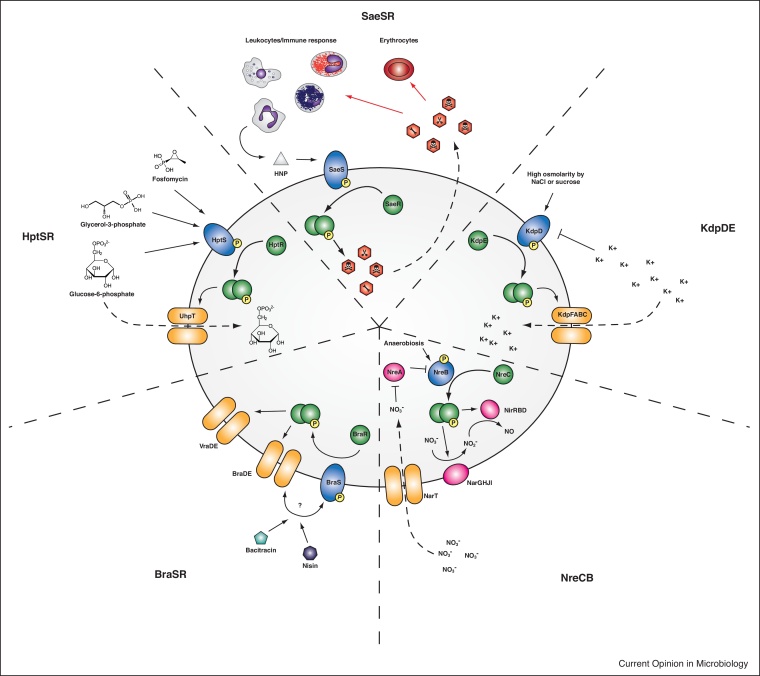
TCSs absent in S. saprophyticus and their main functional roles. Five of the 16 TCSs in S. aureus are absent in S. saprophyticus. The HptSR TCS responds to extracellular phosphates and activates the glucose-6-phosphate transporter UhpT but can also facilitate the uptake of the antibiotic Fosfomycin. SaeSR controls the expression of secreted toxins and immune evasion factors involved in erythrocyte and leukocyte lysis as well as modifying several immune evasion pathways. SaeSR responds to antimicrobial peptides such as the human neutrophil peptide (HNP) secreted by neutrophils. The KdpDE TCS is involved in the control of a highly specific potassium uptake system (KdpFABC) required for growth under highly potassium restricting conditions. The TCS is repressed by potassium ions and cyclic di-AMP and can be activated by high osmotic conditions. Activation of KdpDE also leads to the expression of genes involved in the uptake of compatible solutes and sugars, capsule synthesis as well as amino acid biosynthesis and central metabolism. The NreCB TCS controls the reduction of nitrate to nitrite to nitric oxide. The TCS is inhibited by NreA in the absence of nitrate and induced under anaerobic conditions. The BraSR TCS is involved in the response to antimicrobial peptides such as bacitracin and nisin and involves the BraDE transporter in sensing these peptides. It also activates the expression of the GraRS TCS-associated VraDE transporter.
Figure 2
Figure 2
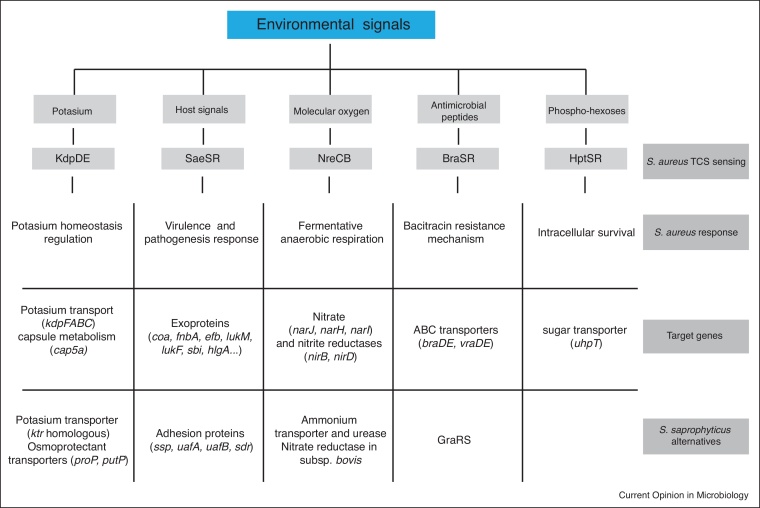
Summary of the activity of the TCSs absent in S. saprophyticus. HptSR, SaeSR, KdpDE, NreCB, and BraSR are the five TCSs present in S. aureus but missing in S. saprophyticus. S. aureus colonises different niches to S. saprophyticus and consequently has to adapt to different environmental conditions. The five TCSs specific to S. aureus allow it to sense relevant environmental signals and allow it to respond by activating the expression of different target genes. Thus, S. aureus uses its larger arsenal of TCSs to adapt its physiology to the new environments. The genome of S. saprophyticus encodes genes that may compensate for the loss of genes and pathways regulated by the TCSs absent in this staphylococcal species. HptSR and its function in the uptake of extracellular hexose-6-phosphates is the only TCS-regulated adaptation mechanism for which S. saprophyticus does not encode any alternative.

References

    1. Galperin M.Y. A census of membrane-bound and intracellular signal transduction proteins in bacteria: bacterial IQ, extroverts and introverts. BMC Microbiol. 2005;5:35. - PMC - PubMed
    1. Ulrich L.E., Zhulin I.B. The MiST2 database: a comprehensive genomics resource on microbial signal transduction. Nucleic Acids Res. 2010;38:D401–407. - PMC - PubMed
    1. Capra E.J., Laub M.T. Evolution of two-component signal transduction systems. Annu Rev Microbiol. 2012;66:325–347. - PMC - PubMed
    1. Salazar M.E., Laub M.T. Temporal and evolutionary dynamics of two-component signaling pathways. Curr Opin Microbiol. 2015;24C:7–14. - PMC - PubMed
    1. Balasubramanian D., Harper L., Shopsin B., Torres V.J. Staphylococcus aureus pathogenesis in diverse host environments. Pathog Dis. 2017;75 - PMC - PubMed

Publication types

Substances