


Correlates of death during outpatient treatment for opioid use disorder: A national study
- PMID: 32199549
- PMCID: PMC10395190
- DOI: 10.1016/j.jsat.2020.01.003
Correlates of death during outpatient treatment for opioid use disorder: A national study
Abstract
Background: As the burden of opioid use disorder (OUD) increases in the United States, manifold federal and state initiatives have sought to increase access to treatment for OUD, which includes behavioral and pharmaceutical treatment modalities. Although the evidence base for outpatient treatment for OUD-including medications for opioid use disorder-is substantial, few studies have examined the risk factors for fatality during treatment for OUD.
Methods: Treatment Episode Data Set-Discharges (TEDS-D) data were used to evaluate correlates of death during outpatient treatment for OUD in 2016. To determine the correlates of mortality during an outpatient treatment for OUD, we constructed a pooled logistic regression model, stratified by use of medication for opioid use disorder (MOUD), to control for the duration of time in treatment and to identify the independent characteristics that may lead to differences in the odds of mortality during treatment.
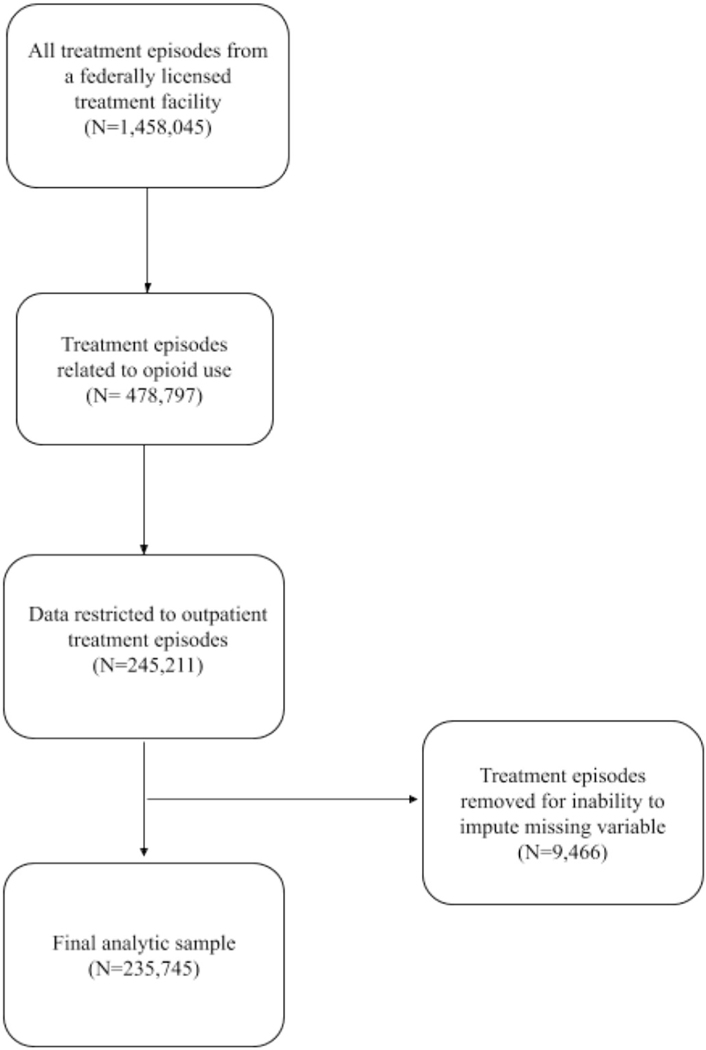
Findings: 1861 (0.8%) of 235,745 outpatient treatment episodes for OUD included in our analysis resulted in fatality. Many factors correlated with death during treatment were similar for individuals who did and did not receive MOUD. However, non-White race was only significantly associated with decreases in fatality in non-MOUD treatment episodes. Male sex and reported intravenous drug use at admission were associated with fatality only for treatment episodes that did not involve MOUD.
Conclusions: In this national study of outpatient treatment episodes for OUD, we found differences in age, sex, region, drug use history, treatment setting, and treatment history significantly affected the risk of death during treatment. As more people become engaged with treatment, facilities should work toward delivering optimal treatment for all patients regardless of personal characteristics.
Keywords: Fatality; Medications for opioid use disorder; Opioid use disorder; Outpatient treatment.
Copyright © 2020 Elsevier Inc. All rights reserved.
Conflict of interest statement
Declaration of competing interest The authors do not have any interests to declare.
Figures
References
-
- Ahrnsbrak R, Bose J, Hedden SL, Lipari RN, & Park-Lee E. (2017). Key substance use and mental health indicators in the United States. Retrieved from Substance Abuse and Mental Health Services Administration website https://www.samhsa.gov/data/sites/default/files/NSDUH-FFR1-2016/NSDUH-FF....
-
- Alderks CE (2017). Trends in the use of methadone, buprenorphine, and extendedrelease naltrexone at substance abuse treatment facilities: 2003–2015 (update). Retrieved from Substance Abuse and Mental Health Services Administration website https://www.samhsa.gov/data/sites/default/files/report_3192/ShortReport-.... - PubMed
-
- Amato L, Davoli M, Perucci CA, Ferri M, Faggiano F, & Mattick RP (2005). An overview of systematic reviews of the effectiveness of opiate maintenance therapies: Available evidence to inform clinical practice and research. Journal of Substance Abuse Treatment, 28(4), 321–329. - PubMed
-
- Amato L, Minozzi S, Davoli M, & Vecchi S. (2011). Psychosocial and pharmacological treatments versus pharmacological treatments for opioid detoxification. Cochrane Database of Systematic Reviews, 9, CD005031. - PubMed
Publication types
MeSH terms
Substances
Grants and funding
LinkOut - more resources
Full Text Sources
Medical
Research Materials
