


Proportion and associated factors of meeting the 2018 Physical Activity Guidelines for Americans in adults with or at risk for knee osteoarthritis
- PMID: 32200050
- PMCID: PMC7261619
- DOI: 10.1016/j.joca.2020.03.007
Proportion and associated factors of meeting the 2018 Physical Activity Guidelines for Americans in adults with or at risk for knee osteoarthritis
Abstract
Objectives: Evaluate the prevalence of meeting the updated 2018 Physical Activity Guidelines for Americans (150 unbouted minutes in moderate-to-vigorous intensity physical activity [MVPA]) and determine cross-sectional factors associated with Guideline attainment in a community-based cohort of adults with or at elevated risk for knee osteoarthritis (OA).
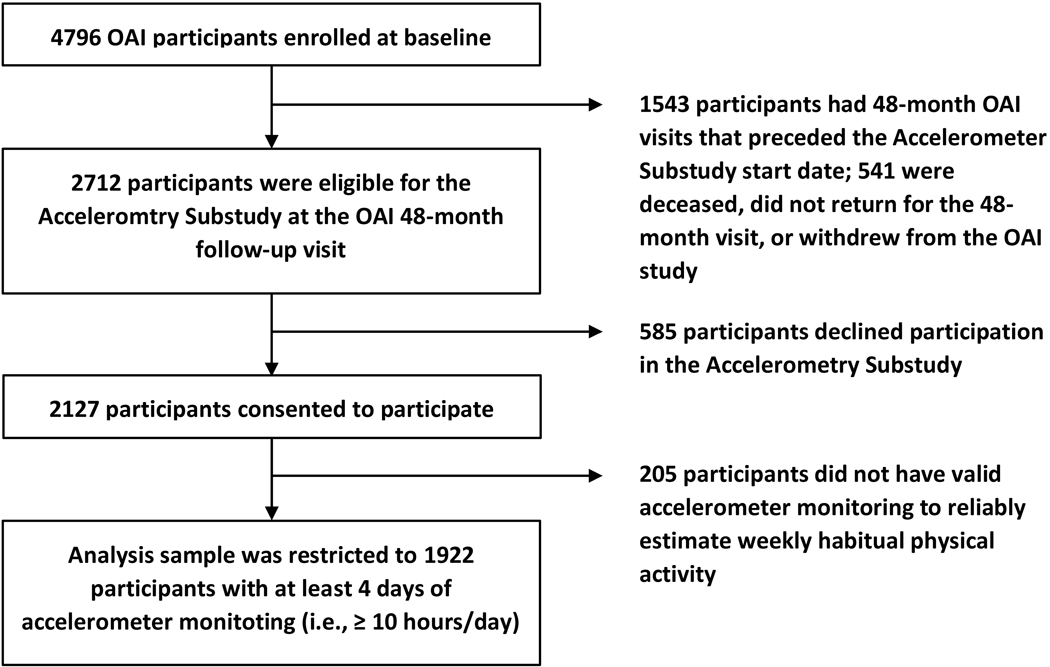
Methods: Physical activity was monitored for 1 week in a subset of Osteoarthritis Initiative (OAI) participants with or at increased risk for knee OA. Accelerometer-measured weekly MVPA minutes were calculated; sociodemographic (age, sex, race, education, and working status) and health-related (body mass index [BMI], comorbidity, depressive symptoms, radiographic knee OA, and frequent knee symptoms) factors were assessed. We evaluated the prevalence of meeting 2018 Guidelines and used multivariate partial proportional odds model to identify factors associated with Guideline attainment, controlling for other factors in the model.
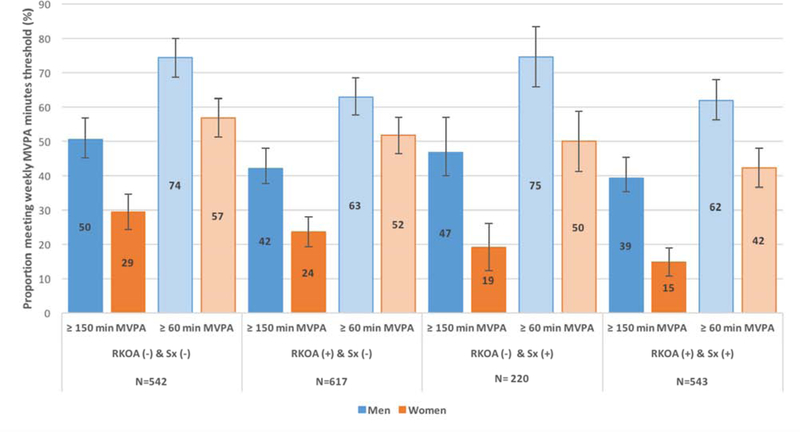
Results: Among 1922 participants (age 65.1 [standard deviation 9.1] years, BMI 28.4 [4.8] kg/m2, 55.2% women), 44.1% men and 22.2% women met the 2018 PA Guidelines. Adjusted cross-sectional factors associated with not-meeting 2018 Guidelines were: women, older age, higher BMI, non-Whites, depressive symptoms, not working, and frequent knee symptoms.
Conclusion: In community-recruited adults with or at high risk for knee OA, more than 50% of men and nearly 80% of women failed to achieve the 2018 recommended level of at least 150 weekly unbouted minutes of MVPA. Study findings support gender and racial disparity in Guideline attainment and suggest addressing potentially modifiable factors (e.g., BMI, depressive symptoms, and frequent knee symptoms) to optimize benefits in PA-promoting interventions.
Keywords: Guidelines; Knee; Osteoarthritis; Physical activity.
Copyright © 2020 Osteoarthritis Research Society International. Published by Elsevier Ltd. All rights reserved.
Conflict of interest statement
The authors have no conflict of interest relevant to the reported work.
Figures
References
-
- Jordan JM, Helmick CG, Renner JB, Luta G, Dragomir AD, Woodard J, et al. Prevalence of knee symptoms and radiographic and symptomatic knee osteoarthritis in African Americans and Caucasians: the Johnston County Osteoarthritis Project. J Rheumatol. 2007;34(1):172–180. - PubMed
Publication types
MeSH terms
Grants and funding
LinkOut - more resources
Full Text Sources
Medical
Miscellaneous
