


Proportion of High-Risk/Very High-Risk Patients in Europe with Low-Density Lipoprotein Cholesterol at Target According to European Guidelines: A Systematic Review
- PMID: 32200537
- PMCID: PMC7467492
- DOI: 10.1007/s12325-020-01285-2
Proportion of High-Risk/Very High-Risk Patients in Europe with Low-Density Lipoprotein Cholesterol at Target According to European Guidelines: A Systematic Review
Abstract
Objective: Assess achievement of low-density lipoprotein cholesterol (LDL-C) targets in European Society of Cardiology (ESC)/European Atherosclerosis Society (EAS) guidelines.
Design: Systematic literature review.
Data sources: Medline, EMBASE, Cumulated Index to Nursing and Allied Health Literature.
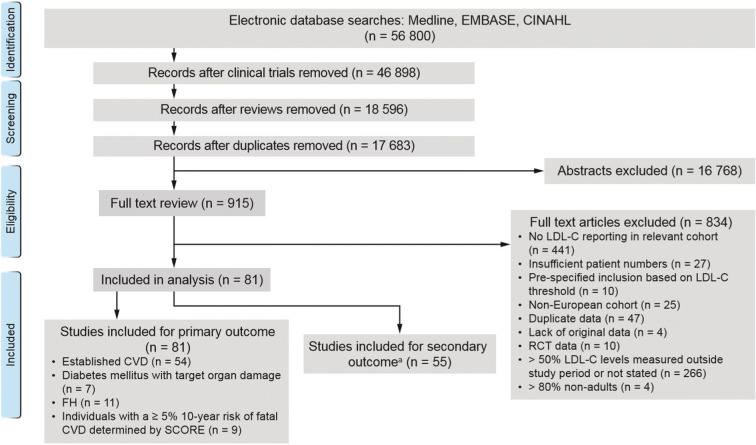
Eligibility criteria: Observational studies reporting LDL-C levels/target attainment, measured between 1 August 2006 to 31 August 2017, in European adults with established cardiovascular disease (CVD), diabetes with target organ damage, familial hypercholesterolaemia (FH) or 10-year risk of fatal CVD ≥ 5% (assessed by Systematic Coronary Risk Evaluation [SCORE]).
Data extraction and synthesis: Two reviewers independently extracted relevant studies and assessed study quality using the Risk of Bias for Non-Randomised Studies-Interventions (ROBINS-I) tool. Primary outcome was the proportion of patients achieving LDL-C targets in the 2011/2016 ESC/EAS guidelines. Where available, patient characteristics were presented as means weighted by sample size. The proportions of patients achieving LDL-C targets in the 5 years before and after publication of the 2011 guidelines were compared using a chi-square test.
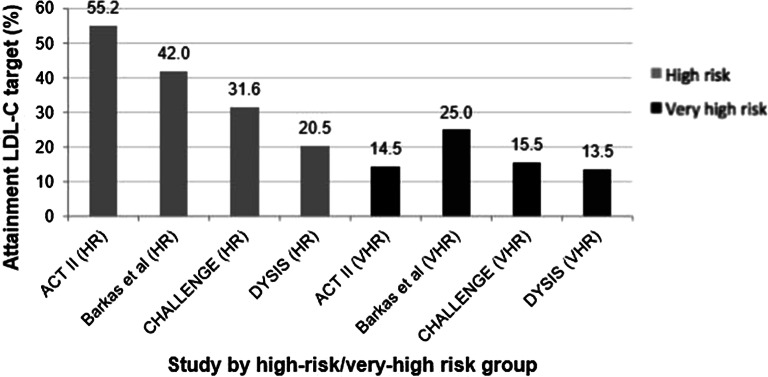
Results: Across 81 eligible studies (303,534 patients), achievement of LDL-C < 1.8 mmol/L was poor among patients with established CVD (16%; range 9-56%) and at very high risk of CVD (SCORE ≥ 10% [18%; 14-25%]). In individuals with FH, SCORE 5-10%, or diabetes and target organ damage, LDL-C < 2.5 mmol/L was achieved by 15% (9-22%), 46% (21-55%) and 13% (6-34%), respectively. Comparing the 5 years before/after publication of the 2011 guidelines, target achievement increased significantly over time but remained suboptimal (LDL-C < 1.8, 22% versus 15%; LDL-C < 2.5, 68% versus 61%; both p < 0.001; established CVD group only).
Conclusions: These data show suboptimal LDL-C control among European patients at high risk of CVD. Those at greatest overall risk (clinically established CVD or at least a 10% 10-year risk of fatal CVD) had the lowest achievement of 2011/2016 EAS/ESC LDL-C targets. With lower LDL-C targets advocated in 2019 ESC/EAS guidelines, this unmet need will increase.
Protocol registration: PROSPERO registration number; CRD77844.
Keywords: Cardiovascular disease; Guidelines; High-risk; LDL-C targets; Low-density lipoprotein cholesterol; Systematic review.
Figures
References
-
- Catapano AL, Graham I, De Backer G, et al. 2016 ESC/EAS guidelines for the management of dyslipidaemias. Eur Heart J. 2016;37:2999–3058. - PubMed
-
- Piepoli MF, Hoes AW, Agewall S, et al. 2016 European guidelines on cardiovascular disease prevention in clinical practice: the Sixth Joint Task Force of the European Society of Cardiology and Other Societies on Cardiovascular Disease Prevention in Clinical Practice (constituted by representatives of 10 societies and by invited experts) Developed with the special contribution of the European Association for Cardiovascular Prevention & Rehabilitation (EACPR) Eur Heart J. 2016;37:2315–2381. - PMC - PubMed
-
- Reiner Ž, Catapano AL, De Backer G, et al. ESC/EAS guidelines for the management of dyslipidaemias: the Task Force for the management of dyslipidaemias of the European Society of Cardiology (ESC) and the European Atherosclerosis Society (EAS) Eur Heart J. 2011;32:1769–1818. - PubMed
Publication types
MeSH terms
Substances
LinkOut - more resources
Full Text Sources
Medical
Miscellaneous
