


Barriers, Opportunities, and Challenges in Addressing Disparities in Diet-Related Cardiovascular Disease in the United States
- PMID: 32200727
- PMCID: PMC7428614
- DOI: 10.1161/JAHA.119.014433
Barriers, Opportunities, and Challenges in Addressing Disparities in Diet-Related Cardiovascular Disease in the United States
Abstract
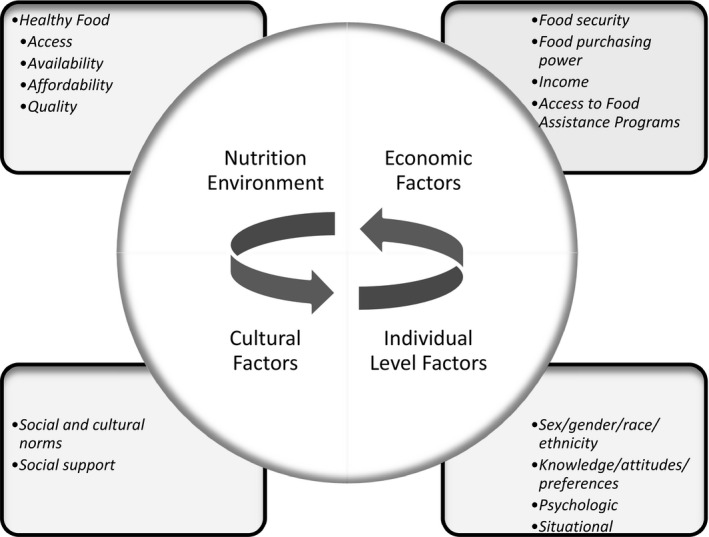
In the United States, cardiovascular disease (CVD) is the leading cause of death and disability. Suboptimal diet quality is responsible for a greater percentage of CVD-related morbidity and mortality than any other modifiable risk factor. Further troubling are the stark racial/ethnic and socioeconomic disparities in diet quality. This represents a major public health concern that urgently requires a coordinated effort to better characterize the barriers to healthy dietary practices in population groups disproportionally affected by CVD and poor diet quality to inform multifaceted approaches at the government (policy), community environment, sociocultural, and individual levels. This paper reviews the barriers, opportunities, and challenges involved in shifting population behaviors, especially in underserved populations, toward healthy dietary practices. It is imperative that public health policies address the social determinants of nutrition more intensively than previously in order to significantly decrease CVD on a population-wide basis.
Keywords: cardiovascular disease prevention; cardiovascular disease risk factors; diet; disparities; nutrition; social determinants.
Figures

References
-
- Institute for Health Metrics and Evaluation . GBD Results Tool: Deaths and DALYs for 2017 With Trends Since 1990. Seattle, WA: University of Washington; 2017.
-
- Benjamin EJ, Muntner P, Alonso A, Bittencourt MS, Callaway CW, Carson AP, Chamberlain AM, Chang AR, Cheng S, Das SR, et al. Heart disease and stroke statistics‐2019 update: a report from the American Heart Association. Circulation. 2019;139:e56–e66. - PubMed
-
- Carnethon MR, Pu J, Howard G, Albert MA, Anderson CAM, Bertoni AG, Mujahid MS, Palaniappan L, Taylor HA Jr, Willis M, et al. Cardiovascular health in African Americans: a scientific statement from the American Heart Association. Circulation. 2017;136:e393–e423. - PubMed
Publication types
MeSH terms
LinkOut - more resources
Full Text Sources
Medical
