. 2020 May 11;375(1798):20190245.
doi: 10.1098/rstb.2019.0245. Epub 2020 Mar 23.

Metabolically cohesive microbial consortia and ecosystem functioning

Affiliations

Metabolically cohesive microbial consortia and ecosystem functioning

Alberto Pascual-García et al. Philos Trans R Soc Lond B Biol Sci. .

Abstract

Recent theory and experiments have reported a reproducible tendency for the coexistence of microbial species under controlled environmental conditions. This observation has been explained in the context of competition for resources and metabolic complementarity given that, in microbial communities (MCs), many excreted by-products of metabolism may also be resources. MCs therefore play a key role in promoting their own stability and in shaping the niches of the constituent taxa. We suggest that an intermediate level of organization between the species and the community level may be pervasive, where tightly knit metabolic interactions create discrete consortia that are stably maintained. We call these units Metabolically Cohesive Consortia (MeCoCos) and we discuss the environmental context in which we expect their formation, and the ecological and evolutionary consequences of their existence. We argue that the ability to identify MeCoCos would open new avenues to link the species-, community- and ecosystem-level properties, with consequences for our understanding of microbial ecology and evolution, and an improved ability to predict ecosystem functioning in the wild. This article is part of the theme issue 'Conceptual challenges in microbial community ecology'.

Keywords: ecosystem functioning; functional groups; metabolism; microbial ecology.


Conflict of interest statement

We declare we have no competing interest.

Figures
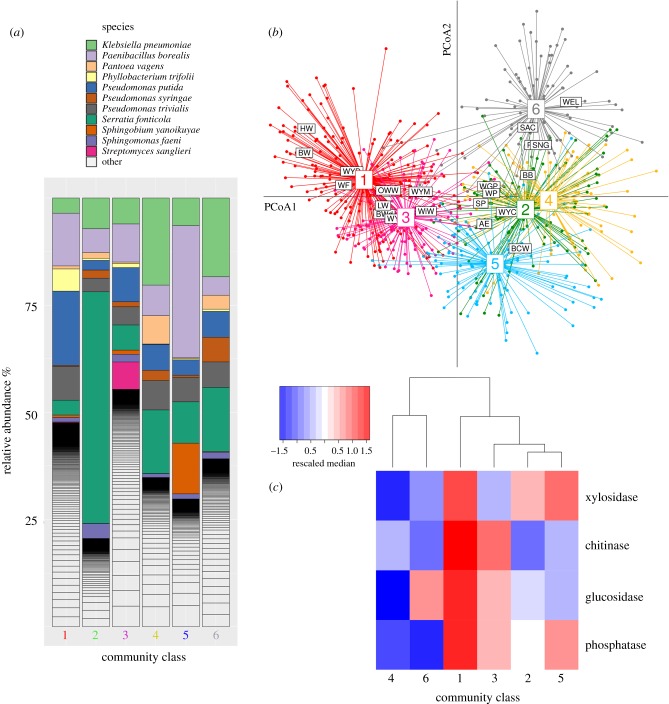
Figure 1.
Figure 1.
Community-level classes. (a) Approximately 700 natural MCs sampled from tree-holes were classified into six classes. The bar-plot shows the relative abundance of the most representative species (operational taxonomic units (OTUs) at more than 97% sequence similarity) in each class. (b) Projection of the similarity of the communities into the first two principal coordinates of a principal coordinate analysis. Significant spatial autocorrelation was found, which is apparent when the centroid of each sampling location (each site identified by a three-letter code) is superimposed on the ordination, showing that sampling sites are associated with specific community classes. However, the classes (labelled 1 to 6) yield a more economical classification with comparable significance, with the constituent communities often sampled from different locations. (c) In addition, communities contained in these classes have distinct functions and metagenomic repertoires. The functional differences among the classes are illustrated in the heatmap, which indicates the median capacity of communities from each class to degrade a set of common substrates, showing divergent functional ‘signatures’ for each of the community classes. Overall, the data suggest that local environmental conditions occurring in different locations, rather than neutral evolution with dispersal limitation, shape these communities. More details in [9].
Figure 2.
Figure 2.
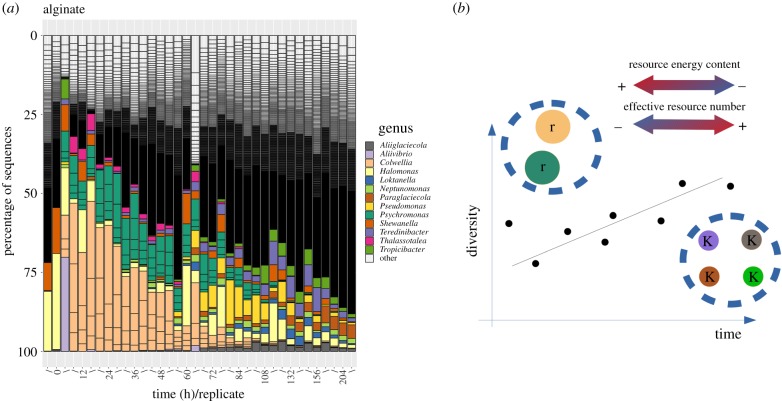
Diversity and resources properties in an ecological succession. (a) Population dynamics of natural marine assemblage MCs on synthetic particles of alginate. Each bar represents the relative abundance in the corresponding sample, labelled by time-point, with the 15 most abundant genera highlighted and the remainder shown as ‘others’. Three replicates per time-point are shown. (b) Illustration of the expected diversity increase through time as a function of the energy content and the effective number of resources that results from the degradation of resources. r-strategists will be observed at earlier times where the resources are abundant and rich in energy, while K-strategists should be expected at later times, where the resources are more heterogeneous, lower in energy and scarce (see Discussion).
Figure 3.
Figure 3.
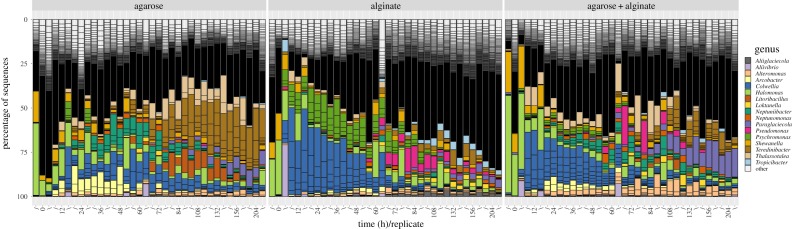
Population dynamics in single- and mixed-resource environments. Microbial communities were allowed to colonize particles composed of alginate (a), agarose (b) or a mixture of the two (c). The community dynamics in all three conditions exhibit a transition at intermediate times, in which the dynamics are split into well-differentiated communities. Although the community composition on the two substrates differs, the remarkable modularity of the experiments allows us to predict the relative abundance for the most abundant members as a linear combination of the relative abundances of the pure substrates [13].
Figure 4.
Figure 4.
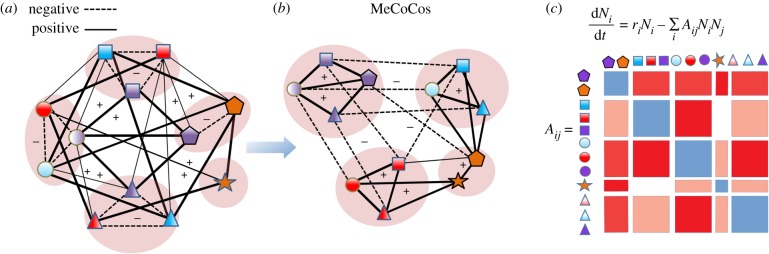
MeCoCos as a level of organization. (a) The symbols represent different species, where the same shape represents similar metabolic capabilities (functionally redundant groups), which would lead to competitive interaction (dotted lines) owing to a high niche overlap. On the other hand, members of different functional groups may engage in commensal or mutualistic relationships, driven by metabolic complementarity (solid lines). (b) A rearrangement of the left network leads to a new representation, in which members related through complementary functions tend to co-occur, forming MeCoCos, which constitute an intermediate level of organization between the species and the community levels. Understanding community-level dynamics may thus be simplified to understanding how MeCoCos compete (figure 5). (c) The interaction matrix corresponding to the networks has a block structure that makes it feasible to build population dynamics models as in macroscopic systems (e.g. [–47]). Blue blocks represent competitive interactions, and red blocks represent mutualistic interactions arising from metabolic complementarity.
Figure 5.
Figure 5.
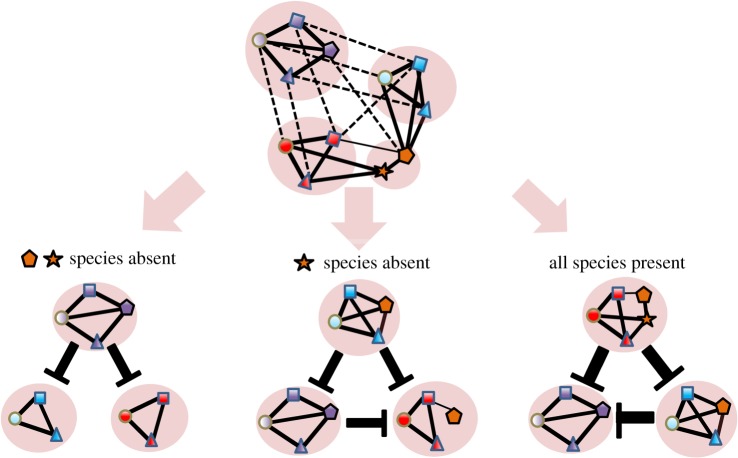
Competition between MeCoCos. Illustration of how changes in species composition alter which MeCoCo becomes dominant. The dominant community is the one that depletes resources to a minimum concentration, which we assume is related to the number of realized metabolic (complementary) links (solid lines connecting species). The orange species may be understood as community-level ‘metabolic switches’ that determine the outcome of the dynamics.

References

    1. Ley RE, Lozupone CA, Hamady M, Knight R, Gordon JI. 2008. Worlds within worlds: evolution of the vertebrate gut microbiota. Nat. Rev. Microbiol. 6, 776–788. ( 10.1038/nrmicro1978) - DOI - PMC - PubMed
    1. Becerra-Castro C, Lopes AR, Vaz-Moreira I, Silva EF, Manaia CM, Nunes OC. 2015. Wastewater reuse in irrigation: a microbiological perspective on implications in soil fertility and human and environmental health. Environ. Int. 75, 117–135. ( 10.1016/j.envint.2014.11.001) - DOI - PubMed
    1. Falkowski PG. 1998. Biogeochemical controls and feedbacks on ocean primary production. Science 281, 200–206. ( 10.1126/science.281.5374.200) - DOI - PubMed
    1. Chicurel M. 2000. Slimebusters. Nature 408, 284–286. ( 10.1038/35042737) - DOI - PubMed
    1. Rivett DW, Bell T. 2018. Abundance determines the functional role of bacterial phylotypes in complex communities. Nat. Microbiol. 3, 767 ( 10.1038/s41564-018-0180-0) - DOI - PMC - PubMed

Publication types