Review
. 2020 May 11;375(1798):20190251.
doi: 10.1098/rstb.2019.0251. Epub 2020 Mar 23.

Ecological and evolutionary mechanisms underlying patterns of phylosymbiosis in host-associated microbial communities

Affiliations
Review

Ecological and evolutionary mechanisms underlying patterns of phylosymbiosis in host-associated microbial communities

Kevin D Kohl. Philos Trans R Soc Lond B Biol Sci. .

Abstract

Phylosymbiosis, where similarities in host-associated microbial communities recapitulate the phylogeny of their hosts, is a newly recognized yet pervasive pattern in the field of host-microbe interactions. While phylosymbiosis has been documented across many systems, we still have a poor understanding of the mechanisms that underlie this emergent pattern. Host selection of the microbiome is a widely cited mechanism, yet other basic ecological and evolutionary processes (dispersal, drift and diversification) may also be at play. This paper discusses the roles that each of these processes and their interactions may play in yielding phylosymbiotic signals across hosts. Finally, this paper will identify open questions and methods that are required to better understand the relative contributions of these basic processes to phylosymbiosis. Given that phylosymbiosis has been shown to relate to functional components of host fitness, understanding the processes that contribute to these patterns will be important for our understanding of the ecology and evolution of host-microbe interactions. This article is part of the theme issue 'Conceptual challenges in microbial community ecology'.

Keywords: community assembly; community ecology; host–microbe interactions; microbiome.


Conflict of interest statement

I declare I have no competing interests.

Figures
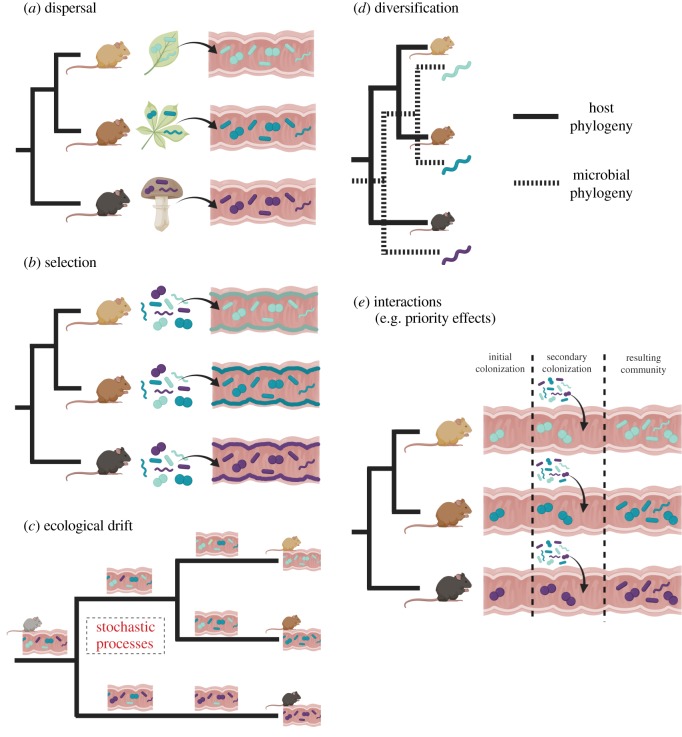
Figure 1.
Figure 1.
Ecological and evolutionary processes that may contribute to observed patterns of phylosymbiosis. Here, colours of microbes represent different species, and shapes represent different functional guilds. (a) Disperal—host species may come into contact with distinct microbial communities as part of their natural history or transmission from conspecifics. (b) Selection—hosts may exert selective forces that allow certain microbial members to colonize, while others are excluded from associating with the host. (c) Ecological drift—stochastic processes may result in the gain or loss of microbial members over evolutionary time. (d) Diversification—microbes may co-speciate with their host species. (e) Interactions—here, priority effects are depicted. Here, assume that there is no host selection occurring (hence the lack of coloured epithelial layers as depicted in (b)). Hosts may be initially colonized with a vertically transmitted microbe that has co-speciated with the host. These initial colonizing microbes may then exert subsequent selective forces through habitat modification or microbe–microbe interactions to only allow certain microbes to colonize, yielding phylosymbiotic patterns. (Online version in colour.)

References

    1. McFall-Ngai M, Hadfield MG, Bosch TC, Carey HV, Domazet-Lošo T, Wernegreen JJ. 2013. Animals in a bacterial world, a new imperative for the life sciences. Proc. Natl Acad. Sci. USA 110, 3229–3236. (10.1073/pnas.1218525110) - DOI - PMC - PubMed
    1. Ley RE, et al. 2008. Evolution of mammals and their gut microbes. Science 320, 1647–1651. (10.1126/science.1155725) - DOI - PMC - PubMed
    1. Spor A, Koren O, Ley R. 2011. Unravelling the effects of the environment and host genotype on the gut microbiome. Nat. Rev. Microbiol. 9, 279 (10.1038/nrmicro2540) - DOI - PubMed
    1. Yatsunenko T, et al. 2012. Human gut microbiome viewed across age and geography. Nature 486, 222 (10.1038/nature11053) - DOI - PMC - PubMed
    1. Amato KR, et al. 2013. Habitat degradation impacts black howler monkey (Alouatta pigra) gastrointestinal microbiomes. ISME J. 7, 1344 (10.1038/ismej.2013.16) - DOI - PMC - PubMed

MeSH terms