


Comparison of 9-Month Angiographic Follow-Up and Long-Term Clinical Outcomes of Biodegradable Polymer Drug-Eluting Stents and Second-Generation Durable Polymer Drug-Eluting Stents in Patients Undergoing Single Coronary Artery Stenting
- PMID: 32201459
- PMCID: PMC7062815
- DOI: 10.6515/ACS.202003_36(2).20190729A
Comparison of 9-Month Angiographic Follow-Up and Long-Term Clinical Outcomes of Biodegradable Polymer Drug-Eluting Stents and Second-Generation Durable Polymer Drug-Eluting Stents in Patients Undergoing Single Coronary Artery Stenting
Abstract
Background: The durable polymers (DP) used in first-generation drug-eluting stents (DESs) were associated with long-term cardiovascular events, and thus biodegradable polymer DESs (BP-DESs) and second-generation DP-DESs were designed to overcome this problem. In this study, we compared angiographic follow-up and long-term clinical outcomes between patients who received BP-DESs or second-generation DP-DESs.
Methods: We enrolled 436 patients with single coronary lesions who received a second-generation DP-DES or BP-DES between June 2009 and October 2012. All patients received follow-up angiography when new clinical events developed or at 9 months after index stenting. All participants received follow-up for 5 years.
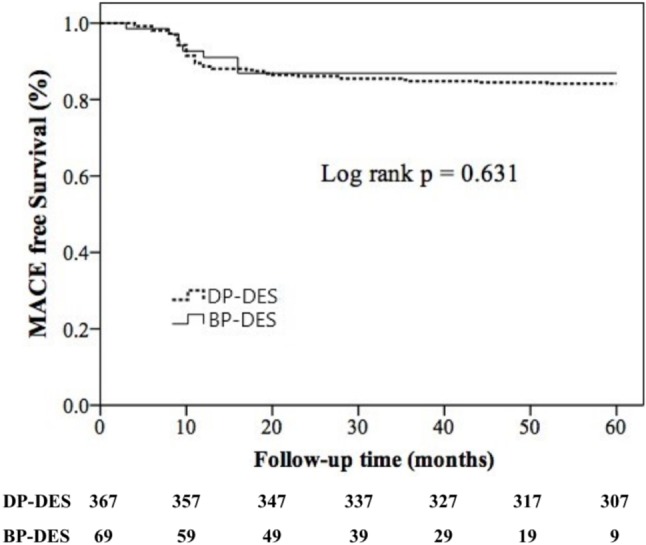
Results: There were no significant differences in patient and lesion characteristics between the two groups. The 9-month angiographic follow-up showed a lower net gain in the second-generation DP-DES group (2.19 mm vs. 2.41 mm, p = 0.040), but a similar binary restenosis rate between the two groups (5.4% vs. 8.7%, p = 0.276). During the 5-year follow-up period, no significant differences were observed between the two groups in major adverse cardiac events (MACEs), cardiovascular death, nonfatal myocardial infarction (MI), target vessel revascularization (TVR), all revascularization, stent thrombosis (ST), or MACE-free survival.
Conclusions: No significant differences were observed in cardiovascular death, nonfatal MI, TVR, all revascularization, ST, or MACE-free survival between the patients undergoing single coronary artery stenting with BP-DESs and second-generation DP-DESs.
Keywords: Coronary artery disease; Drug-eluting stent; Major adverse cardiac events; Polymer.
Figures
References
-
- Sammel AM, Chen D, Jepson N. New generation coronary stent technology--is the future biodegradable? Heart Lung Circ. 2013;22:495–506. - PubMed
-
- Commandeur S, van Beusekom HM, van der Giessen WJ. Polymers, drug release, and drug-eluting stents. J Interv Cardiol. 2006;19:500–506. - PubMed
-
- Virmani R, Guagliumi G, Farb A, et al. Localized hypersensitivity and late coronary thrombosis secondary to a sirolimus-eluting stent: should we be cautious? Circulation. 2004;109:701–705. - PubMed
LinkOut - more resources
Full Text Sources