Biosynthesis of Silver Nanoparticles Using Cucumis prophetarum Aqueous Leaf Extract and Their Antibacterial and Antiproliferative Activity Against Cancer Cell Lines
- PMID: 32201844
- PMCID: PMC7081640
- DOI: 10.1021/acsomega.0c00155
Biosynthesis of Silver Nanoparticles Using Cucumis prophetarum Aqueous Leaf Extract and Their Antibacterial and Antiproliferative Activity Against Cancer Cell Lines
Abstract
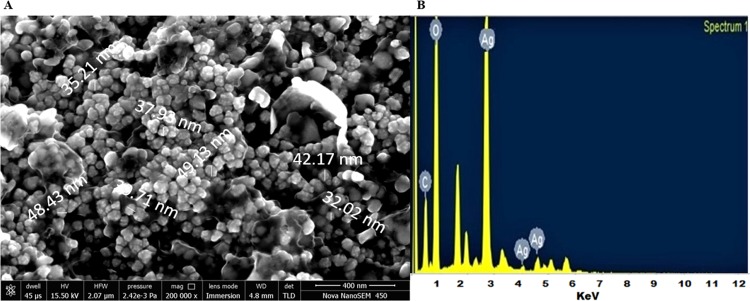
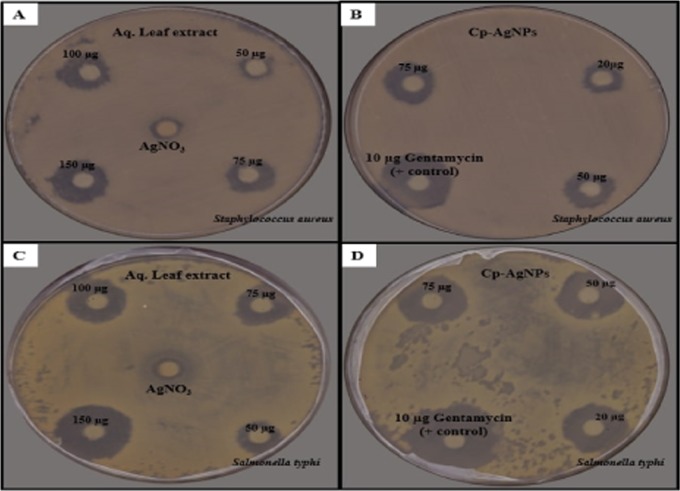
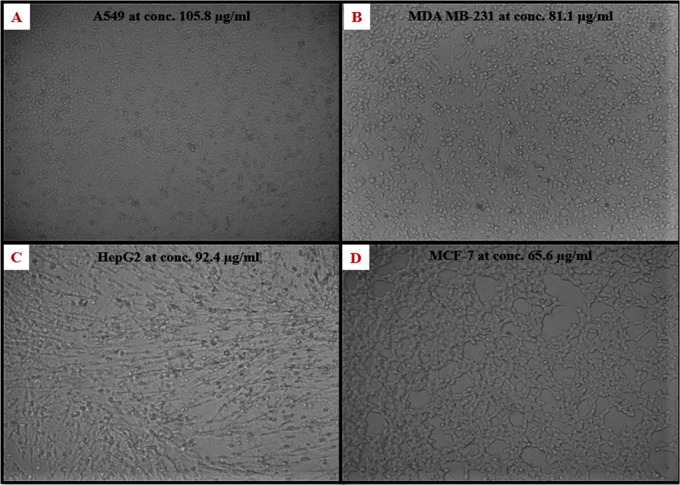
Biosynthesized nanoparticles are gaining attention because of biologically active plant secondary metabolites that help in green synthesis and also due to their unique biological applications. This study reports a facile, ecofriendly, reliable, and cost-effective synthesis of silver nanoparticles using the aqueous leaf extract of Cucumis prophetarum (C. prophetarum) and their antibacterial and antiproliferative activity. Silver nanoparticles were biosynthesized using the aqueous leaf extract of C. prophetarum, which acted as a reducing and capping agent. The biosynthesized C. prophetarum silver nanoparticles (Cp-AgNPs) were characterized using different techniques, such as UV-visible spectroscopy, dynamic light scattering (DLS), Fourier transform infrared (FTIR) spectroscopy, X-ray diffraction (XRD), scanning electron microscopy (SEM) and energy-dispersive X-ray analysis (EDAX). Phytochemical analysis was performed to determine the phytochemicals responsible for the reduction and capping of the biosynthesized Cp-AgNPs. The antioxidant activity of the biosynthesized nanoparticles was determined using 2,2-diphenyl-1-picrylhydrazyl (DPPH) and 3-ethylbenzothiazoline-6-sulfonic acid (ABTS) assays. Their antibacterial activity was checked against Staphylococcus aureus (Gram-positive) and Salmonella typhi (Gram-negative) bacteria. The biosynthesized nanoparticles showed dosage-dependent inhibition activity with a significant zone of inhibition and were more effective toward S. typhi as compared to S. aureus. Their antiproliferative activity was evaluated using 3-(4,5-dimethylthiazol-2-yl)-2,5-diphenyltetrazolium bromide (MTT) assay on selected cancer cell lines. The IC50 values of Cp-AgNPs on A549, MDA-MB-231, HepG2, and MCF-7 were found to be 105.8, 81.1, 94.2, and 65.6 μg/mL, respectively, and this showed that the Cp-AgNPs were more potent toward MCF-7 as compared to other cell lines used in this study. This work revealed that the biosynthesized silver nanoparticles using C. prophetarum leaf extract were associated with good antibacterial activity and antiproliferative potential against selected cancer cell lines. The biosynthesized C. prophetarum AgNPs can be further exploited as a potential candidate for antioxidant, antibacterial, and anticancer agents.
Copyright © 2020 American Chemical Society.
Conflict of interest statement
The authors declare no competing financial interest.
Figures


References
-
- Erci F.; Cakir-Koc R.; Isildak I. Green synthesis of silver nanoparticles using Thymbra spicata L. var. spicata (zahter) aqueous leaf extract and evaluation of their morphology-dependent antibacterial and cytotoxic activity. Artif. Cells, Nanomed., Biotechnol. 2018, 46, 150–158. 10.1080/21691401.2017.1415917. - DOI - PubMed
-
- Tanase C.; Berta L.; Coman N. A.; Rosca I.; Man A.; Toma F.; Mocan A.; Jakab-Farkas L.; Biro D.; Mare A. Investigation of In Vitro Antioxidant and Antibacterial Potential of Silver Nanoparticles Obtained by Biosynthesis Using Beech Bark Extract. Antioxidants 2019, 8, 45910.3390/antiox8100459. - DOI - PMC - PubMed
-
- Behboodi S.; Baghbani-Arani F.; Abdalan S.; Sadat Shandiz S. A. Green Engineered Biomolecule-Capped Silver Nanoparticles Fabricated from Cichorium intybus Extract: In Vitro Assessment on Apoptosis Properties Toward Human Breast Cancer (MCF-7) Cells. Biol. Trace Elem. Res. 2019, 187, 392–402. 10.1007/s12011-018-1392-0. - DOI - PubMed
-
- Rajan R.; Chandran K.; Harper S. L.; Yun S.-I.; Kalaichelvan P. T. Plant extract synthesized silver nanoparticles: an ongoing source of novel biocompatible materials. Ind. Crops Prod. 2015, 70, 356–373. 10.1016/j.indcrop.2015.03.015. - DOI
LinkOut - more resources
Full Text Sources
Other Literature Sources
Miscellaneous