


Comment
doi: 10.1038/s41422-020-0297-6.
A separation that's for the best: coming together at the PAS
Affiliations
- PMID: 32203129
- PMCID: PMC7196122
- DOI: 10.1038/s41422-020-0297-6
Item in Clipboard
Comment
A separation that's for the best: coming together at the PAS
Cell Res.
2020 May.
No abstract available
Conflict of interest statement
The authors declare no competing interests.
Figures
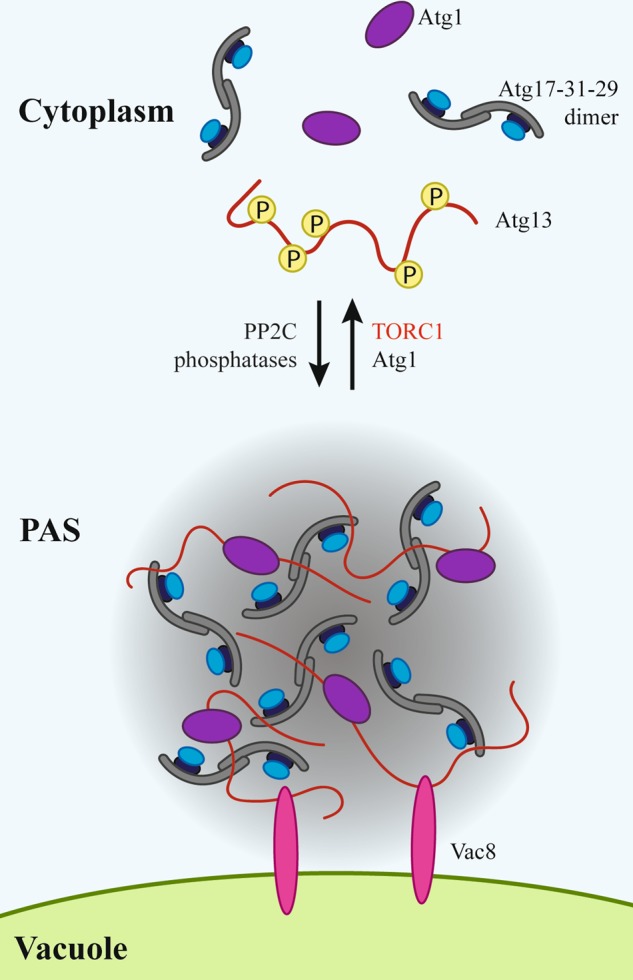
Under high nutrient availability, TORC1 is active and phosphorylates several autophagy proteins including Atg13 at residues S428 and S429, modifications that impair the Atg13-Atg17 interaction, precluding PAS formation in growing conditions. When cells are starved for nutrients, TORC1 is inactivated and the inhibitory phosphoryl groups placed on Atg13 by this complex are removed by PP2C phosphatases. This dephosphorylation allows formation of the PAS droplet resulting in the clustering of Atg1 molecules, which contributes to activating autophosphorylation of this kinase. Activated Atg1 then re-phosphorylates S428 and S429 on Atg13; however, this is reversed by PP2C phosphatases such that the PAS condensate remains stable. The peri-vacuolar localization of the PAS is facilitated at least partially by the interactions between Atg13 and Vac8.
Comment on
-
Phase separation organizes the site of autophagosome formation.Nature. 2020 Feb;578(7794):301-305. doi: 10.1038/s41586-020-1977-6. Epub 2020 Feb 5. Nature. 2020. PMID: 32025038
References
Publication types
MeSH terms
Grants and funding
LinkOut - more resources
Full Text Sources
