


Parental repeat length instability in myotonic dystrophy type 1 pre- and protomutations
- PMID: 32203199
- PMCID: PMC7316980
- DOI: 10.1038/s41431-020-0601-4
Parental repeat length instability in myotonic dystrophy type 1 pre- and protomutations
Abstract
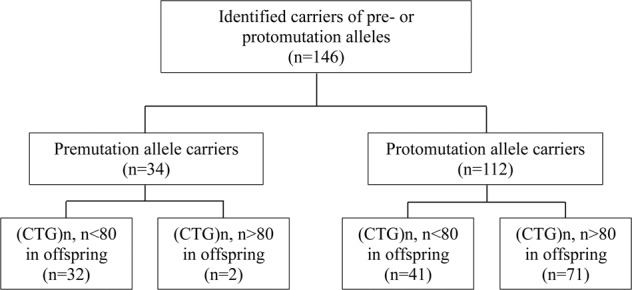
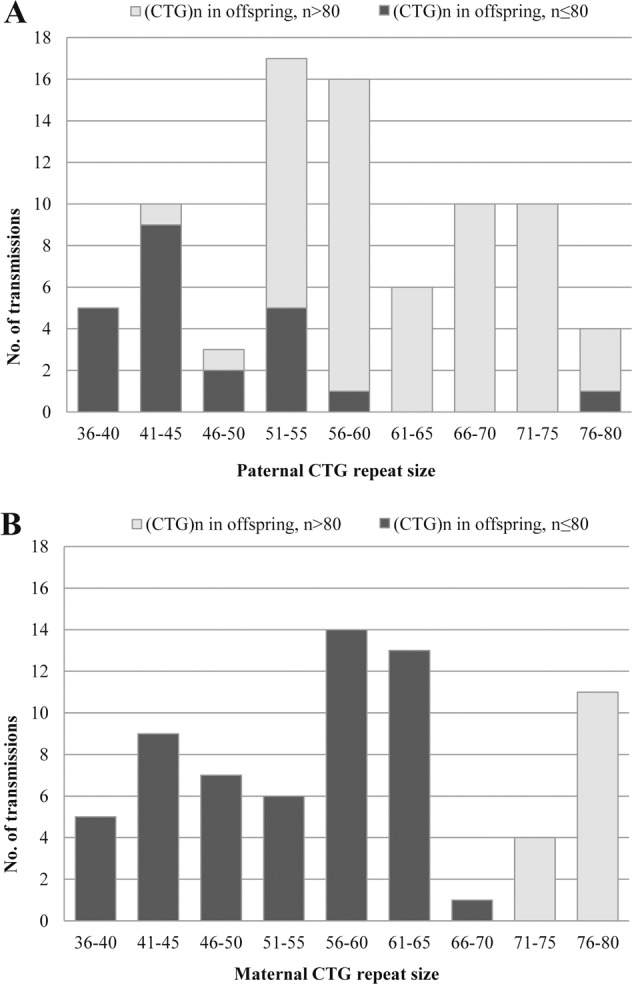
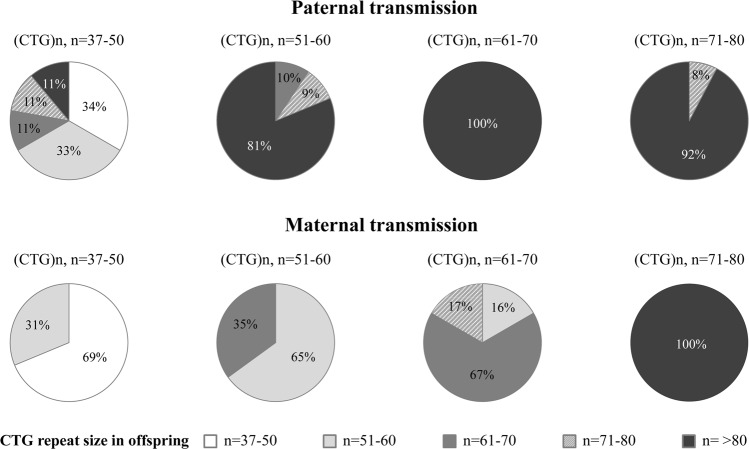
Myotonic dystrophy type 1 (DM1) is caused by a CTG trinucleotide repeat expansion on chromosome 19q13.3. While DM1 premutation (36-50 repeats) and protomutation (51-80 repeats) allele carriers are mostly asymptomatic, offspring is at risk of inheriting expanded, symptom-associated, (CTG)n repeats of n > 80. In this study we aimed to evaluate the intergenerational instability of DM1 pre- and protomutation alleles, focussing on the influence of parental gender. One hundred and forty-six parent-child pairs (34 parental premutations, 112 protomutations) were retrospectively selected from the DM1 patient cohort of the Maastricht University Medical Center+. CTG repeat size of parents and children was determined by (triplet-primed) PCR followed by fragment length analysis and Southern blot analysis. Fifty-eight out of eighty-one (71.6%) paternal transmissions led to a (CTG)n repeat of n > 80 in offspring, compared with 15 out of 65 (23.1%) maternal transmissions (p < 0.001). Repeat length instability occurred for paternal (CTG)n repeats of n ≥ 45, while maternal instability did not occur until (CTG)n repeats reached a length of n ≥ 71. Transmission of premutations caused (CTG)n repeats of n > 80 in offspring only when paternally transmitted (two cases), while protomutations caused (CTG)n repeats of n > 80 in offspring in 71 cases, of which 56 (78.9%) were paternally transmitted. In conclusion, our data show that paternally transmitted pre- and protomutations were more unstable than maternally transmitted pre- and protomutations. For genetic counseling, this implies that males with a small DMPK mutation have a higher risk of symptomatic offspring compared with females. Consequently, we suggest addressing sex-dependent factors in genetic counseling of small-sized CTG repeat carriers.
Conflict of interest statement
The authors declare that they have no conflict of interest.
Figures
References
-
- Brook JD, McCurrach ME, Harley HG, Buckler AJ, Church D, Aburatani H, et al. Molecular basis of myotonic dystrophy: expansion of a trinucleotide (CTG) repeat at the 3’ end of a transcript encoding a protein kinase family member. Cell. 1992;69:385. - PubMed
-
- Gatchel JR, Zoghbi HY. Diseases of unstable repeat expansion: mechanisms and common principles. Nat Rev Genet. 2005;6:743–55. - PubMed
-
- Harper PS. Myotonic dystrophy present management, future therapy. Oxford: Oxford University Press; 2004. - PubMed
-
- Meola G, Cardani R. Myotonic dystrophies: an update on clinical aspects, genetic, pathology, and molecular pathomechanisms. Biochimica et Biophysica Acta. 2015;1852:594–606. - PubMed
-
- Imbert G, Kretz C, Johnson K, Mandel JL. Origin of the expansion mutation in myotonic dystrophy. Nat Genet. 1993;4:72–6. - PubMed
MeSH terms
LinkOut - more resources
Full Text Sources
