


Delta neutrophil index for predicting mortality in trauma patients who underwent emergent abdominal surgery: A case controlled study
- PMID: 32203541
- PMCID: PMC7089524
- DOI: 10.1371/journal.pone.0230149
Delta neutrophil index for predicting mortality in trauma patients who underwent emergent abdominal surgery: A case controlled study
Abstract
Background: Delta neutrophil index (DNI) can be used as a biomarker for infection to predict patient outcomes. We aimed to investigate the relationship between DNI and clinical outcomes in trauma patients who underwent abdominal surgery.
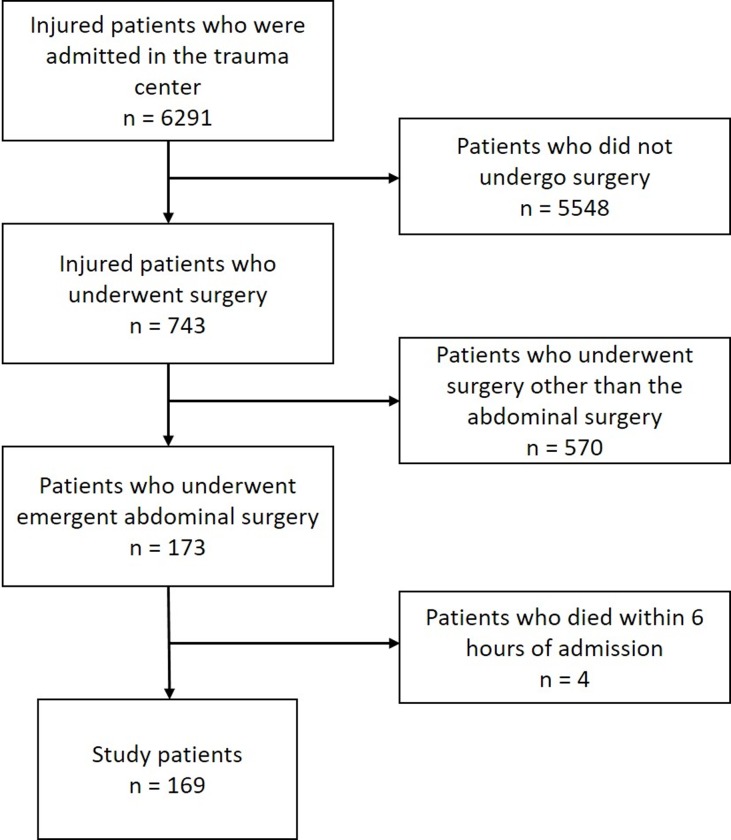
Materials and methods: We retrospectively analyzed injured patients who underwent emergent abdominal surgery in the regional trauma center of Wonju Severance Christian Hospital between March 2016 and May 2018. Patient characteristics, operation type, preoperative and postoperative laboratory findings, and clinical outcomes were evaluated. Logistic regression analysis was performed for risk factors associated with mortality.
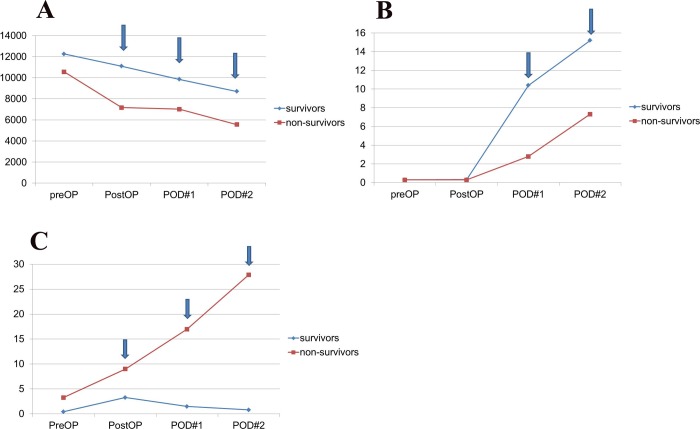
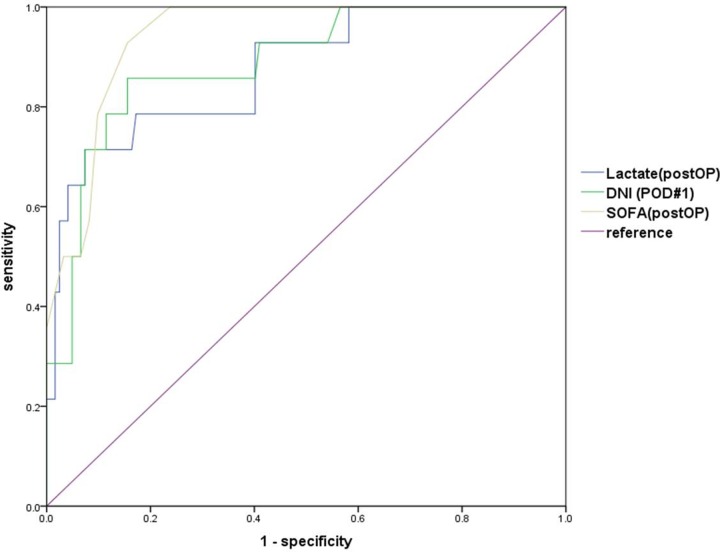
Results: Overall, 169 patients (mean age, 53.8 years; 66.3% male) were enrolled in this study, of which 19 (11.2%) died. The median injury severity score (ISS) was 12. The non-survivors had a significantly higher ISS [25(9-50) vs. 10(1-50), p<0.001] and serum lactate level (9.00±4.10 vs. 3.04±2.23, p<0.001) and more frequent shock (63.2% vs 23.3%, p<0.001) and solid organ injury (52.6% vs. 25.3%, p = 0.013) than the survivors. There were significant differences in postoperative DNI between the two groups (p<0.009 immediate post-operation, p = 0.001 on postoperative day 1 [POD1], and p = 0.013 on POD2). Logistic regression analysis showed that the independent factors associated with mortality were postoperative lactate level (odds ratio [OR] 1.926, 95% confidence interval [CI] 1.101-3.089, p = 0.007), postoperative sequential organ failure assessment score (OR 1.593, 95% CI 1.160-2.187, p = 0.004), and DNI on POD1 (OR 1.118, 95% CI 1.028-1.215, p = 0.009). The receiver operating characteristics curve demonstrated that the area under the curve of DNI on POD1 was 0.887 (cut-off level: 7.1%, sensitivity 85.7%, and specificity 84.4%).
Conclusions: Postoperative DNI may be a useful biomarker to predict mortality in trauma patients who underwent emergent abdominal surgery.
Conflict of interest statement
An author [K.K] works as a volunteer at the Saidabad clinic, a commercial clinic. The funder did not provide support in the form of salary for author [K.K], and did not have any additional role in the study design, data collection and analysis, decision to publish, or preparation of the manuscript. This does not alter our adherence to PLOS ONE polices on sharing data and materials. All other authors have no competing interest. The authors have declared that no competing interests exist.
Figures
References
-
- Kofoed K, Andersen O, Kronborg G, Tvede M, Petersen J, Eugen-Olsen J, et al. Use of plasma C-reactive protein, procalcitonin, neutrophils, macrophage migration inhibitory factor, soluble urokinase-type plasminogen activator receptor, and soluble triggering receptor expressed on myeloid cells-1 in combination to diagnose infections: a prospective study. Critical care (London, England). 2007;11(2):R38. - PMC - PubMed
-
- Shapiro NI, Trzeciak S, Hollander JE, Birkhahn R, Otero R, Osborn TM, et al. A prospective, multicenter derivation of a biomarker panel to assess risk of organ dysfunction, shock, and death in emergency department patients with suspected sepsis. Critical care medicine. 2009;37(1):96–104. 10.1097/CCM.0b013e318192fd9d - DOI - PubMed
-
- Suarez-de-la-Rica A, Maseda E, Anillo V, Tamayo E, Garcia-Bernedo CA, Ramasco F, et al. Biomarkers (Procalcitonin, C Reactive Protein, and Lactate) as Predictors of Mortality in Surgical Patients with Complicated Intra-Abdominal Infection. Surgical infections. 2015;16(3):346–51. 10.1089/sur.2014.178 - DOI - PubMed
MeSH terms
Substances
LinkOut - more resources
Full Text Sources
Medical
