. 2020 Mar 19;21(6):2106.
doi: 10.3390/ijms21062106.

Genetic Transformation of Tribonema minus, a Eukaryotic Filamentous Oleaginous Yellow-Green Alga

Affiliations

Genetic Transformation of Tribonema minus, a Eukaryotic Filamentous Oleaginous Yellow-Green Alga

Yan Zhang et al. Int J Mol Sci. .

Abstract

Eukaryotic filamentous yellow-green algae from the Tribonema genus are considered to be excellent candidates for biofuels and value-added products, owing to their ability to grow under autotrophic, mixotrophic, and heterotrophic conditions and synthesize large amounts of fatty acids, especially unsaturated fatty acids. To elucidate the molecular mechanism of fatty acids and/or establish the organism as a model strain, the development of genetic methods is important. Towards this goal, here, we constructed a genetic transformation method to introduce exogenous genes for the first time into the eukaryotic filamentous alga Tribonema minus via particle bombardment. In this study, we constructed pSimple-tub-eGFP and pEASY-tub-nptⅡ plasmids in which the green fluorescence protein (eGFP) gene and the neomycin phosphotransferase Ⅱ-encoding G418-resistant gene (nptⅡ) were flanked by the T. minus-derived tubulin gene (tub) promoter and terminator, respectively. The two plasmids were introduced into T. minus cells through particle-gun bombardment under various test conditions. By combining agar and liquid selecting methods to exclude the pseudotransformants under long-term antibiotic treatment, plasmids pSimple-tub-eGFP and pEASY-tub- nptⅡ were successfully transformed into the genome of T. minus, which was verified using green fluorescence detection and the polymerase chain reaction, respectively. These results suggest new possibilities for efficient genetic engineering of T. minus for future genetic improvement.

Keywords: Tribonema minus; green fluorescence protein; particle-gun bombardment; transformation; tubulin gene.


Conflict of interest statement

The authors declare no conflict of interest.

Figures

Figure 1
Figure 1
Analysis of herbicide and antibiotic sensitivities of T. minus. (A) Effects of different concentrations of all tested herbicides and antibiotics on the growth of T. minus in liquid medium. Five different antibiotics and one herbicide were used in this experiment, including hygromycin (light purple bars), chloramphenicol (dark red bars), geneticin (light yellow bars), kanamycin (light blue bars), streptomycin (dark purple bars), and basta (light red bars). Data are the average of n = 3 independent repeats; bars show SDs. Significant differences in biomass changes under each antibiotic test (p 0.05). (B) Growth of T. minus on the agar plates containing different concentrations of G418.
Figure 2
Figure 2
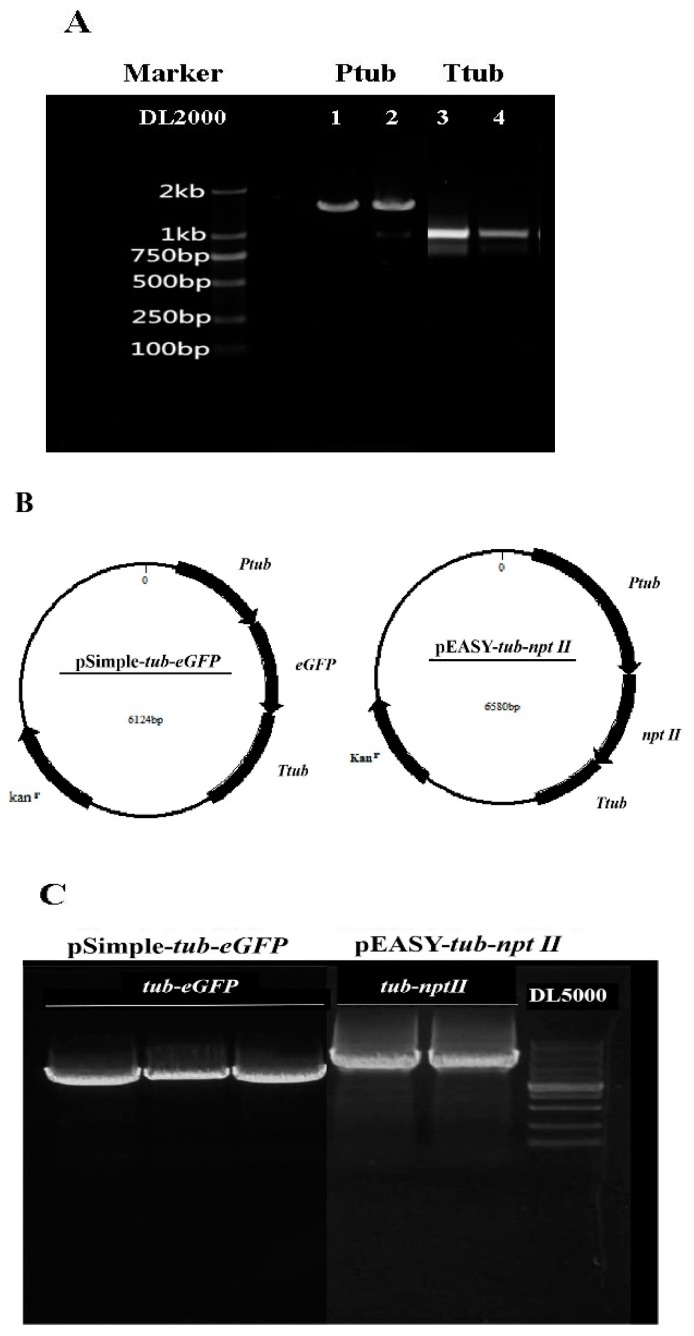
Construction of pSimple-tub-eGFP and pEASY-tub-nptⅡ vectors. (A) Gel analysis of tub promoter and terminator. (B) Design structure and size of pSimple-tub-eGFP and pEASY-tub-nptⅡ vectors. (C) Gel analysis of pSimple-tub-eGFP and pEASY-tub-nptⅡ vectors.
Figure 3
Figure 3
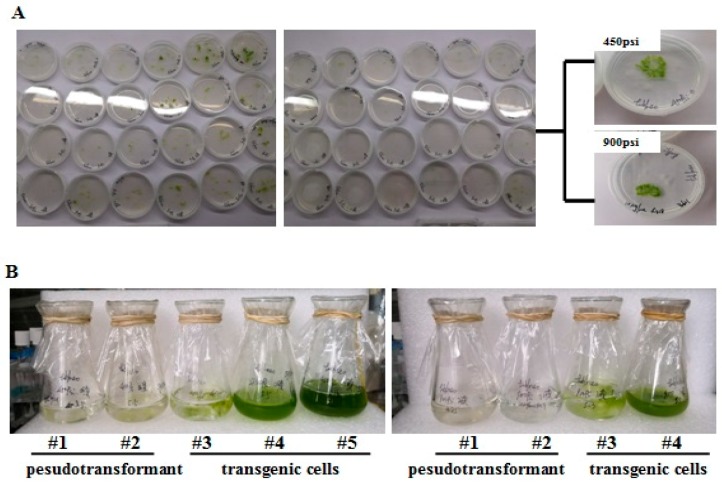
Agar and liquid selecting of transgenic cells. (A) Cells grown on an agar plate containing 10 μg mL−1 G418. (B) After growth, cells were transferred from the agar plate to BG11 medium supplemented with 20 μg mL−1 G418.
Figure 4
Figure 4
Phenotypic characterization of pSimple-tub-eGFP transformed T. minus under 450 psi. Detection was in the range of 685–735 nm for chloroplast autofluorescence (A, B) and 495–556 nm for eGFP (A’, B’).
Figure 5
Figure 5
PCR amplification from genes using the genomic DNA of T. minus transformants and wild types (marker: DL2000). Gel analysis of the nptⅡ (A) and eGFP genes (B) in transformants and wild types. (C) Gel analysis of fragment in pEASY-tub-nptⅡ in third-generation transformants and wild types.
Figure 6
Figure 6
Quantification of the nptⅡ gene in three transformants of T. minus through real-time PCR.

References

    1. Hu Q., Sommerfeld M., Jarvis E., Ghirardi M., Posewitz M., Seibert M., Darzins A. Microalgal triacylglcerols as feedstocks for biofuel production: Perspectives and advances. Plant J. 2008;54:621–639. doi: 10.1111/j.1365-313X.2008.03492.x. - DOI - PubMed
    1. Irina A.G., John L.H. Lipids and lipid metabolism in eukaryotic algae. Prog. Lipid Res. 2006;45:160–186. - PubMed
    1. Liang J.B., Wen F., Liu J.H. Transcriptomic and lipidomic analysis of an EPA-containing Nannochloropsis sp. PJ 12 in response to nitrogen deprivation. Sci. Rep. 2019;9:4540. doi: 10.1038/s41598-019-41169-2. - DOI - PMC - PubMed
    1. William P.L.I.B., Laurens L.M.L. Microalgae as biodiesel and biomass feedstocks: Review and analysis of the biochemistry, energetics and economics. Energy Environ. Sci. 2010;3:554–590. doi: 10.1039/b924978h. - DOI
    1. Adrme-Vega T.C., Lim D.K., Timmins M., Vernen F., Li Y., Schenk P.M. Microalgal biofactories: A proming approach towards sustainable omega-3 fatty acid production. Microb. Cell Facotries. 2012;11:96. doi: 10.1186/1475-2859-11-96. - DOI - PMC - PubMed

MeSH terms

LinkOut - more resources