Review
. 2020 Mar 19;21(6):2108.
doi: 10.3390/ijms21062108.

The PERK-Dependent Molecular Mechanisms as a Novel Therapeutic Target for Neurodegenerative Diseases

Affiliations
Review

The PERK-Dependent Molecular Mechanisms as a Novel Therapeutic Target for Neurodegenerative Diseases

Wioletta Rozpędek-Kamińska et al. Int J Mol Sci. .

Abstract

Higher prevalence of neurodegenerative diseases is strictly connected with progressive aging of the world population. Interestingly, a broad range of age-related, neurodegenerative diseases is characterized by a common pathological mechanism-accumulation of misfolded and unfolded proteins within the cells. Under certain circumstances, such protein aggregates may evoke endoplasmic reticulum (ER) stress conditions and subsequent activation of the unfolded protein response (UPR) signaling pathways via the protein kinase RNA-like endoplasmic reticulum kinase (PERK)-dependent manner. Under mild to moderate ER stress, UPR has a pro-adaptive role. However, severe or long-termed ER stress conditions directly evoke shift of the UPR toward its pro-apoptotic branch, which is considered to be a possible cause of neurodegeneration. To this day, there is no effective cure for Alzheimer's disease (AD), Parkinson's disease (PD), Huntington's disease (HD), or prion disease. Currently available treatment approaches for these diseases are only symptomatic and cannot affect the disease progression. Treatment strategies, currently under detailed research, include inhibition of the PERK-dependent UPR signaling branches. The newest data have reported that the use of small-molecule inhibitors of the PERK-mediated signaling branches may contribute to the development of a novel, ground-breaking therapeutic approach for neurodegeneration. In this review, we critically describe all the aspects associated with such targeted therapy against neurodegenerative proteopathies.

Keywords: Alzheimer’s disease; PERK; PERK inhibitors; Parkinson’s disease; apoptosis; endoplasmic reticulum stress; neurodegeneration; neurodegenerative diseases; unfolded protein response.


Conflict of interest statement

The authors declare no conflict of interest.

Figures
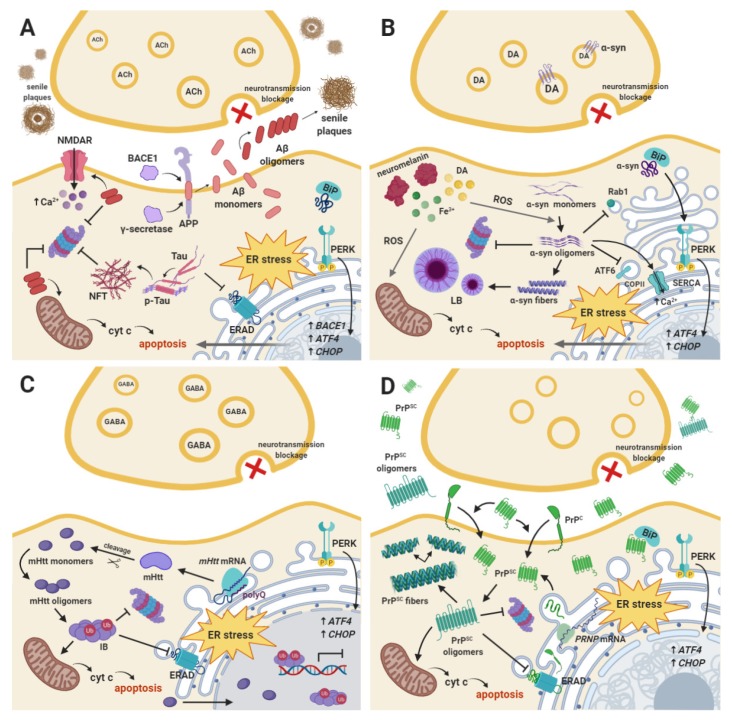
Figure 1
Figure 1
The schematic view of molecular perturbances resulting in subsequent activation of the protein kinase RNA-like endoplasmic reticulum kinase (PERK)-dependent unfolded protein response (UPR) signaling pathway in the following neurodegenerative disorders: (A) Alzheimer’s disease (AD), (B) Parkinson’s disease (PD), (C) Huntington’s disease (HD), and (D) prion disease. More details are included in the text of the manuscript.
Figure 2
Figure 2
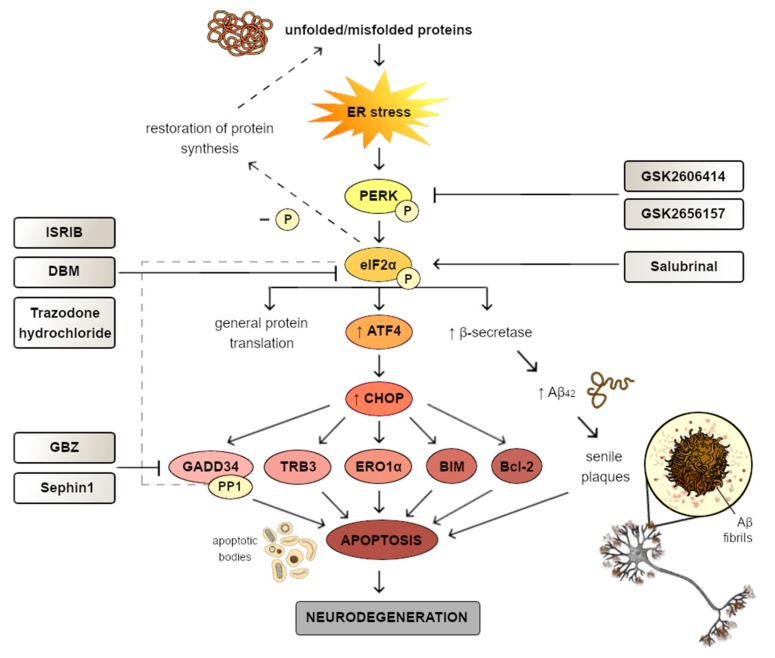
Small-molecule inhibitors of the protein kinase RNA-like endoplasmic reticulum kinase (PERK)-dependent UPR signaling pathway and their targets of action. Numerous studies have suggested that the pathogenesis of neurodegenerative diseases, including Alzheimer’s disease (AD), is correlated with the accumulation of misfolded and unfolded proteins, which may directly or indirectly trigger endoplasmic reticulum (ER) stress conditions and activation of the PERK-dependent unfolded protein response (UPR) signaling pathways. The upregulation of specific mechanisms related to the PERK branch of UPR signaling and AD pathogenesis is indicated by arrow, downregulation by inhibiting line, whereas GADD34-mediated dephosphorylation of eIF2α in a negative feedback loop by dotted arrow. Under mild-to-moderate ER stress conditions, UPR has a pro-adaptive role, whereas severe or long-termed ER stress conditions directly evoke shift of the UPR toward its pro-apoptotic branch, leading to neurodegeneration. The newest data have reported that pharmacological modulation of the PERK-dependent branch of the UPR signaling pathway via small-molecule inhibitors may constitute a novel treatment strategy against neurodegeneration.

References

    1. Brown R.C., Lockwood A.H., Sonawane B.R. Neurodegenerative diseases: An overview of environmental risk factors. Environ. Health Perspect. 2005;113:1250–1256. doi: 10.1289/ehp.7567. - DOI - PMC - PubMed
    1. Skoog I., Börjesson-Hanson A., Kern S., Johansson L., Falk H., Sigström R., Östling S. Decreasing prevalence of dementia in 85-year olds examined 22 years apart: The influence of education and stroke. Sci. Rep. 2017;7:1–8. doi: 10.1038/s41598-017-05022-8. - DOI - PMC - PubMed
    1. Prince M., Bryce R., Albanese E., Wimo A., Ribeiro W., Ferri C.P. The Global Prevalence of Dementia: A Systematic Review and Metaanalysis. Alzheimers Dement. 2013;9:63–75. doi: 10.1016/j.jalz.2012.11.007. - DOI - PubMed
    1. Babusikova E., Evinova A., Jurecekova J., Jesenak M., Dobrot D. Advanced Understanding of Neurodegenerative Diseases. IntechOpen; London, UK: 2011. Alzheimer’s Disease: Definition, Molecular and Genetic Factors.
    1. Krantic S. Editorial Thematic Issue: From Current Diagnostic Tools and Therapeutics for Alzheimer’s Disease towards Earlier Diagnostic Markers and Treatment Targets. Curr. Alzheimer Res. 2016;14:2–5. doi: 10.2174/156720501401161201104858. - DOI - PubMed

MeSH terms