. 2020 Apr 7;117(14):8126-8134.
doi: 10.1073/pnas.2001615117. Epub 2020 Mar 23.

Abstinence-dependent dissociable central amygdala microcircuits control drug craving

Affiliations

Abstinence-dependent dissociable central amygdala microcircuits control drug craving

Marco Venniro et al. Proc Natl Acad Sci U S A. .

Erratum in

Abstract

We recently reported that social choice-induced voluntary abstinence prevents incubation of methamphetamine craving in rats. This inhibitory effect was associated with activation of protein kinase-Cδ (PKCδ)-expressing neurons in central amygdala lateral division (CeL). In contrast, incubation of craving after forced abstinence was associated with activation of CeL-expressing somatostatin (SOM) neurons. Here we determined the causal role of CeL PKCδ and SOM in incubation using short-hairpin RNAs against PKCδ or SOM that we developed and validated. We injected two groups with shPKCδ or shCtrlPKCδ into CeL and trained them to lever press for social interaction (6 d) and then for methamphetamine infusions (12 d). We injected two other groups with shSOM or shCtrlSOM into CeL and trained them to lever press for methamphetamine infusions (12 d). We then assessed relapse to methamphetamine seeking after 1 and 15 abstinence days. Between tests, the rats underwent either social choice-induced abstinence (shPKCδ groups) or homecage forced abstinence (shSOM groups). After test day 15, we assessed PKCδ and SOM, Fos, and double-labeled expression in CeL and central amygdala medial division (CeM). shPKCδ CeL injections decreased Fos in CeL PKCδ-expressing neurons, increased Fos in CeM output neurons, and reversed the inhibitory effect of social choice-induced abstinence on incubated drug seeking on day 15. In contrast, shSOM CeL injections decreased Fos in CeL SOM-expressing neurons, decreased Fos in CeM output neurons, and decreased incubated drug seeking after 15 forced abstinence days. Our results identify dissociable central amygdala mechanisms of abstinence-dependent expression or inhibition of incubation of craving.

Keywords: PKCδ; SOM; amygdala; social reward; voluntary abstinence.


Conflict of interest statement

The authors declare no competing interest.

Figures
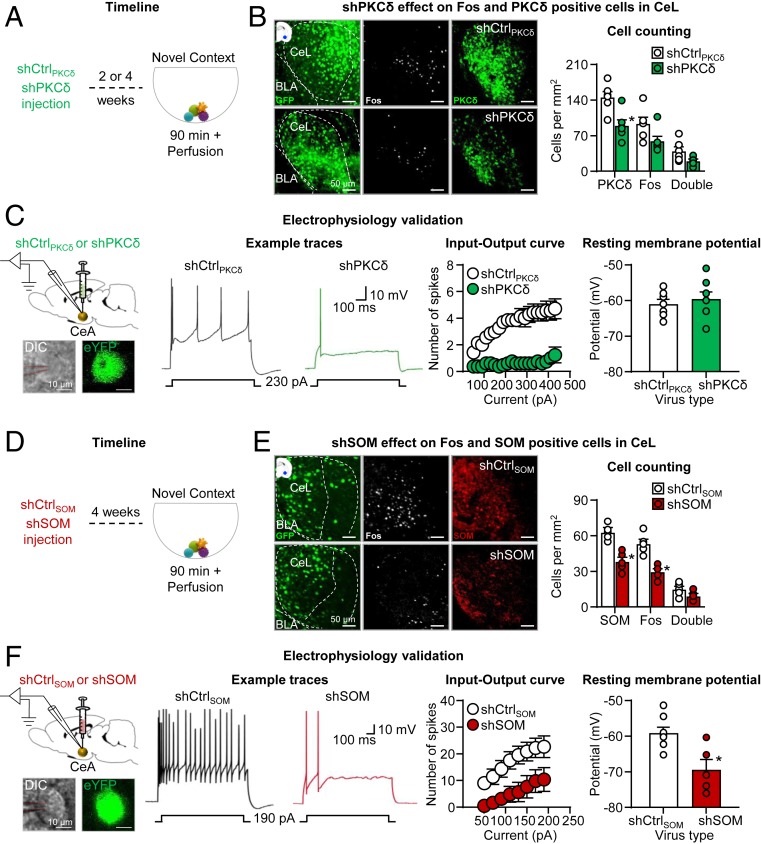
Fig. 1.
Fig. 1.
shPKCδ and shSOM validation. (A) Timeline of the experiment (shPKCδ). We injected six male rats with shCtrlPKCδ into the CeL of one hemisphere and shPKCδ into the other hemisphere (counterbalanced) either 2 or 4 wk prior to novel context-induced Fos expression. (B) shPKCδ effect on Fos expression and PKCδ levels in CeL. (Left) Representative CeL photomicrographs of shCtrlPKCδ (Top) and shPKCδ (Bottom) viral expression, Fos, and PKCδ expression (n = 6). Virus is shown in green, Fos is shown in white, and PKCδ is shown in green. (Scale bars, 50 μm.) (Right) Cell counting graph (reporting also individual data) for Fos, PKCδ, and double-labeled neurons. (C). Electrophysiology validation. The first panel shows a representative photomicrograph of recorded cells. (Scale bars, 10 µm.) The second panel shows example traces showing spiking activity in response to a depolarizing somatic current injection in CeL neurons expressing either shCtrlPKCδ or shPKCδ. The third panel shows input–output curve demonstrating spiking activity output in response to depolarizing steps of current input in CeL neurons expressing either shCtrlPKCδ or shPKCδ. The fourth panel shows summary data showing resting membrane potential of recorded CeL neurons expressing either shCtrlPKCδ or shPKCδ. (D) Timeline of the experiment (SOM). We injected two groups of male rats (n = 5) bilaterally with shCtrlSOM or shSOM into the CeL 4 wk prior to novel context-induced Fos expression. (E) shSOM effect on Fos expression and SOM levels in CeL. (Left) Representative CeL photomicrographs of shCtrlSOM (Top) and shSOM (Bottom) viral expression and Fos and SOM expression (n = 5 per group). Virus is shown in green, Fos is shown in white, and SOM is shown in red. (Scale bars, 50 μm.) (Right) Cell counting graph (reporting also individual data) for Fos, SOM, and double-labeled neurons. (F). Electrophysiology validation. The first panel shows a representative photomicrograph of recorded cells. (Scale bars, 10 µm.) The second panel shows example traces showing spiking activity in response to a depolarizing somatic current injection in CeL neurons expressing either shCtrlSOM or shSOM. The third panel shows input–output curve demonstrating spiking activity output in response to depolarizing steps of current input in CeL neurons expressing either shCtrlSOM or shSOM. The fourth panel shows a summary graph showing resting membrane potential of recorded CeL neurons expressing either shCtrlSOM or shSOM. *, different from shCtrl control viruses, P < 0.05. See also SI Appendix, Figs. S1–S3. Statistical details are included in SI Appendix, Table S1.
Fig. 2.
Fig. 2.
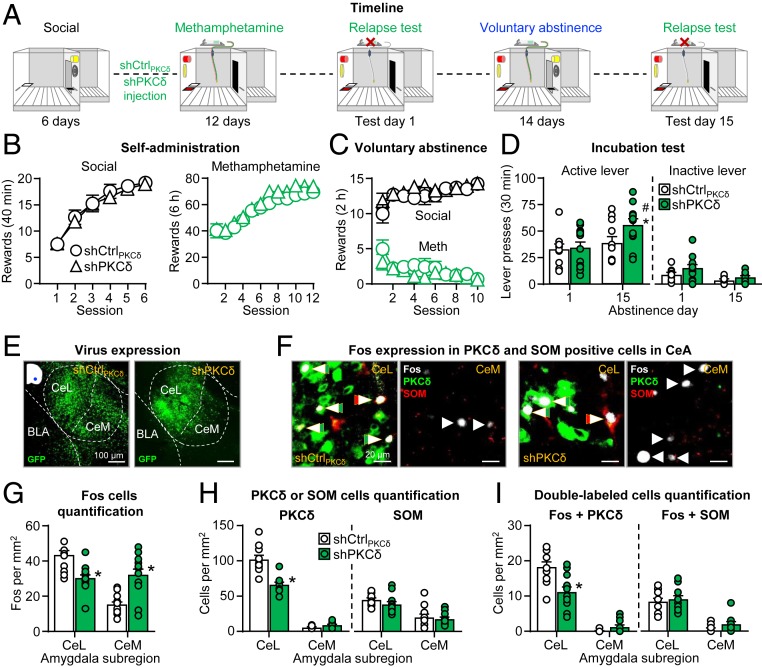
CeL shPKCδ virus injections reversed the inhibitory effect of voluntary abstinence on incubation of methamphetamine craving. (A) Timeline of the experiment. (B) Self-administration training (rewards: social or methamphetamine infusion). Number of social rewards (20 trials) or methamphetamine infusions (6 h). (C) Voluntary abstinence. Social rewards and methamphetamine infusions earned during 10 discrete choice sessions (15 trials per session). (D) Incubation test. (Left) Active lever and (Right) inactive lever presses during the 30-min test sessions (including individual data). During testing, active lever presses led to contingent presentation of the discrete light cue previously paired with methamphetamine infusions during training but not methamphetamine (extinction conditions). shCtrlPKCδ n = 11; shPKCδ n = 12 male rats. *, different from test day 1 within each shRNA type, P < 0.05; #, different from shCtrlPKCδ on day 15, P < 0.05. Data are mean ± SEM. (E) Virus expression. Representative CeA photomicrographs of shCtrlPKCδ (Left) and shPKCδ (Right) viral expression (green). (Scale bars, 100 μm.) (F) Representative CeL and CeM photomicrographs of Fos expression in PKCδ and SOM neurons: (Left) shCtrlPKCδ group (n = 11) and (Right) shPKCδ group (n = 12). Arrows indicate representative cells; double arrows indicate double-labeled cells. Fos is shown in white, PKCδ is shown in green, and SOM is shown in red. (Scale bars, 20 μm.) (G) Fos neuron quantification. Number of Fos-immunoreactive (IR) neurons per mm2 in the CeL and CeM. (H) PKCδ and SOM quantification. Number of PKCδ-IR or SOM-IR in CeL and CeM. (I) Quantification of double-labeled cells. Number of Fos + PKCδ-IR or Fos + SOM-IR double-labeled neurons per mm2 in the CeL and CeM. *, different from shCtrlPKCδ, P < 0.05. Data are mean ± SEM. See also SI Appendix, Figs. S1, S3, and S4.
Fig. 3.
Fig. 3.
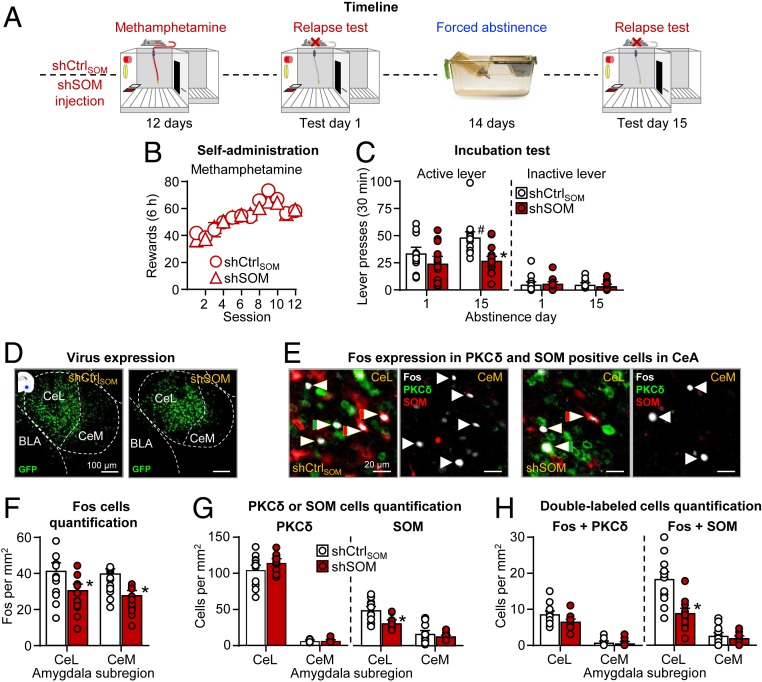
CeL shSOM injections decreased incubation of methamphetamine craving after forced abstinence. (A) Timeline of the experiment. (B) Self-administration training (methamphetamine infusions). Number of methamphetamine infusions (6 h). (C) Incubation test. (Left) Active lever and (Right) inactive lever during the 30-min test sessions (including individual data). During testing, active lever presses led to contingent presentation of the discrete light cue previously paired with methamphetamine infusions during training but not methamphetamine (extinction conditions). shCtrlSOM n = 13; shSOM n = 13 male rats. #, different from test day 1 within each shRNA type; *, different from shCtrlSOM on day 15, P < 0.05. Data are mean ± SEM. (D) Virus expression. Representative CeA photomicrographs of shCtrlSOM (Left) and shSOM (Right) viral expression (green). (Scale bars, 100 μm.) (E) Representative CeL and CeM photomicrographs of Fos expression in PKCδ and SOM neurons: (Left) shCtrlSOM group (n = 13) and (Right) shSOM group (n = 13). Arrows indicate representative cells; double arrows indicate double-labeled cells. Fos is shown in white, PKCδ is shown in green, and SOM is shown in red. (Scale bars, 20 μm.) (F) Fos neuron quantification. Number of Fos-immunoreactive (IR) neurons per mm2 in the CeL and CeM. (G) PKCδ and SOM quantification. Number of PKCδ-IR or SOM-IR in CeL and CeM. (H) Quantification of double-labeled cells. Number of Fos + PKCδ-IR or Fos + SOM-IR double-labeled neurons per mm2 in the CeL and CeM. *, different from shCtrlSOM, P < 0.05. Data are mean ± SEM. See also SI Appendix, Figs. S2–S4.
Fig. 4.
Fig. 4.
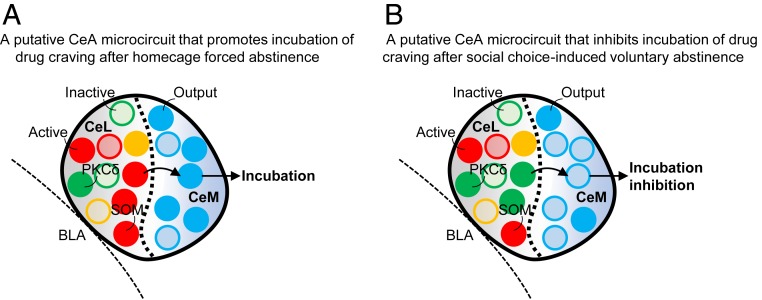
Schematic illustration of the dissociable CeA mechanisms mediating abstinence-dependent expression or inhibition of incubation of methamphetamine craving. (A) A putative central amygdala microcircuit that promotes incubation of drug craving after forced abstinence: active CeL somatostatin (SOM) neurons activate CeM output neurons (via disinhibition) and promote incubation. (B) A putative central amygdala microcircuit that inhibits incubation of drug craving after voluntary abstinence: active CeL PKCδ neurons inhibit CeM output neurons and inhibit incubation. CeL, CeM, central amygdala lateral and medial subdivision; BLA, basolateral amygdala. Full circle indicates active neurons, and empty circle indicates inactive neurons. PKCδ neurons (green), SOM neurons (red), output neurons (blue) neurons, and other neurons (yellow).

References

    1. Heilig M., Epstein D. H., Nader M. A., Shaham Y., Time to connect: Bringing social context into addiction neuroscience. Nat. Rev. Neurosci. 17, 592–599 (2016). - PMC - PubMed
    1. Marlatt G. A., Baer J. S., Donovan D. M., Kivlahan D. R., Addictive behaviors: Etiology and treatment. Annu. Rev. Psychol. 39, 223–252 (1988). - PubMed
    1. Azrin N. H., Improvements in the community-reinforcement approach to alcoholism. Behav. Res. Ther. 14, 339–348 (1976). - PubMed
    1. Dunn K., et al. , Employment-based reinforcement of adherence to oral naltrexone in unemployed injection drug users: 12-month outcomes. Psychol. Addict. Behav. 29, 270–276 (2015). - PMC - PubMed
    1. Wikler A., Dynamics of drug dependence. Implications of a conditioning theory for research and treatment. Arch. Gen. Psychiatry 28, 611–616 (1973). - PubMed

Publication types

MeSH terms