


Cannabis use in pregnancy and breastfeeding: The pharmacist's role
- PMID: 32206154
- PMCID: PMC7079319
- DOI: 10.1177/1715163519893395
Cannabis use in pregnancy and breastfeeding: The pharmacist's role
Abstract
Background: The recent legalization of cannabis use in Canada requires pharmacists to be able to support their patients with accurate knowledge of its known risks and benefits. Certain populations, such as pregnant and breastfeeding women and their developing children, may be at higher risk than other populations.
Methods: The authors independently searched the literature for clinical reports or reviews of the literature regarding the safety of cannabis use in pregnancy and breastfeeding using search terms such as cannabis, marijuana, pregnancy and breastfeeding.
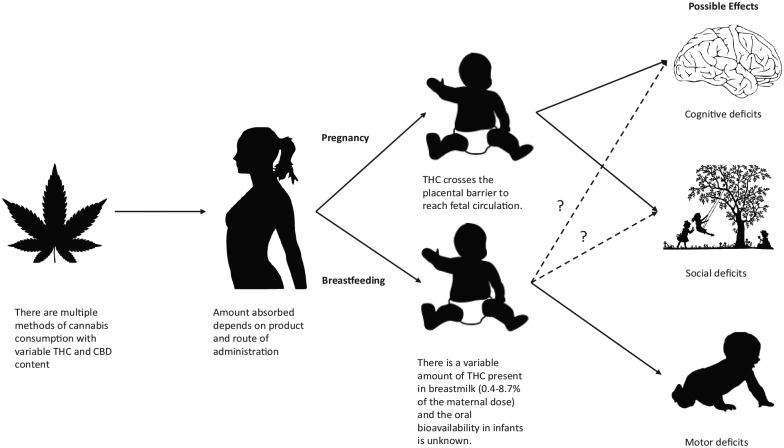
Results: This review combines the relevant pharmacological, pharmacokinetic and clinical evidence for the effects of cannabis in this special patient population. The literature demonstrates that some of the constituents of cannabis can reach children in utero and through breastmilk. Given that Δ⁹-tetrahydrocannabinol can be present in breastmilk as quickly as 1 hour after consumption and last up to 6 days, it may not be possible to use cannabis and avoid infant exposure. There is evidence that this exposure may result in cognitive, social and motor defects. Some of these effects may be long term, lasting years. The pharmacist must be able to educate and screen patients regarding marijuana use in pregnancy and breastfeeding, with the ultimate aim of harm reduction.
© The Author(s) 2020.
Conflict of interest statement
Conflict of Interest:None of the authors have any conflicts to declare.
Figures
References
-
- Statistics Canada. National Cannabis Survey 3rd quarter 2018. Ottawa (ON): Government of Canada; 2018. Available: https://www150.statcan.gc.ca/n1/en/daily-quotidien/180418/dq180418b-eng.... (accessed Nov. 6, 2018).
-
- MacCallum CA, Russo EB. Practical considerations in medical cannabis administration and dosing. Eur J Intern Med 2018;49:12-9. - PubMed
-
- Perez-Reyes M, Wall ME. Presence of Δ⁹-tetrahydrocannabinol in human milk. N Engl J Med 1982;307(13):819-20. - PubMed
-
- Best Start Resource Centre. A30-E—Risk of cannabis on fertility, pregnancy, breastfeeding and parenting. Toronto (ON): Health Nexus; 2017. Available: https://www.beststart.org/cgi-bin/commerce.cgi?search=action&category=A0... (accessed Nov. 6, 2018).
Publication types
LinkOut - more resources
Full Text Sources