Review
. 2020 Feb;9(Suppl 1):S120-S132.
doi: 10.21037/tlcr.2019.12.15.

Peritoneal mesothelioma

Affiliations
Review

Peritoneal mesothelioma

Alissa Greenbaum et al. Transl Lung Cancer Res. 2020 Feb.

Abstract

Malignant peritoneal mesothelioma (MPM) is a rare and lethal disease of the peritoneal lining, with high variability in biologic aggressiveness. Morbidity and mortality of the disease are related to progressive locoregional effects within the abdominal cavity, such as distention, pain, early satiety, and decreased oral intake that can ultimately lead to bowel obstruction and cachexia. The standard of care for patients with resectable disease remains cytoreductive surgery and hyperthermic intraperitoneal chemotherapy (CRS-HIPEC), with potential survival outcomes greater than 5 years in appropriately selected patients. Patients with inoperable MPM can be offered systemic treatment, although the disease is usually refractory to standard chemotherapic regimens. Patients with MPM should be treated at high volume centers with strong consideration for inclusion in tumor registries and clinical trials. In 2020, research will continue to explore promising genetic and immunologic targets and focus on refinement of surgical methods to optimize CRS-HIPEC approaches.

Keywords: Mesothelioma; cytoreductive surgery (CRS); peritoneal malignancy.


Conflict of interest statement

Conflicts of Interest: The authors have no conflicts of interest to declare.

Figures
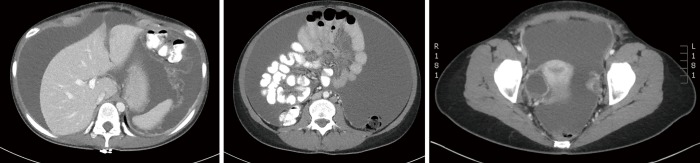
Figure 1
Figure 1
Favorable findings of peritoneal mesothelioma on CT, with diffuse ascites as primary manifestation. Additional findings including smooth contour of the liver surrounded by ascites (top panel), free floating small bowel and mesentery (middle) and ascites with right ovarian abnormality within the pelvis (lower). CT, computed tomography.
Figure 2
Figure 2
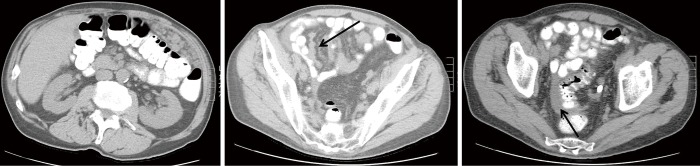
Unfavorable findings of peritoneal mesothelioma on CT with omental caking in the left upper quadrant (left panel), implants within the small bowel mesentery (arrow, middle) small amount of ascites only within the pelvis, surrounding sigmoid colon (arrow, right). CT, computed tomography.
Figure 3
Figure 3
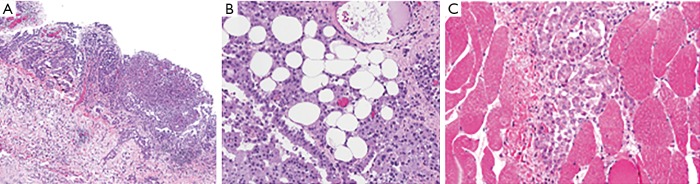
Histopathology demonstrating depth of MPM invasion. Increasing depth of invasion into (A) stroma, (B) fat and (C) adjacent structures correlates to worse prognosis. With permission from Elsevier (21). Hematoxylin and eosin staining, panel (A) is 40× and panels (B,C) are 100×. MPM, malignant peritoneal mesothelioma.
Figure 4
Figure 4
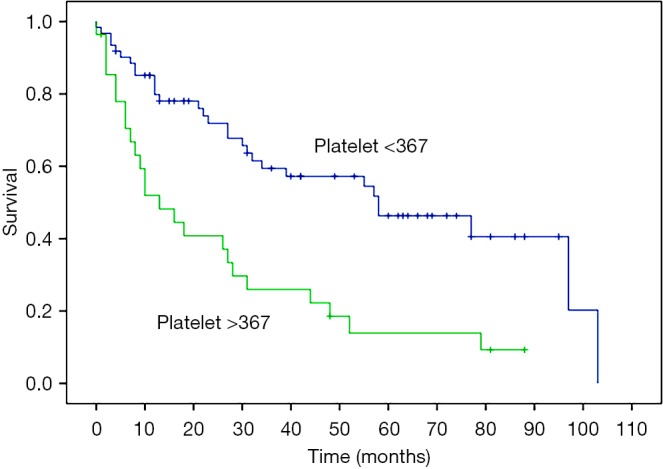
Preoperative thrombocytosis (>367/mm3) in with patients with MPM portends a significantly shorter actuarial OS vs. a normal platelet count (≤367/mm3). With permission from Elsevier (30). MPM, malignant peritoneal mesothelioma; OS, overall survival.

References

    1. Li CY, Alexander HR, Jr. Peritoneal metastases from malignant mesothelioma. Surg Oncol Clin N Am 2018;27:539-49. 10.1016/j.soc.2018.02.010 - DOI - PubMed
    1. Alexander HR, Jr, Burk AP. Diagnosis and management of patients with malignant peritoneal mesothelioma. J Gastrointest Oncol 2016;7:79-86. - PMC - PubMed
    1. Sugarbaker PH. Update on the management of malignant peritoneal mesothelioma. Transl Lung Cancer Res 2018;7:599-608. 10.21037/tlcr.2018.08.03 - DOI - PMC - PubMed
    1. Enomoto LM, Shen P, Levine EA, et al. Cytoreductive surgery with hyperthermic intraperitoneal chemotherapy for peritoneal mesothelioma: patient selection and special considerations. Cancer Manag Res 2019;11:4231-41. 10.2147/CMAR.S170300 - DOI - PMC - PubMed
    1. Miura JT, Johnston FM, Gamblin TC, et al. Current trends in the management of malignant peritoneal mesothelioma. Ann Surg Oncol 2014;21:3947-53. 10.1245/s10434-014-3803-6 - DOI - PubMed