Review
. 2020 Jun 1;143(6):1651-1673.
doi: 10.1093/brain/awaa022.

The multifaceted role of kinases in amyotrophic lateral sclerosis: genetic, pathological and therapeutic implications

Affiliations
Review

The multifaceted role of kinases in amyotrophic lateral sclerosis: genetic, pathological and therapeutic implications

Wenting Guo et al. Brain. .

Abstract

Amyotrophic lateral sclerosis is the most common degenerative disorder of motor neurons in adults. As there is no cure, thousands of individuals who are alive at present will succumb to the disease. In recent years, numerous causative genes and risk factors for amyotrophic lateral sclerosis have been identified. Several of the recently identified genes encode kinases. In addition, the hypothesis that (de)phosphorylation processes drive the disease process resulting in selective motor neuron degeneration in different disease variants has been postulated. We re-evaluate the evidence for this hypothesis based on recent findings and discuss the multiple roles of kinases in amyotrophic lateral sclerosis pathogenesis. We propose that kinases could represent promising therapeutic targets. Mainly due to the comprehensive regulation of kinases, however, a better understanding of the disturbances in the kinome network in amyotrophic lateral sclerosis is needed to properly target specific kinases in the clinic.

Keywords: amyotrophic lateral sclerosis; kinase; motor neuron; phosphorylation.


Figures

Figure 1
Figure 1
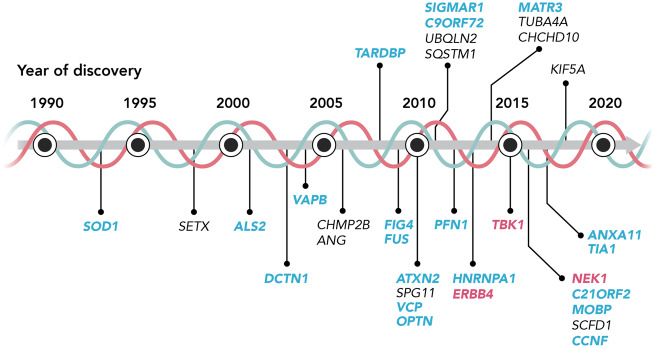
ALS genetics, the emerging role of kinases. Chronological overview of the discovery of gene mutations involved in ALS. Genes in blue are ALS genes of which the gene product could interact with kinases pathologically. Genes in pink are encoding kinases. Each of these gene mutations is reported in more than one ALS-affected family, or in multiple, unrelated cases of sporadic ALS.
Figure 2
Figure 2
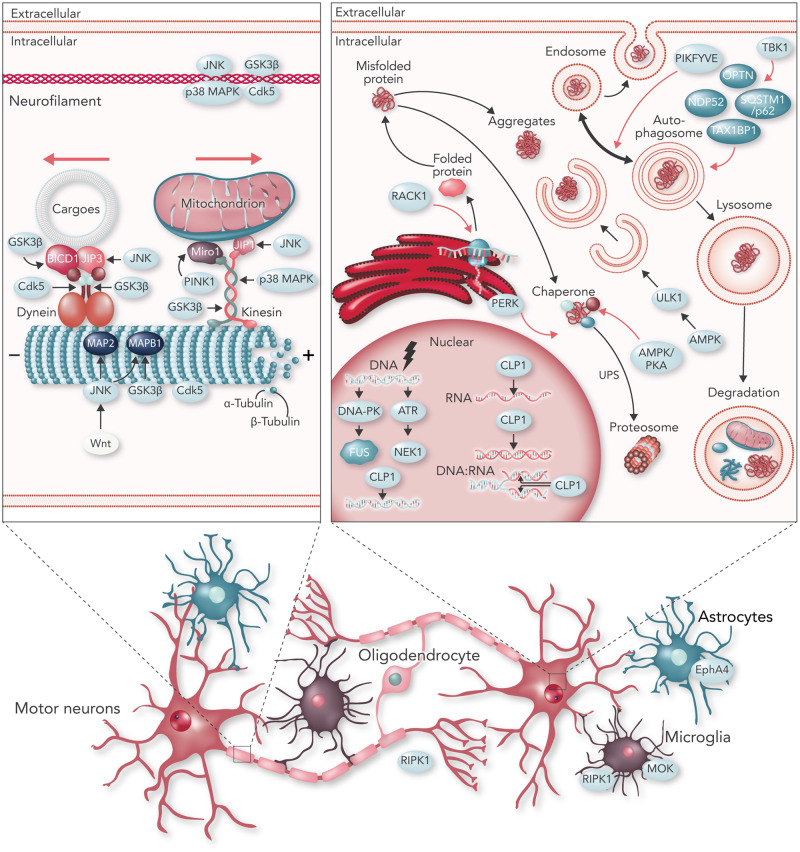
Kinases in neurodegenerative processes involved in ALS. Schematic overview of kinases involved in different ALS pathophysiological processes. Names identified in light blue ovals indicate kinases. Names in dark blue ovals indicate adaptors that interact with kinases. Top left: Examples of kinases regulating axonal transport by interacting with subunits of the transport process including dynein (retrograde transport), kinesin (anterograde transport) and their adaptors, microtubules, neurofilaments, and cargo specific-adaptors. Bottom: Examples of kinases activated in non-neuronal cells including astrocytes, microglia and oligodendrocytes. Top right: Examples of kinases regulating proteostasis including protein synthesis through ribosomes on the endoplasmic reticulum (ER), the ubiquitin-proteasome system (UPS) and autophagy by direct or indirect phosphorylation. Examples of kinases activated by DNA damage and involved in RNA-related processes are also shown.
Figure 3
Figure 3
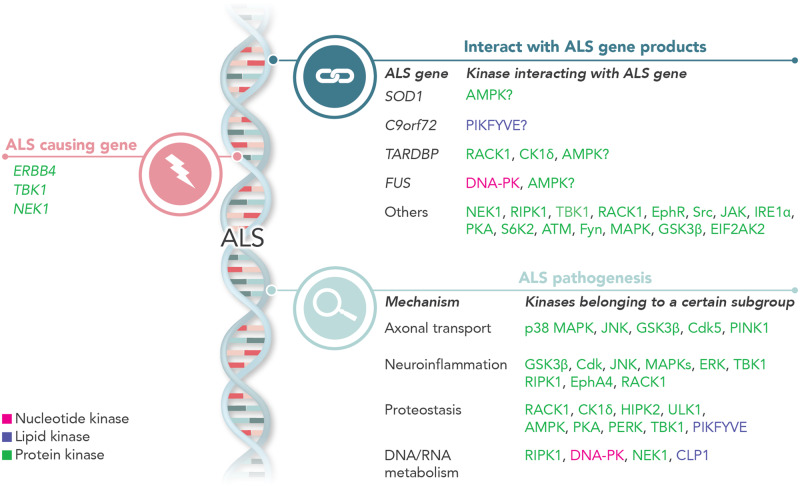
The multifaceted role of kinases in ALS. Overview of the different types of kinases involved in ALS genetics and pathophysiology. These include protein kinases (green), lipid kinases (purple) and nucleotide kinases (pink).

References

    1. Ackerley S, Grierson AJ, Banner S, Perkinton MS, Brownlees J, Byers HL, et al. p38alpha stress-activated protein kinase phosphorylates neurofilaments and is associated with neurofilament pathology in amyotrophic lateral sclerosis. Mol Cell Neurosci 2004; 26: 354–64. - PubMed
    1. Ahmad L, Zhang S-Y, Casanova J-L, Sancho-Shimizu V.. Human TBK1: a Gatekeeper of Neuroinflammation. Trends Mol. Med 2016; 22: 511–27. - PMC - PubMed
    1. Ahn S-W, Jeon GS, Kim M-J, Shon J-H, Kim J-E, Shin J-Y, et al. Neuroprotective effects of JGK-263 in transgenic SOD1-G93A mice of amyotrophic lateral sclerosis. J Neurol Sci 2014; 340: 112–6. - PubMed
    1. Al-Chalabi A, Allen C, Counsell C, Farrin A, Dickie B, Kelly J, et al. Lithium in patients with amyotrophic lateral sclerosis (LiCALS): a phase 3 multicentre, randomised, double-blind, placebo-controlled trial. Lancet Neurol 2013; 12: 339–45. - PMC - PubMed
    1. Alexander EJ, Ghanbari Niaki A, Zhang T, Sarkar J, Liu Y, Nirujogi RS, et al. Ubiquilin 2 modulates ALS/FTD-linked FUS–RNA complex dynamics and stress granule formation. Proc Natl Acad Sci U S A 2018; 115: E11485–94. - PMC - PubMed

Publication types

Substances