


Effect of the "Recruitment" Maneuver on Respiratory Mechanics in Laparoscopic Sleeve Gastrectomy Surgery
- PMID: 32207048
- PMCID: PMC7224081
- DOI: 10.1007/s11695-020-04551-y
Effect of the "Recruitment" Maneuver on Respiratory Mechanics in Laparoscopic Sleeve Gastrectomy Surgery
Abstract
Purpose: LSG surgery is used for surgical treatment of morbid obesity. Obesity, anesthesia, and pneumoperitoneum cause reduced pulmoner functions and a tendency for atelectasis. The alveolar "recruitment" maneuver (RM) keeps airway pressure high, opening alveoli, and increasing arterial oxygenation. The aim of our study is to research the effect on respiratory mechanics and arterial blood gases of performing the RM in LSG surgery.
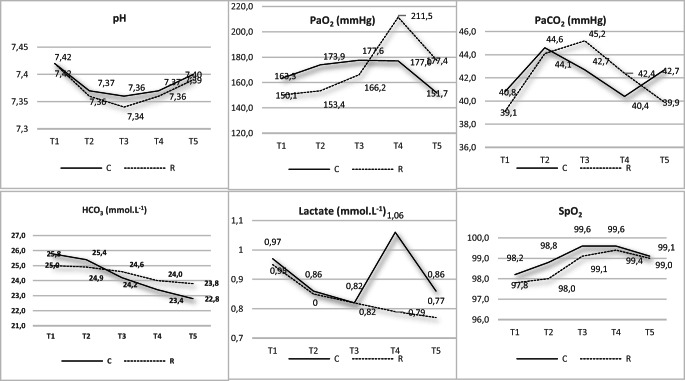
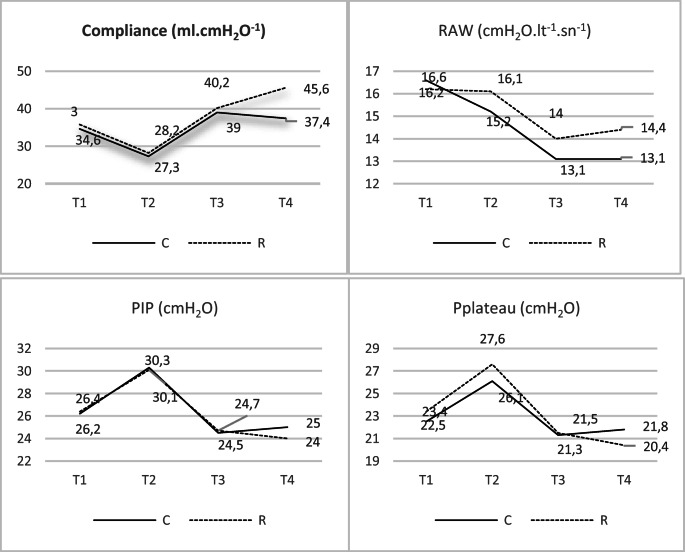
Materials and methods: Sixty patients undergoing LSG surgery were divided into two groups (n = 30) Patients in group R had the RM performed 5 min after desufflation with 100% oxygen, 40 cmH2O pressure for 40 s. Group C had standard mechanical ventilation. Assessments of respiratory mechanics and arterial blood gases were made in the 10th min after induction (T1), 10th min after insufflation (T2), 5th min after desufflation (T3), and 15th min after desufflation (T4). Arterial blood gases were assessed in the 30th min (T5) in the postoperative recovery unit.
Results: In group R, values at T5, PaO2 were significantly high, while PaCO2 were significantly low compared with group C. Compliance in both groups reduced with pneumoperitoneum. At T4, the compliance in the recruitment group was higher. In both groups, there was an increase in PIP with pneumoperitoneum and after desufflation this was identified to reduce to levels before pneumoperitoneum.
Conclusion: Adding the RM to PEEP administration for morbidly obese patients undergoing LSG surgery is considered to be effective in improving respiratory mechanics and arterial blood gas values and can be used safely.
Keywords: Laparoscopic sleeve gastrectomy; PEEP; Recruitment maneuver.
Conflict of interest statement
The authors declare no conflicts of interest.
Figures
References
-
- WHO. Obesity Report, Updated: http://www.who.int/mediacentre/factsheets/fs311/en/. 2013
-
- Colquitt JL, Picot J, Loveman E, Clegg AJ. Surgery for obesity. Cochrane Database Syst Rev. 2009;2:CD003641. - PubMed
MeSH terms
LinkOut - more resources
Full Text Sources
Medical
