Diagnostic Yield of Newborn Screening for Biliary Atresia Using Direct or Conjugated Bilirubin Measurements
- PMID: 32207797
- PMCID: PMC7093763
- DOI: 10.1001/jama.2020.0837
Diagnostic Yield of Newborn Screening for Biliary Atresia Using Direct or Conjugated Bilirubin Measurements
Abstract
Importance: Treating biliary atresia in newborns earlier can delay or prevent the need for liver transplant; however, treatment typically occurs later because biliary atresia is difficult to detect during its early stages.
Objective: To determine the diagnostic yield of newborn screening for biliary atresia with direct or conjugated bilirubin measurements and to evaluate the association of screening implementation with clinical outcomes.
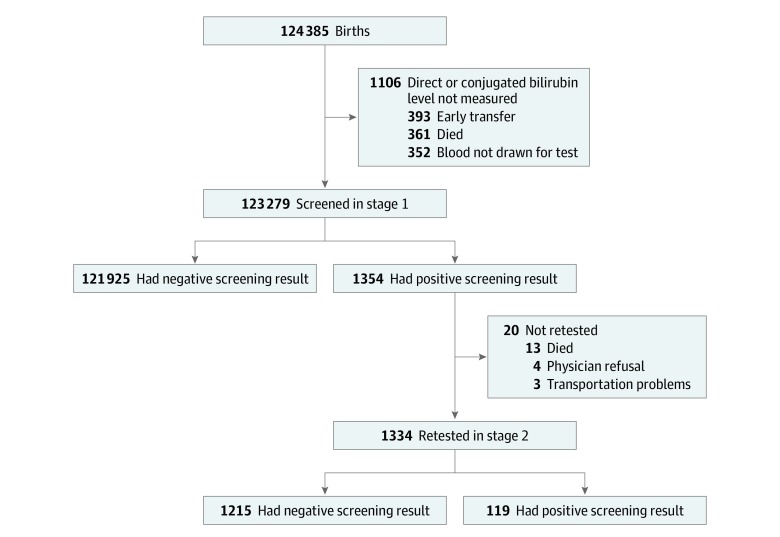
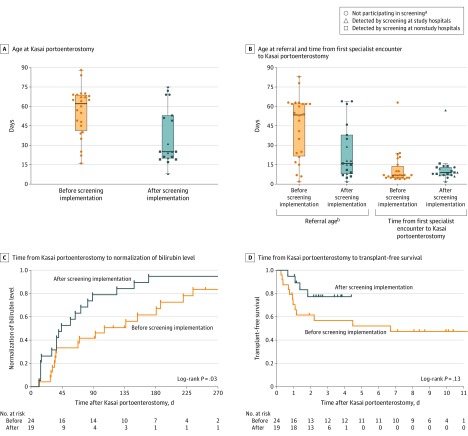
Design, setting, and participants: A cross-sectional screening study of 124 385 infants born at 14 Texas hospitals between January 2015 and June 2018; and a pre-post study of 43 infants who underwent the Kasai portoenterostomy as treatment for biliary atresia at the region's largest pediatric hepatology center before (January 2008-June 2011) or after (January 2015-June 2018) screening implementation. Final follow-up occurred on July 15, 2019.
Exposures: Two-stage screening with direct or conjugated bilirubin measurements. In stage 1, all newborns were tested within the first 60 hours of life, with a positive screening result defined as bilirubin levels exceeding derived 95th percentile reference intervals. In stage 2, infants who had a positive screening result in stage 1 were retested at or before the 2-week well-child visit, with a positive screening result defined as bilirubin levels greater than the stage 1 result or greater than 1 mg/dL.
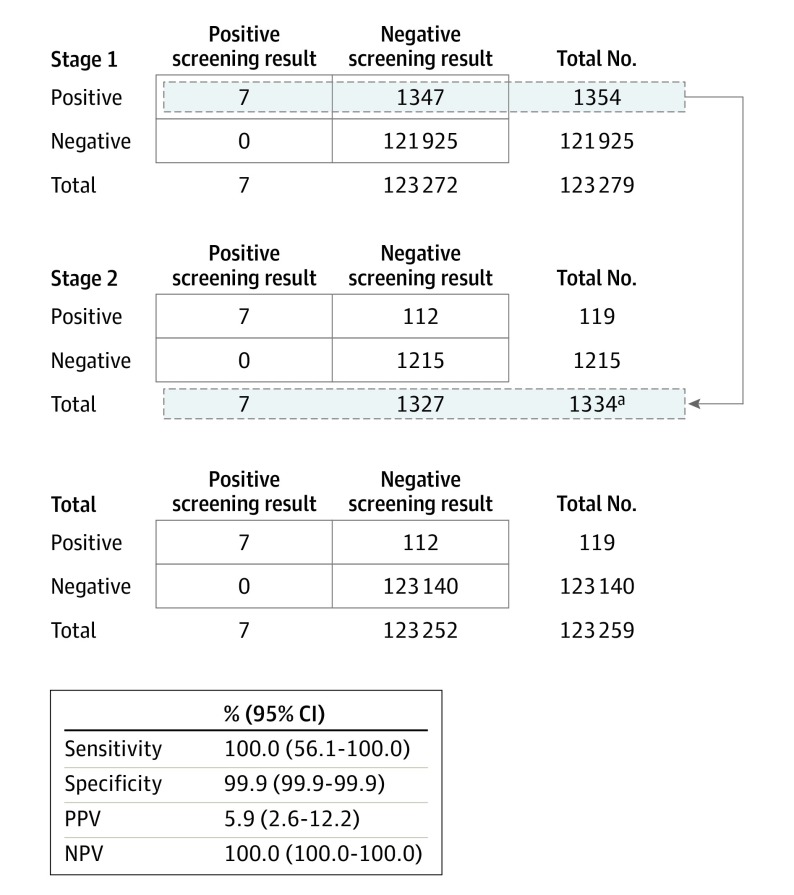
Main outcomes and measures: The primary outcomes of the screening study were sensitivity, specificity, positive predictive value, and negative predictive value based on infants testing positive in both stages. The reference standard was biliary atresia diagnosed at the region's pediatric hepatology centers. The primary outcome of the pre-post study was the age infants underwent the Kasai portoenterostomy for treatment of biliary atresia.
Results: Of 124 385 newborns in the screening study, 49.2% were female, 87.6% were of term gestational age, 70.0% were white, and 48.1% were Hispanic. Screening identified the 7 known infants with biliary atresia with a sensitivity of 100% (95% CI, 56.1%-100.0%), a specificity of 99.9% (95% CI, 99.9%-99.9%), a positive predictive value of 5.9% (95% CI, 2.6%-12.2%), and a negative predictive value of 100.0% (95% CI, 100.0%-100.0%). In the pre-post study, 24 infants were treated before screening implementation and 19 infants were treated after screening implementation (including 6 of 7 from the screening study, 7 from screening at nonstudy hospitals, and 6 from referrals because of clinical symptoms). The age infants underwent the Kasai portoenterostomy was significantly younger after screening was implemented (mean age, 56 days [SD, 19 days] before screening implementation vs 36 days [SD, 22 days] after screening implementation; between-group difference, 19 days [95% CI, 7-32 days]; P = .004).
Conclusions and relevance: Newborn screening with direct or conjugated bilirubin measurements detected all known infants with biliary atresia in the study population, although the 95% CI around the sensitivity estimate was wide and the study design did not ensure complete ascertainment of false-negative results. Research is needed in larger populations to obtain more precise estimates of diagnostic yield and to better understand the clinical outcomes and cost-effectiveness of this screening approach.
Conflict of interest statement
Figures
Comment in
-
Newborn Screening for Biliary Atresia.JAMA. 2020 Mar 24;323(12):1137-1138. doi: 10.1001/jama.2020.2727. JAMA. 2020. PMID: 32207779 No abstract available.
References
Publication types
MeSH terms
Substances
Grants and funding
LinkOut - more resources
Full Text Sources
Other Literature Sources
Medical