


Monotherapy versus combination therapy of statin and renin-angiotensin system inhibitor in ST-segment elevation myocardial infarction
- PMID: 32207841
- PMCID: PMC8890409
- DOI: 10.5603/CJ.a2020.0035
Monotherapy versus combination therapy of statin and renin-angiotensin system inhibitor in ST-segment elevation myocardial infarction
Abstract
Background: The beneficial effects of statin and renin-angiotensin system inhibitor (RASI) are well-known. In this retrospective cohort study, 2-year clinical outcomes were compared between monotherapy and combination therapy with statin and RASI in ST-segment elevation myocardial infarction (STEMI) patients after stent implantation.
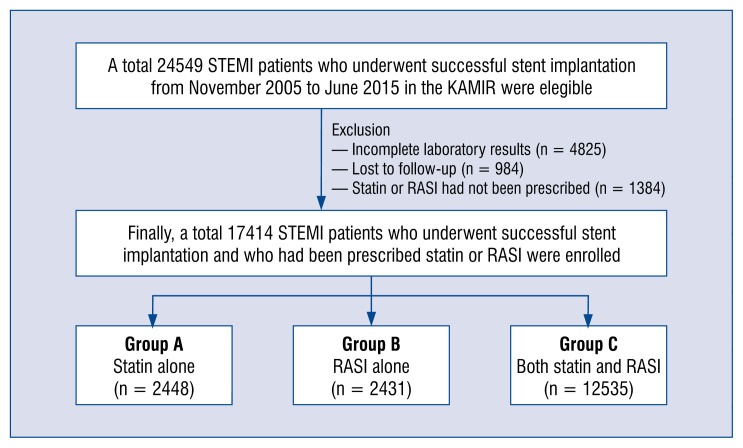
Methods: A total of 17,414 STEMI patients were enrolled and divided into the three groups (group A: 2448 patients, statin alone; group B: 2431 patients, RASI alone; and group C: 12,535 patients, both statin and RASI). The principal clinical endpoint was the occurrence of major adverse cardiac events (MACEs) defined as all-cause death, recurrent myocardial infarction, and any repeat revascularization.
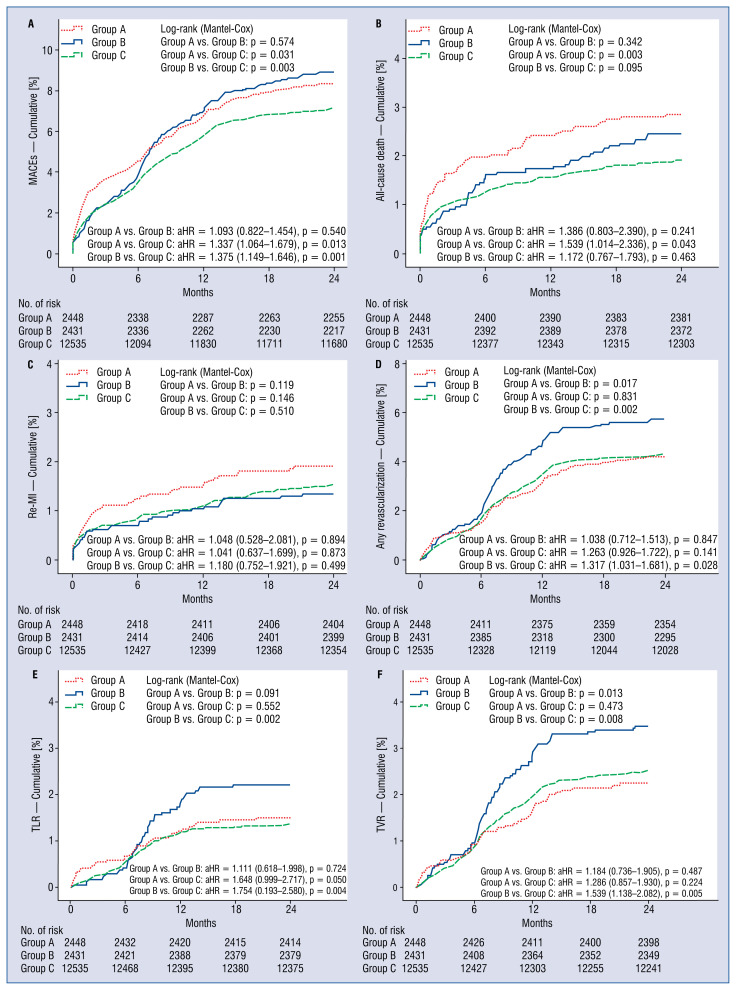
Results: After adjustment, the cumulative incidences of MACEs in group A (adjusted hazard ratio [aHR] 1.337; 95% confidence interval [CI] 1.064-1.679; p = 0.013) and in group B (aHR 1.375; 95% CI 1.149-1.646; p = 0.001) were significantly higher than in group C. The cumulative incidence of all-cause death in group A was significantly higher than that in group C (aHR 1.539; 95% CI 1.014-2.336; p = 0.043). The cumulative incidences of any repeat revascularization (aHR 1.317; 95% CI 1.031-1.681; p = 0.028), target lesion vascularization, and target vessel vascularization in group B were significantly higher than in group C.
Conclusions: A statin and RASI combination therapy significantly reduced the cumulative incidence of MACEs compared with a monotherapy of these drugs. Moreover, the combination therapy showed a reduced all-cause death rate compared with statin monotherapy, and a decreased repeat revascularization rate compared with RASI monotherapy.
Keywords: ST-segment elevation myocardial infarction; long-term outcome; renin–angiotensin system; statin.
Conflict of interest statement
Figures
References
-
- Baigent C, Keech A, Kearney PM, et al. Cholesterol Treatment Trialists’ (CTT) Collaborators. Efficacy and safety of cholesterol-lowering treatment: prospective meta-analysis of data from 90,056 participants in 14 randomised trials of statins. Lancet. 2005;366(9493):1267–1278. doi: 10.1016/S0140-6736(05)67394-1. - DOI - PubMed
-
- Ibanez B, James S, Agewall S, et al. ESC Scientific Document Group. 2017 ESC Guidelines for the management of acute myocardial infarction in patients presenting with ST-segment elevation: The Task Force for the management of acute myocardial infarction in patients presenting with ST-segment elevation of the European Society of Cardiology (ESC) Eur Heart J. 2018;39(2):119–177. doi: 10.1093/eurheartj/ehx393. - DOI - PubMed
-
- O’Gara PT, Kushner FG, Ascheim DD, et al. 2013 ACCF/AHA guideline for the management of ST-elevation myocardial infarction: a report of the American College of Cardiology Foundation/American Heart Association Task Force on Practice Guidelines. J Am Coll Cardiol. 2013;61(4):e78–e7.e140. doi: 10.1016/j.jacc.2012.11.019. - DOI - PubMed
Publication types
MeSH terms
Substances
LinkOut - more resources
Full Text Sources
Medical
