


Post-traumatic osteoarthritis following ACL injury
- PMID: 32209130
- PMCID: PMC7092615
- DOI: 10.1186/s13075-020-02156-5
Post-traumatic osteoarthritis following ACL injury
Abstract
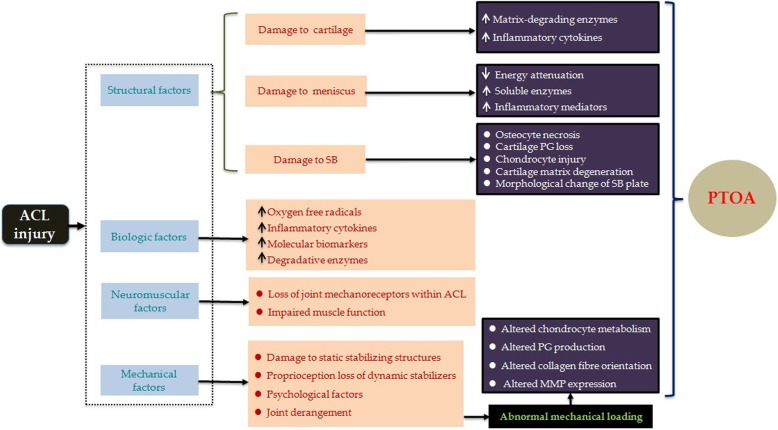
Post-traumatic osteoarthritis (PTOA) develops after joint injury. Specifically, patients with anterior cruciate ligament (ACL) injury have a high risk of developing PTOA. In this review, we outline the incidence of ACL injury that progresses to PTOA, analyze the role of ACL reconstruction in preventing PTOA, suggest possible mechanisms thought to be responsible for PTOA, evaluate current diagnostic methods for detecting early OA, and discuss potential interventions to combat PTOA. We also identify important directions for future research. Although much work has been done, the incidence of PTOA among patients with a history of ACL injury remains high due to the complexity of ACL injury progression to PTOA, the lack of sensitive and easily accessible diagnostic methods to detect OA development, and the limitations of current treatments. A number of factors are thought to be involved in the underlying mechanism, including structural factors, biological factors, mechanical factors, and neuromuscular factor. Since there is a clear "start point" for PTOA, early detection and intervention is of great importance. Currently, imaging modalities and specific biomarkers allow early detection of PTOA. However, none of them is both sensitive and easily accessible. After ACL injury, many patients undergo surgical reconstruction of ACL to restore joint stability and prevent excessive loading. However, convincing evidence is still lacking for the superiority of ACL-R to conservative management in term of the incidence of PTOA. As for non-surgical treatment such as anti-cytokine and chemokine interventions, most of them are investigated in animal studies and have not been applied to humans. A complete understanding of mechanisms to stratify the patients into different subgroups on the basis of risk factors is critical. And the improvement of standardized and quantitative assessment techniques is necessary to guide intervention. Moreover, treatments targeted toward different pathogenic pathways may be crucial to the management of PTOA in the future.
Keywords: Anterior cruciate ligament injury; Intervention; Mechanism; Post-traumatic osteoarthritis.
Conflict of interest statement
The authors declare that they have no competing interests.
Figures
References
-
- Carbone A, Rodeo S. Review of current understanding of post-traumatic osteoarthritis resulting from sports injuries. J Orthop Res. 2017;35:397–405. - PubMed
-
- Riordan EA, Little C, Hunter D. Pathogenesis of post-traumatic OA with a view to intervention. Best Practic Res Clin Rheumatol. 2014;28:17–30. - PubMed
Publication types
MeSH terms
Substances
Grants and funding
LinkOut - more resources
Full Text Sources
Medical
Research Materials
