. 2020 Mar 24;10(3):e034253.
doi: 10.1136/bmjopen-2019-034253.

Towards defining the surgical workforce for children: a geospatial analysis in Brazil

Collaborators, Affiliations

Towards defining the surgical workforce for children: a geospatial analysis in Brazil

Thiago Augusto Hernandes Rocha et al. BMJ Open. .

Abstract

Objectives: The optimal size of the health workforce for children's surgical care around the world remains poorly defined. The goal of this study was to characterise the surgical workforce for children across Brazil, and to identify associations between the surgical workforce and measures of childhood health.

Design: This study is an ecological, cross-sectional analysis using data from the Brazil public health system (Sistema Único de Saúde).

Settings and participants: We collected data on the surgical workforce (paediatric surgeons, general surgeons, anaesthesiologists and nursing staff), perioperative mortality rate (POMR) and under-5 mortality rate (U5MR) across Brazil for 2015.

Primary and secondary outcome measures: We performed descriptive analyses, and identified associations between the workforce and U5MR using geospatial analysis (Getis-Ord-Gi analysis, spatial cluster analysis and linear regression models).

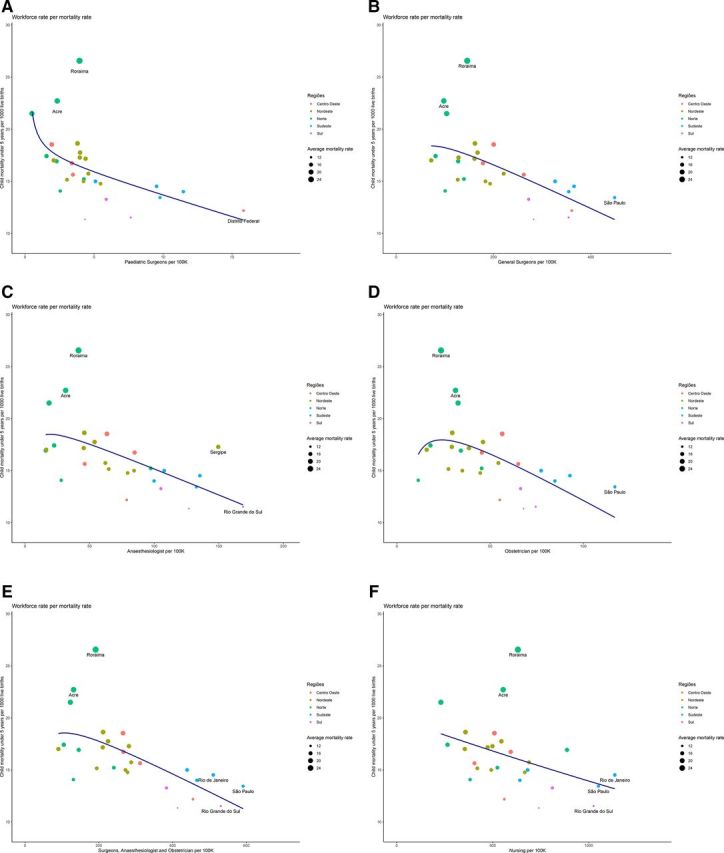
Findings: There were 39 926 general surgeons, 856 paediatric surgeons, 13 243 anaesthesiologists and 103 793 nurses across Brazil in 2015. The U5MR ranged from 11 to 26 deaths/1000 live births and the POMR ranged from 0.11-0.17 deaths/100 000 children across the country. The surgical workforce is inequitably distributed across the country, with the wealthier South and Southeast regions having a higher workforce density as well as lower U5MR than the poorer North and Northeast regions. Using linear regression, we found an inverse relationship between the surgical workforce density and U5MR. An U5MR of 15 deaths/1000 births across Brazil is associated with a workforce level of 5 paediatric surgeons, 200 surgeons, 100 anaesthesiologists or 700 nurses/100 000 children.

Conclusions: We found wide disparities in the surgical workforce and childhood mortality across Brazil, with both directly related to socioeconomic status. Areas of increased surgical workforce are associated with lower U5MR. Strategic investment in the surgical workforce may be required to attain optimal health outcomes for children in Brazil, particularly in rural regions.

Keywords: epidemiology; paediatrics; surgery.


Conflict of interest statement

Competing interests: None declared.

Figures
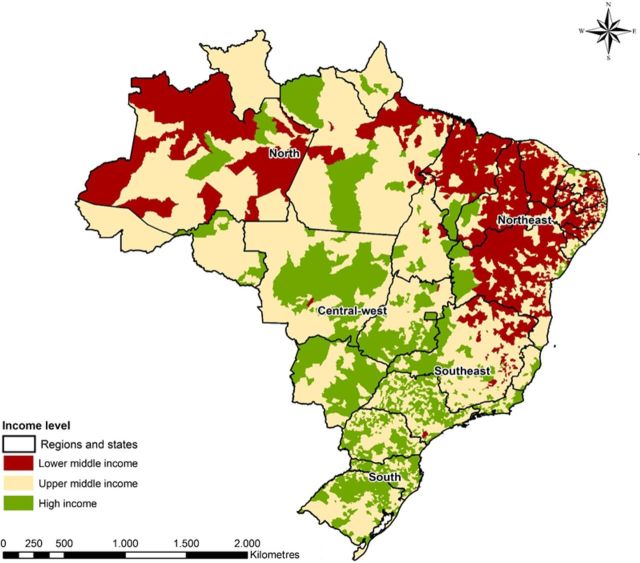
Figure 1
Figure 1
Income group distribution of Brazilian municipalities. socioeconomic data were extracted from Brazilian Institute of Geography and Statistic, and used with the Brazilian gross domestic product to classify municipalities according to income groups as defined by the world bank as high income, upper-middle income or lower-middle income. The map of Brazil was freely obtained in shapefile format through online access to the website of the Brazilian Institute of Geography and Statistics (https://mapas.ibge.gov.br/bases-e-referenciais/bases-cartograficas/malhas-digitais.html). Reprinted from Vissoci et al.
Figure 2
Figure 2
(A–F): Association between the density of the surgical workforce (weighted per 100 000 children) and under-5 mortality rate (U5MR, per 1000 live births) in each state across Brazil. Linear regression models were used to define associations between the workforce density and U5MR. The line resulting from each regression model was plotted using bivariate scatter plots. The size of each point in the graphic is proportional to the average U5MR for each state, with different colours used to summarise data by region.
Figure 3
Figure 3
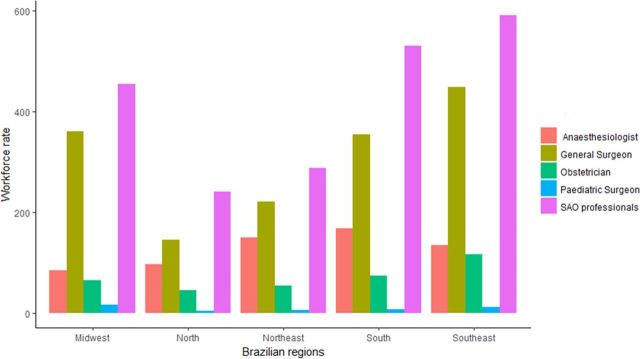
The density (rate) of the surgical workforce for each professional role across Brazil as summarised by region. The density of each professional role is weighted per 100 000 children. SAO, surgeons, anaesthesiologists or obstetricians.
Figure 4
Figure 4
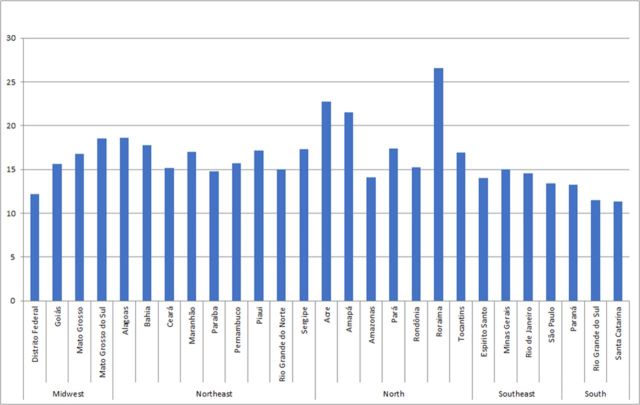
Under-5 mortality rates (per 1000 live births) across Brazil summarised by state as well as by region levels.
Figure 5
Figure 5
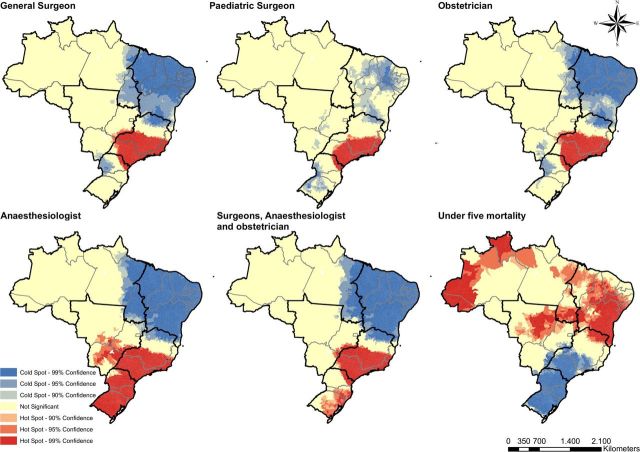
Spatial distribution of the surgical workforce density (weighted per 100 000 children) and under-5 mortality rate (U5MR, per 1000 live births) at the municipality level. hot spot cluster analysis of association between the surgical workforce density (weighted per 100 000 children) and U5MR (per 1000 live births) across Brazil using Getis-Ord-Gi analysis.17 hot spots (red areas) depict clusters of municipalities with adjacent municipalities with high values for a given indicator (workforce density or U5MR), and cold spots (blue areas) depict clusters with an adjacent low values regarding each indicator. Yellow areas mark locations where no clustering was observed. Note that the scatter plots are not adjusted for spatial autocorrelation.
Figure 6
Figure 6
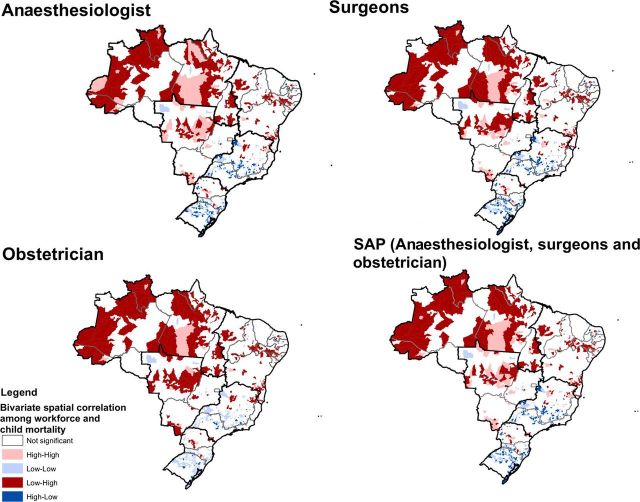
Association between the surgical workforce density (weighted per 100 000 children) and under-5 mortality rate (U5MR, per 1000 live births) across Brazil using spatial correlation analysis. High-high areas (red areas) depict clusters of municipalities with high values for workforce adjacent municipalities with high values for a U5MR, and low-low areas (blue areas) depict clusters with an adjacent low values regarding each indicator.

References

    1. Lopes MA, Almeida Álvaro Santos, Almada-Lobo B. Handling healthcare workforce planning with care: where do we stand? Hum Resour Health 2015;13:38 10.1186/s12960-015-0028-0 - DOI - PMC - PubMed
    1. Meara JG, Leather AJM, Hagander L, et al. Global surgery 2030: evidence and solutions for achieving health, welfare, and economic development. Lancet 2015;386:569–624. 10.1016/S0140-6736(15)60160-X - DOI - PubMed
    1. Holmer H, Lantz A, Kunjumen T, et al. Global distribution of surgeons, anaesthesiologists, and obstetricians. Lancet Glob Health 2015;3 Suppl 2:S9–11. 10.1016/S2214-109X(14)70349-3 - DOI - PubMed
    1. Rose J, Weiser TG, Hider P, et al. Estimated need for surgery worldwide based on prevalence of diseases: a modelling strategy for the who global health estimate. Lancet Glob Health 2015;3 Suppl 2:S13–20. 10.1016/S2214-109X(15)70087-2 - DOI - PMC - PubMed
    1. Goodman LF, St-Louis E, Yousef Y, et al. The global initiative for children's surgery: optimal resources for improving care. Eur J Pediatr Surg 2018;28:051–9. 10.1055/s-0037-1604399 - DOI - PubMed