


Sleep Duration Patterns in Early to Middle Adulthood and Subsequent Risk of Type 2 Diabetes in Women
- PMID: 32209646
- PMCID: PMC7245349
- DOI: 10.2337/dc19-2371
Sleep Duration Patterns in Early to Middle Adulthood and Subsequent Risk of Type 2 Diabetes in Women
Abstract
Objective: To identify sleep duration trajectories from early to middle adulthood and their associations with incident type 2 diabetes.
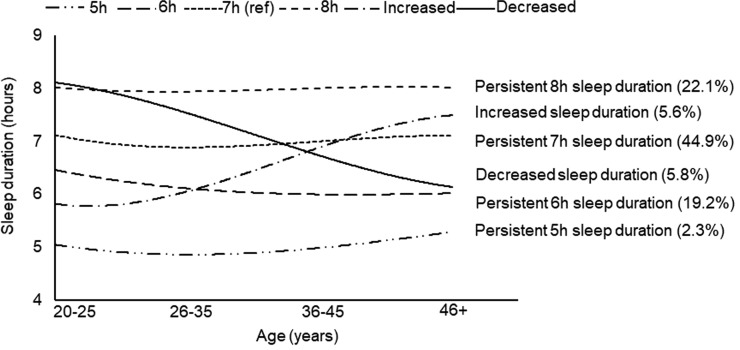
Research design and methods: Using a group-based modeling approach, we identified sleep duration trajectories based on sleep duration in ages 20-25, 26-35, 36-45, and 46+ years, which were retrospectively assessed in 2009 among 60,068 women from the Nurses' Health Study II (median age 54.9 years) who were free of diabetes, cardiovascular disease, and cancer. We investigated the prospective associations between sleep duration trajectories and diabetes risk (2009-2017) using multivariable Cox proportional hazards models.
Results: We documented 1,797 incident diabetes cases over a median follow-up of 7.8 years (442,437 person-years). Six sleep duration trajectories were identified: persistent 5-, 6-, 7-, or 8-h sleep duration and increased or decreased sleep duration. After multivariable adjustment for diabetes risk factors, compared with the persistent 7-h sleep duration group, the hazard ratio was 1.43 (95% CI 1.10, 1.84) for the 5-h group, 1.17 (1.04, 1.33) for the 6-h group, 0.96 (0.84, 1.10) for the 8-h group, 1.33 (1.09, 1.61) for the increased sleep duration group, and 1.32 (1.10, 1.59) for the decreased sleep duration group. Additional adjustment for time-updated comorbidities and BMI attenuated these associations, although a significantly higher risk remained in the decreased sleep duration group (1.24 [1.03, 1.50]).
Conclusions: Persistent short sleep duration or changes in sleep duration from early to middle adulthood were associated with higher risk of type 2 diabetes in later life. These associations were weaker after obesity and metabolic comorbidities were accounted for.
© 2020 by the American Diabetes Association.
Figures
References
-
- Okunowo O, Orimoloye HT, Bakre SA, Njesada NS, Solomon A. Age- and body weight-dependent association between sleep duration and hypertension in US adults: findings from the 2014-2017 National Health Interview Survey. Sleep Health 2019;5:509–513 - PubMed
-
- Shan Z, Ma H, Xie M, et al. Sleep duration and risk of type 2 diabetes: a meta-analysis of prospective studies. Diabetes Care 2015;38:529–537 - PubMed
Publication types
MeSH terms
Grants and funding
LinkOut - more resources
Full Text Sources
Medical
