Comparative Study
. 2020 Mar 24;11(2):e00351-20.
doi: 10.1128/mBio.00351-20.

Tailoring a Global Iron Regulon to a Uropathogen

Affiliations
Comparative Study

Tailoring a Global Iron Regulon to a Uropathogen

Rajdeep Banerjee et al. mBio. .

Abstract

Pathogenicity islands and plasmids bear genes for pathogenesis of various Escherichia coli pathotypes. Although there is a basic understanding of the contribution of these virulence factors to disease, less is known about variation in regulatory networks in determining disease phenotypes. Here, we dissected a regulatory network directed by the conserved iron homeostasis regulator, ferric uptake regulator (Fur), in uropathogenic E. coli (UPEC) strain CFT073. Comparing anaerobic genome-scale Fur DNA binding with Fur-dependent transcript expression and protein levels of the uropathogen to that of commensal E. coli K-12 strain MG1655 showed that the Fur regulon of the core genome is conserved but also includes genes within the pathogenicity/genetic islands. Unexpectedly, regulons indicative of amino acid limitation and the general stress response were also indirectly activated in the uropathogen fur mutant, suggesting that induction of the Fur regulon increases amino acid demand. Using RpoS levels as a proxy, addition of amino acids mitigated the stress. In addition, iron chelation increased RpoS to the same levels as in the fur mutant. The increased amino acid demand of the fur mutant or iron chelated cells was exacerbated by aerobic conditions, which could be partly explained by the O2-dependent synthesis of the siderophore aerobactin, encoded by an operon within a pathogenicity island. Taken together, these data suggest that in the iron-poor environment of the urinary tract, amino acid availability could play a role in the proliferation of this uropathogen, particularly if there is sufficient O2 to produce aerobactin.IMPORTANCE Host iron restriction is a common mechanism for limiting the growth of pathogens. We compared the regulatory network controlled by Fur in uropathogenic E. coli (UPEC) to that of nonpathogenic E. coli K-12 to uncover strategies that pathogenic bacteria use to overcome iron limitation. Although iron homeostasis functions were regulated by Fur in the uropathogen as expected, a surprising finding was the activation of the stringent and general stress responses in the uropathogen fur mutant, which was rescued by amino acid addition. This coordinated global response could be important in controlling growth and survival under nutrient-limiting conditions and during transitions from the nutrient-rich environment of the lower gastrointestinal (GI) tract to the more restrictive environment of the urinary tract. The coupling of the response of iron limitation to increased demand for amino acids could be a critical attribute that sets UPEC apart from other E. coli pathotypes.

Keywords: CFT073; Fur; RyhB; Sigma S; UPEC; iron regulation; metabolic adaptation; ppGpp.


Figures

FIG 1
FIG 1
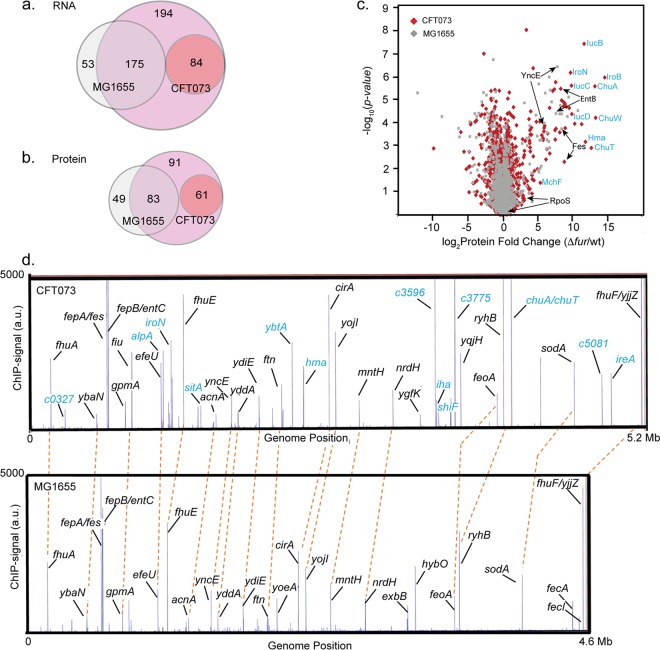
Genome-scale differences in Fur-dependent expression between UPEC strain CFT073 and commensal E. coli strain MG1655. E. coli strains were grown under anaerobic, iron-sufficient conditions. (a and b) Venn diagrams comparing the number of differentially expressed RNAs or proteins (>2-fold change in expression and P < 0.05) in the Δfur mutant strains relative to parent strains CFT073 and MG1655 (32). The region of overlap indicates RNAs (a) or proteins (b) that are regulated by Fur in both CFT073 (pink circle) and MG1655 (gray circle). Fur-regulated CFT073 genes that have no orthologs in strain MG1655 are indicated by the smaller dark pink circle. (c) Volcano plot comparing Fur-regulated proteins from strains CFT073 and MG1655. The x axis indicates the log2 fold change in protein levels in the Δfur mutant/wild-type (wt) strain of CFT073 (red) and MG1655 (gray). The y axis represents –log10 P values for individual proteins. Examples of CFT073-specific proteins (blue font) and orthologous proteins (black font) are indicated. (d) Comparison of genome-wide Fur binding from strains CFT073 and MG1655. The x axis indicates the genomic position of Fur ChIP-seq peaks from CFT073 (version NC_004431.1; top panel) or MG1655 (version U00096.2; bottom panel). The y axis indicates the normalized sequencing read count (in arbitrary units [a.u.]). Enrichment of Fur DNA binding is indicated by the height of the lines in each track. Examples of ChIP-seq peaks upstream of CFT073-specific genes are indicated in blue font, and conservation of ChIP-seq peaks upstream of orthologous genes (black font) is indicated by the orange dashed lines. A complete list of CFT073 ChIP-seq peaks is shown in Table S3 in the supplemental material.
FIG 2
FIG 2
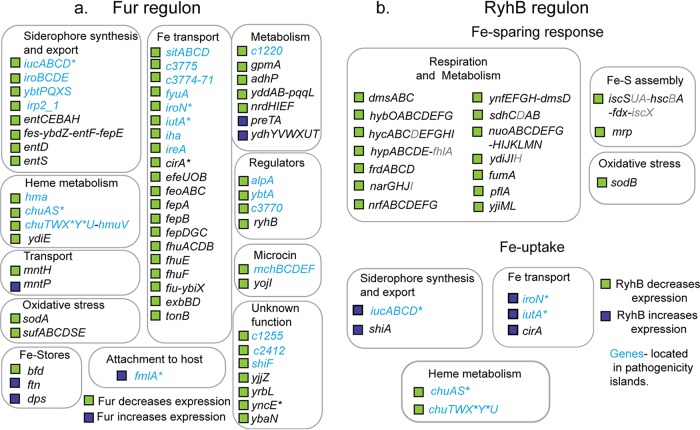
Role of Fur and RyhB in regulation of CFT073 genes differentially expressed in the fur mutant. (a) The CFT073 direct Fur regulon. CFT073 genes that had a Fur ChIP-seq peak in the 5′ upstream region and had >2-fold change (P < 0.05) in RNA-seq expression comparing the Δfur strain to the wild-type strain were assigned to the direct regulon. (b) CFT073 genes predicted to be regulated by RyhB. Operons in which at least one gene (indicated in black type) showed >2-fold change (P < 0.05) in expression comparing the Δfur strain to the wild-type strain and expression was at least partially reversed in ΔfurΔryhB strains indicated RyhB regulation; genes that showed a similar trend but did not meet the above-mentioned cutoff are marked in gray. Candidates for the iron-sparing response were operons decreased by RyhB, encoded iron-containing proteins, had predicted RyhB pairing sites, and regulation was conserved in MG1655 (32). Several iron uptake genes were regulated by both Fur and RyhB (indicated by an asterisk).
FIG 3
FIG 3
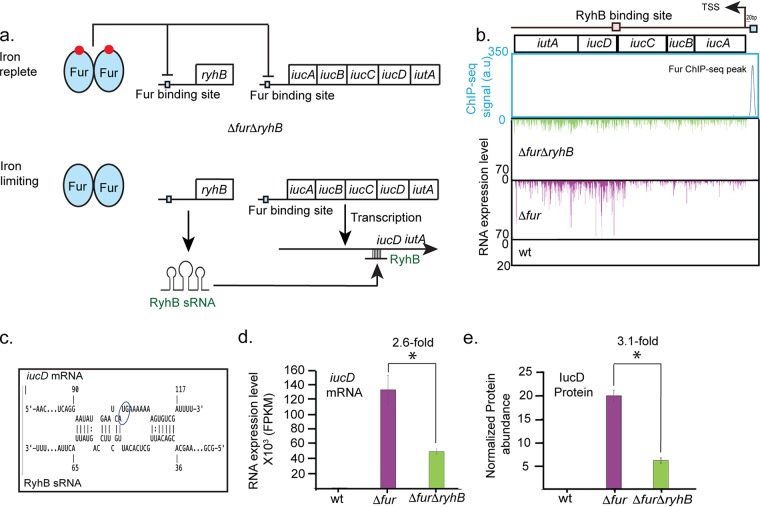
Both Fur and RyhB regulate aerobactin production. (a) Model depicting the independent roles of Fur in transcriptional repression of the iucABCD-iutA operon under iron-replete conditions and of RyhB in increasing RNA levels of the aerobactin biosynthesis gene iucD and its receptor iutA under iron-limiting conditions when Fur is inactivated. sRNA, small RNA. (b) Fur ChIP-seq peak and RNA-seq reads from the wild-type strain (not observed) and Δfur (purple) and Δfur ΔryhB (green) mutant strains were aligned to the CFT073 genome and visualized with the MochiView genome browser depicting the region of aerobactin biosynthetic operon, which is transcribed counterclockwise. TSS, transcription start site. (c) Computational prediction of a RyhB pairing site overlapping the start codon (circled) of iucD aligned with a segment of RyhB. The binding energy was predicted to be −10.9 kcal/mol. (d) Averaged iucD RNA-seq expression from the wild-type strain (undetectable) and Δfur (purple) and ΔfurΔryhB (green) mutant strains are taken from Table S1. (e) IucD protein abundance in the wild-type, Δfur, and ΔfurΔryhB strains were taken from Table S4. An asterisk indicates P of <0.05 as determined from a paired Student’s t test. Similar results were observed for iutA (Tables S1 and S4). FPKM, fragments per kilobase per million.
FIG 4
FIG 4
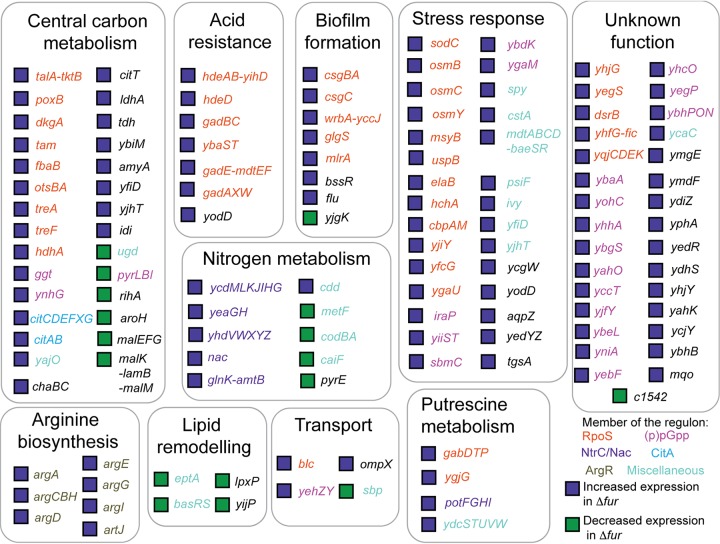
CFT073 genes indirectly regulated by Fur and RyhB include members of several stress regulons. CFT073 genes that lacked a Fur ChIP-seq peak and had >2-fold change (P < 0.05) in expression in comparing the Δfur strain to the wild-type strain but lacked an analogous change in expression in strain MG1655 are shown. In addition, a subset of these genes also showed regulation by RyhB but a putative RyhB binding site was lacking in the 5′ upstream region (Table S3). Operons that show >2-fold upregulation in Δfur strain (purple square) and those that show >2-fold downregulation in Δfur strain (green square) were clustered based on their functions and are colored differently according to which regulon they are part of.
FIG 5
FIG 5
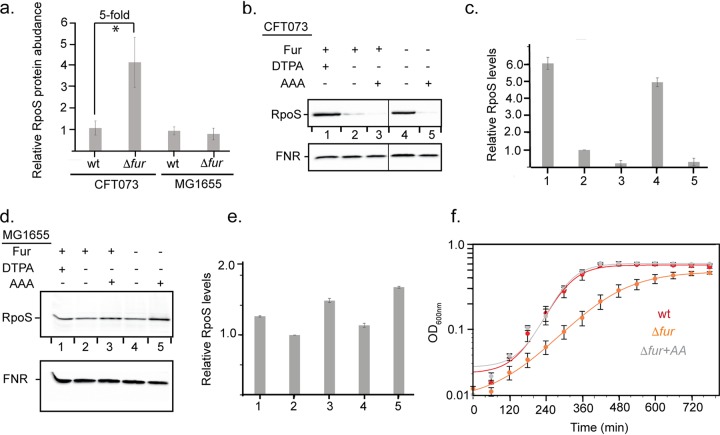
Amino acid addition to strain CFT073 mitigates stress induced by Fur inactivation. (a) RpoS protein abundance in wild-type and Δfur strains of CFT073 and MG1655 as measured by proteomics (Table S4) and analyzed by a paired Student’s t test. (b) RpoS and FNR Western blot analysis of strain CFT073 (lanes 1 to 3) and Δfur mutant (lanes 4 and 5) grown anaerobically in MOPS minimal medium supplemented with glucose and 1.0 mM DTPA (iron chelator; lane 1), no addition (lanes 2 and 5), 100 μM each of all 20 amino acids (AAA) (lanes 3 and 5). (c) Quantification of RpoS levels from Western blots in panel b. RpoS levels were normalized to FNR levels as an internal control and then scaled the wild-type RpoS value from lane 2 to one. (d) RpoS and FNR Western blot analysis of MG1655 (lanes 1 to 3) and MG1655Δfur (lanes 4 and 5). Lane 1, 1.0 mM DTPA; lanes 2 and 4, no addition; lane 3 and 5, 100 μM each of all 20 amino acids. (e) RpoS levels were quantified using the same method as for strain CFT073. (f) Amino acids can rescue the growth defect of the CFT073 Δfur mutant. Cell density was measured over time for the wild-type strain (red), Δfur mutant without (orange) or with all 20 amino acids (+AA; gray) under anaerobic growth conditions in MOPS minimal medium supplemented with glucose. The data represent mean values for three biological replicates, and the error bars represent the standard deviations.
FIG 6
FIG 6
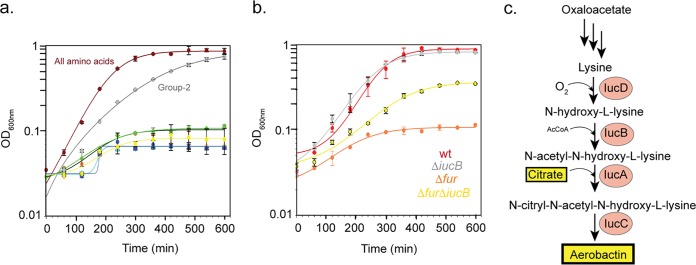
Elimination of Fur imparts a growth defect for strain CFT073 under aerobic conditions. (a) Growth of the Δfur mutant can be largely rescued by adding amino acids derived from oxaloacetate, a metabolic precursor to aerobactin. Cell density was measured for the CFT073Δfur strain grown under aerobic conditions in MOPS minimal medium supplemented with glucose and either all 20 amino acids (dark red) or six different mixtures of amino acids, which were grouped based upon common metabolic precursors. Relevant amino acids were added at a final medium concentration of 100 μM. Group 1 amino acids (Gln, Glu, Pro, and Arg) are derived from α-ketoglutarate (green). Group 2 amino acids (Asp, Lys, Thr, Ile, Met, and Asn) are derived from oxaloacetate (gray). Group 3 (Val, Ala, and Leu) are derived from pyruvate (orange). Group 4 amino acids (Ser, Cys, and Gly) are derived from 3-phosphoglycerate (cyan). Group 5 (His) is derived from phosphoribosyl pyrophosphate (blue). Group 6 amino acids (Trp, Tyr, and Phe) are derived from erythrose 4-phosphate and phosphoenolpyruvate (yellow). (b) Disrupting aerobactin biosynthesis partially recovers growth of CFT073 Δfur under aerobic conditions. Cell density was measured over time for the wild-type strain (red) and Δfur (orange), ΔiucB (gray), and Δfur ΔiucB (yellow) mutant strains under aerobic conditions in MOPS minimal medium supplemented with glucose. The data represent the mean values for three biological replicates, and the error bars represent the standard deviation. (c) Aerobactin biosynthesis. AcCoA, acetyl coenzyme A.
FIG 7
FIG 7
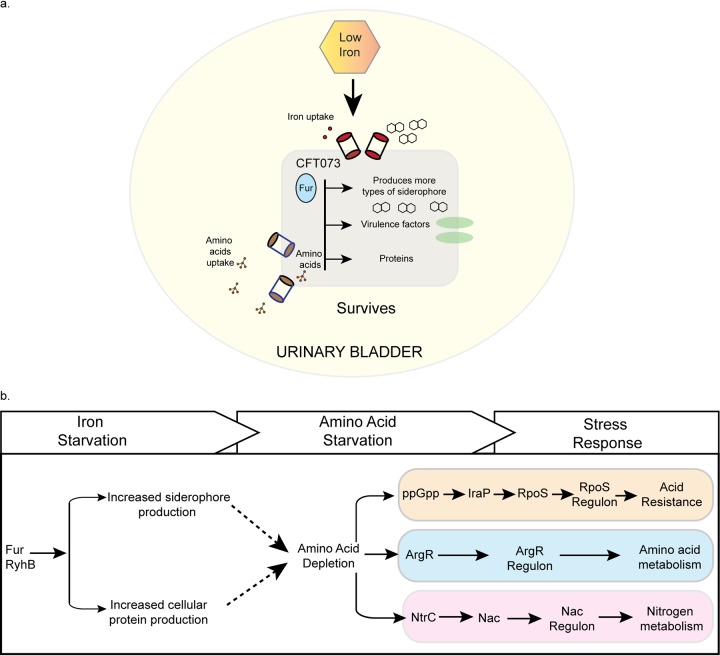
Induction of the Fur regulon indirectly induces stress responses. (a) Cellular overview of model showing how a low-iron environment of the urinary tract leads to induction of the Fur regulon, virulence factors (e.g., siderophores), and cellular proteins that give rise to an increased amino acid demand. Uropathogenic E. coli may offset its greater need for amino acid resources by transporting amino acids from the urinary tract. (b) A model describing our findings of the direct and indirect effects of Fur. Expression of the Fur regulon results in amino acid limitation, which in turn leads to induction of stress responses. The previously known genetic programs/regulons are shown in the right portion with the associated cause and effects.

References

    1. Wiles TJ, Kulesus RR, Mulvey MA. 2008. Origins and virulence mechanisms of uropathogenic Escherichia coli. Exp Mol Pathol 85:11–19. doi: 10.1016/j.yexmp.2008.03.007. - DOI - PMC - PubMed
    1. Schreiber HL, Spaulding CN, Dodson KW, Livny J, Hultgren SJ. 2017. One size doesn’t fit all: unraveling the diversity of factors and interactions that drive E. coli urovirulence. Ann Transl Med 5:28. doi: 10.21037/atm.2016.12.73. - DOI - PMC - PubMed
    1. Forsyth VS, Armbruster CE, Smith SN, Pirani A, Springman AC, Walters MS, Nielubowicz GR, Himpsl SD, Snitkin ES, Mobley HLT. 2018. Rapid growth of uropathogenic Escherichia coli during human urinary tract infection. mBio 9:e00186-18. - PMC - PubMed
    1. Lloyd AL, Henderson TA, Vigil PD, Mobley HL. 2009. Genomic islands of uropathogenic Escherichia coli contribute to virulence. J Bacteriol 191:3469–3481. doi: 10.1128/JB.01717-08. - DOI - PMC - PubMed
    1. Sabate M, Moreno E, Perez T, Andreu A, Prats G. 2006. Pathogenicity island markers in commensal and uropathogenic Escherichia coli isolates. Clin Microbiol Infect 12:880–886. doi: 10.1111/j.1469-0691.2006.01461.x. - DOI - PubMed

Publication types

MeSH terms