RAS, wanted dead or alive: Advances in targeting RAS mutant cancers
- PMID: 32209699
- PMCID: PMC7393681
- DOI: 10.1126/scisignal.aay6013
RAS, wanted dead or alive: Advances in targeting RAS mutant cancers
Abstract
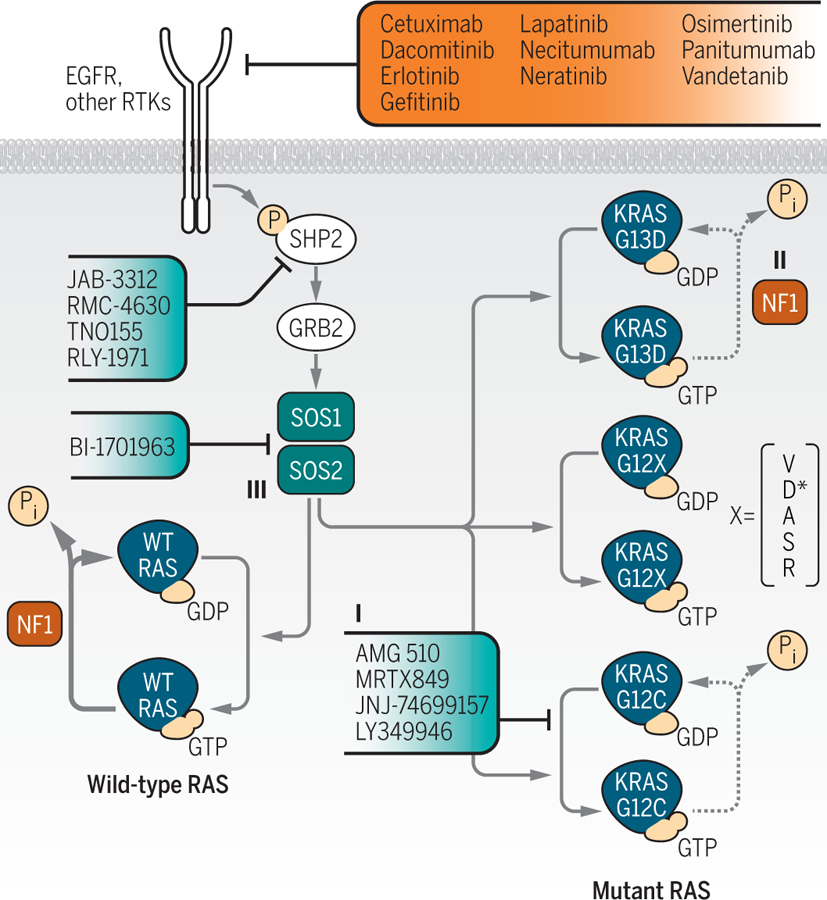
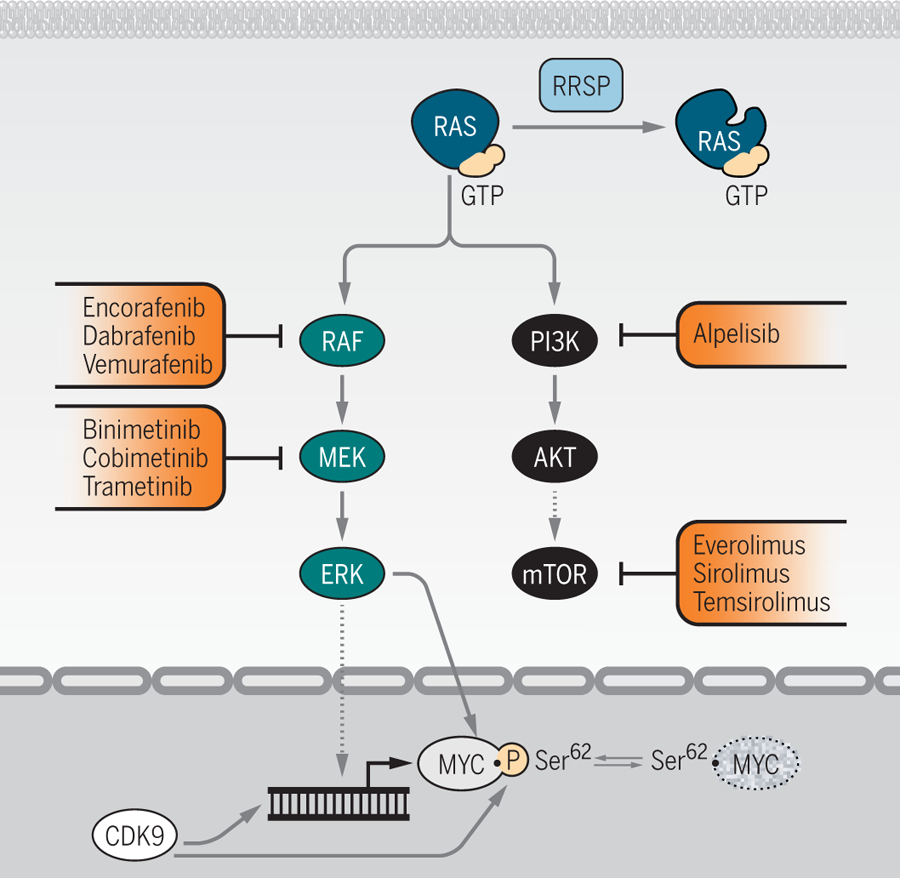
Oncogenic RAS proteins, which are mutated in approximately 24% of all human cancers, have earned a well-deserved reputation as being "undruggable." However, several studies have challenged that reputation. With the first small molecules that directly target one oncogenic RAS mutant (G12C) undergoing clinical evaluation, there have been substantial advances in finding anti-RAS therapeutic strategies. Furthermore, new insights have come from the growing appreciation that neither all RAS proteins (HRAS, NRAS, and KRAS4A/KRAS4B) nor all oncogenic RAS mutations (such as at residues Gly12, Gly13, and Gln61) have the same impact on RAS signaling and function. The role of the nonmutated, wild-type RAS proteins in the context of mutant RAS is increasingly considered to be targetable, with reports of strategies that directly disrupt either the RAS interaction with activating guanine nucleotide exchange factors (GEFs) or receptor tyrosine kinase-mediated and GEF-dependent RAS activation (such as by targeting the scaffolding phosphatase SHP2). Last, the development of agents that target downstream effectors of RAS signaling has advanced substantially. In this review, we highlight some important trends in the targeting of RAS proteins in cancer.
Copyright © 2020 The Authors, some rights reserved; exclusive licensee American Association for the Advancement of Science. No claim to original U.S. Government Works.
Conflict of interest statement
Figures
References
-
- Siegel RL, Miller KD & Jemal A Cancer statistics, 2019. CA. Cancer J. Clin 69, 7–34 (2019). - PubMed
-
- Scheffzek K, Ahmadian MR, Kabsch W, Wiesmüller L, Lautwein A, Schmitz F & Wittinghofer A The Ras-RasGAP Complex: Structural Basis for GTPase Activation and Its Loss in Oncogenic Ras Mutants. Science 277, 333–339 (1997). - PubMed
-
- Hunter JC, Manandhar A, Carrasco MA, Gurbani D, Gondi S & Westover KD Biochemical and Structural Analysis of Common Cancer-Associated KRAS Mutations. Mol. Cancer Res 13, 1325–1335 (2015). - PubMed
Publication types
MeSH terms
Substances
Grants and funding
LinkOut - more resources
Full Text Sources
Other Literature Sources
Medical
Research Materials
Miscellaneous