. 2020 Jul;14(7):1639-1650.
doi: 10.1038/s41396-020-0630-6. Epub 2020 Mar 24.

US nativity and dietary acculturation impact the gut microbiome in a diverse US population

Affiliations

US nativity and dietary acculturation impact the gut microbiome in a diverse US population

Brandilyn A Peters et al. ISME J. 2020 Jul.

Abstract

Little is known regarding the impact of immigrant acculturation on the gut microbiome. We characterized differences in the gut microbiome between racially/ethnically diverse US immigrant and US-born groups, and determined the impact of dietary acculturation on the microbiome. Stool samples were collected from 863 US residents, including US-born (315 White, 93 Black, 40 Hispanic) and foreign-born (105 Hispanic, 264 Korean) groups. We determined dietary acculturation from dissimilarities based on food frequency questionnaires, and used 16S rRNA gene sequencing to characterize the microbiome. Gut microbiome composition differed across study groups, with the largest difference between foreign-born Koreans and US-born Whites, and significant differences also observed between foreign-born and US-born Hispanics. Differences in sub-operational taxonomic unit (s-OTU) abundance between foreign-born and US-born groups tended to be distinct from differences between US-born groups. Bacteroides plebeius, a seaweed-degrading bacterium, was strongly enriched in foreign-born Koreans, while Prevotella copri and Bifidobacterium adolescentis were strongly enriched in foreign-born Koreans and Hispanics, compared with US-born Whites. Dietary acculturation in foreign-born participants was associated with specific s-OTUs, resembling abundance in US-born Whites; e.g., a Bacteroides plebeius s-OTU was depleted in highly diet-acculturated Koreans. In summary, we observed that US nativity is a determinant of the gut microbiome in a US resident population. Dietary acculturation may result in loss of native species in immigrants, though further research is necessary to explore whether acculturation-related microbiome alterations have consequences for immigrant health.


Conflict of interest statement

The authors declare that they have no conflict of interest.

Figures
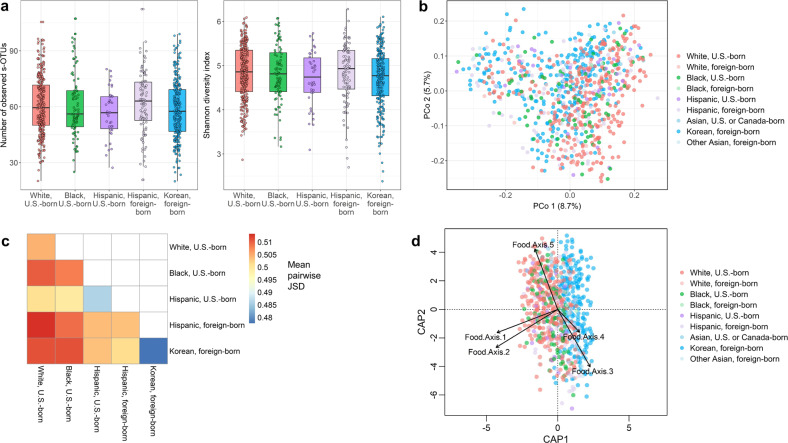
Fig. 1
Fig. 1. Gut microbiome α- and β-diversity according to race/ethnicity and birthplace.
a Boxplots of the number of observed s-OTUs and Shannon diversity index by study group. b Principal coordinate analysis of the Jensen Shannon Divergence (JSD). c Mean pairwise JSD distances between and within study groups. d distance-based redundancy analysis of the JSD, constrained by the first five principal coordinates of the generalized UniFrac diet distance.
Fig. 2
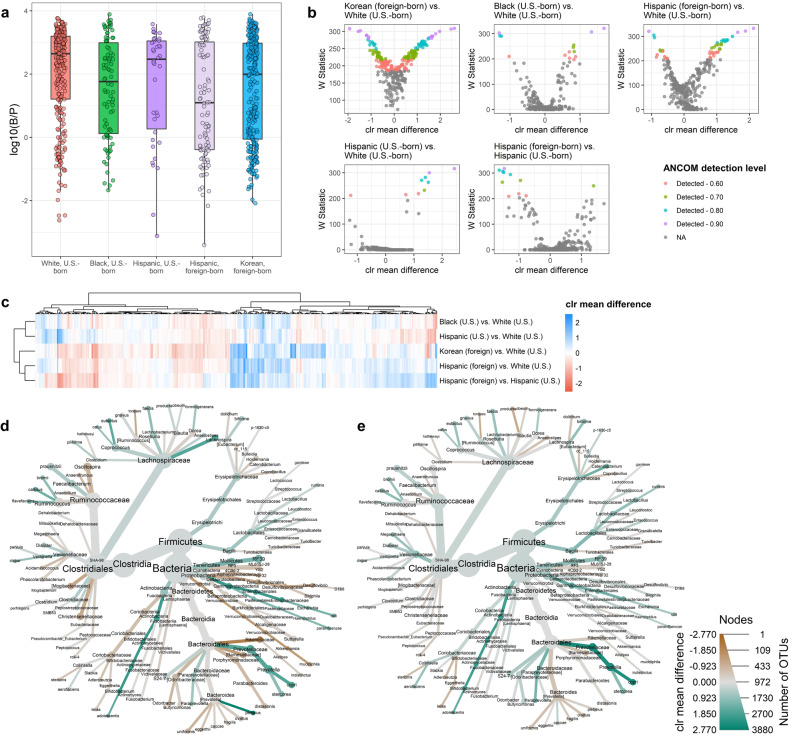
Fig. 2. Differentially abundant taxa by race/ethnicity and birthplace.
a Boxplots of the log Bacteroides/Prevotella ratio. b Volcano plots showing differentially abundant s-OTUs as detected by ANCOM (age and sex adjusted model). The x-axis represents the difference in mean centered log ratio (clr)-transformed abundance between groups, and the y-axis represents the ANCOM W Statistic. s-OTU points are colored by level of ANCOM significance, with 0.9 being the highest level; s-OTUs in gray were not significant. c Heatmap of clr mean differences of s-OTUs for each study group comparison. d, e Cladograms of phylum through species level taxa; color represents clr mean difference between foreign-born Korean and US-born White participants (d) or foreign-born Hispanic and US-born White participants (e); size of node represents number of s-OTU members; only taxa tested in ANCOM are displayed.
Fig. 3
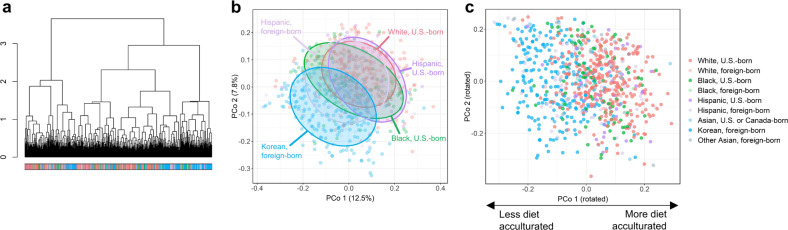
Fig. 3. Measuring dietary acculturation.
a Unsupervised hierarchical clustering (Ward’s method) of the generalized UniFrac diet distance. b Principal coordinate analysis of the generalized UniFrac diet distance, with 75% data ellipses overlayed on the plot. c 46.8° rotation of the plot in (b), corresponding to the angle of the centroids for the Korean, foreign-born and White, US-born groups. The new rotated first axis, a measure of dietary acculturation, achieves high separation of diet patterns between the Korean, foreign-born and White, US-born groups.
Fig. 4
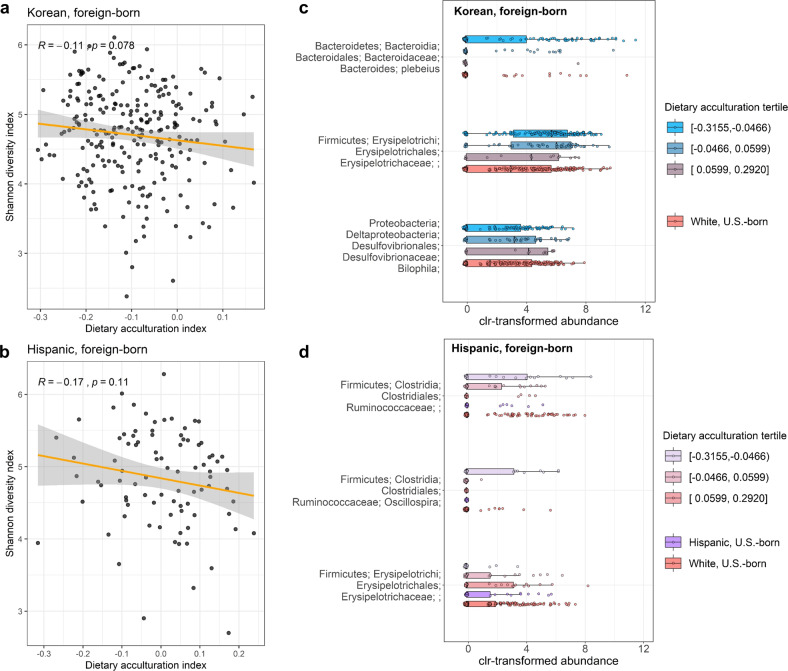
Fig. 4. Dietary acculturation and the gut microbiome in foreign-born Korean and Hispanic participants.
a, b Scatterplots of the dietary acculturation index vs. the Shannon diversity index in Korean, foreign-born participants (R = −0.11, p = 0.08) and Hispanic, foreign-born participants (R = −0.17, p = 0.11). c, d Boxplots of clr-transformed abundance for s-OTUs significantly associated with the dietary acculturation index in foreign-born Koreans or foreign-born Hispanics in ANCOM analysis (age and sex adjusted model). Tertiles of dietary acculturation were determined among the entire population (n = 174, 59, and 16 in tertiles 1, 2, and 3 for foreign-born Koreans; n = 28, 30, and 30 in tertiles 1, 2, and 3 for foreign-born Hispanics). Boxplots of clr-transformed abundance in US-born White and US-born Hispanic (plot d only) participants are included for comparison purposes.

References

    1. United Nations. International Migration Report 2017; United Nations; New York, 2017.
    1. Argeseanu Cunningham S, Ruben JD, Narayan KM. Health of foreign-born people in the United States: a review. Health Place. 2008;14:623–35. doi: 10.1016/j.healthplace.2007.12.002. - DOI - PubMed
    1. Ahmed AT, Quinn VP, Caan B, Sternfeld B, Haque R, Van Den Eeden SK. Generational status and duration of residence predict diabetes prevalence among Latinos: the California Men’s Health Study. BMC Public Health. 2009;9:392. doi: 10.1186/1471-2458-9-392. - DOI - PMC - PubMed
    1. Commodore-Mensah Y, Ukonu N, Obisesan O, Aboagye JK, Agyemang C, Reilly CM, et al. Length of residence in the United States is associated with a higher prevalence of cardiometabolic risk factors in immigrants: a contemporary analysis of the National Health Interview Survey. J Am Heart Assoc. 2016;5:e004059. - PMC - PubMed

    1. Goel MS, McCarthy EP, Phillips RS, Wee CC. Obesity among US immigrant subgroups by duration of residence. JAMA. 2004;292:2860–7. doi: 10.1001/jama.292.23.2860. - DOI - PubMed

Publication types

Substances

Supplementary concepts