. 2020 Mar 5:11:188.
doi: 10.3389/fphar.2020.00188. eCollection 2020.

Functional Selectivity and Antinociceptive Effects of a Novel KOPr Agonist

Affiliations

Functional Selectivity and Antinociceptive Effects of a Novel KOPr Agonist

Andrea Bedini et al. Front Pharmacol. .

Abstract

Kappa opioid receptor (KOPr) agonists represent alternative analgesics for their low abuse potential, although relevant adverse effects have limited their clinical use. Functionally selective KOPr agonists may activate, in a pathway-specific manner, G protein-mediated signaling, that produces antinociception, over β-arrestin 2-dependent induction of p38MAPK, which preferentially contributes to adverse effects. Thus, functionally selective KOPr agonists biased toward G protein-coupled intracellular signaling over β-arrestin-2-mediated pathways may be considered candidate therapeutics possibly devoid of many of the typical adverse effects elicited by classic KOPr agonists. Nonetheless, the potential utility of functionally selective agonists at opioid receptors is still highly debated; therefore, further studies are necessary to fully understand whether it will be possible to develop more effective and safer analgesics by exploiting functional selectivity at KOPr. In the present study we investigated in vitro functional selectivity and in vivo antinociceptive effects of LOR17, a novel KOPr selective peptidic agonist that we synthesized. LOR17-mediated effects on adenylyl cyclase inhibition, ERK1/2, p38MAPK phosphorylation, and astrocyte cell proliferation were studied in HEK-293 cells expressing hKOPr, U87-MG glioblastoma cells, and primary human astrocytes; biased agonism was investigated via cAMP ELISA and β-arrestin 2 recruitment assays. Antinociception and antihypersensitivity were assessed in mice via warm-water tail-withdrawal test, intraperitoneal acid-induced writhing, and a model of oxaliplatin-induced neuropathic cold hypersensitivity. Effects of LOR17 on locomotor activity, exploratory activity, and forced-swim behavior were also assayed. We found that LOR17 is a selective, G protein biased KOPr agonist that inhibits adenylyl cyclase and activates early-phase ERK1/2 phosphorylation. Conversely to classic KOPr agonists as U50,488, LOR17 neither induces p38MAPK phosphorylation nor increases KOPr-dependent, p38MAPK-mediated cell proliferation in astrocytes. Moreover, LOR17 counteracts, in a concentration-dependent manner, U50,488-induced p38MAPK phosphorylation and astrocyte cell proliferation. Both U50,488 and LOR17 display potent antinociception in models of acute nociception, whereas LOR17 counteracts oxaliplatin-induced thermal hypersensitivity better than U50,488, and it is effective after single or repeated s.c. administration. LOR17 administered at a dose that fully alleviated oxaliplatin-induced thermal hypersensitivity did not alter motor coordination, locomotor and exploratory activities nor induced pro-depressant-like behavior. LOR17, therefore, may emerge as a novel KOPr agonist displaying functional selectivity toward G protein signaling and eliciting antinociceptive/antihypersensitivity effects in different animal models, including oxaliplatin-induced neuropathy.

Keywords: antinociception; chemotherapy-induced neuropathic pain; functional selectivity; intracellular signaling; kappa opioid receptor.


Figures

Figure 1
Figure 1
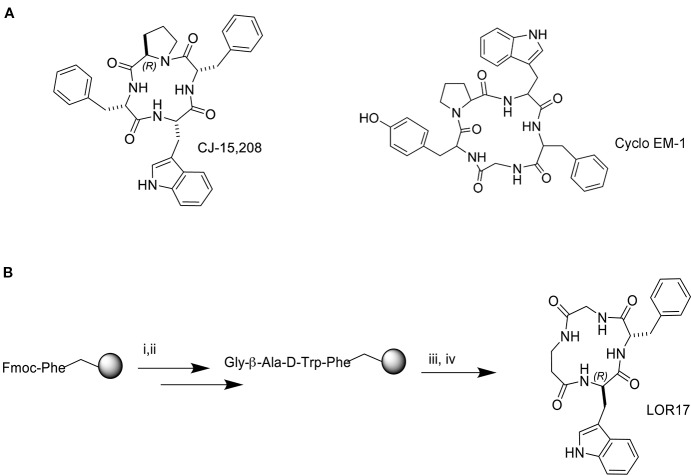
Structure of the natural peptide CJ-15,208 and the synthetic peptide Cyclo EM-1 (A) and synthesis of the peptide hybrid of the two sequences, LOR17 (B); i. 20% Pip/DMF, ii. HOBt/TBTU/DIPEA, iii. TFA/TIPS/PhOH/water, iv. HATU/DIPEA/DMF.
Figure 2
Figure 2
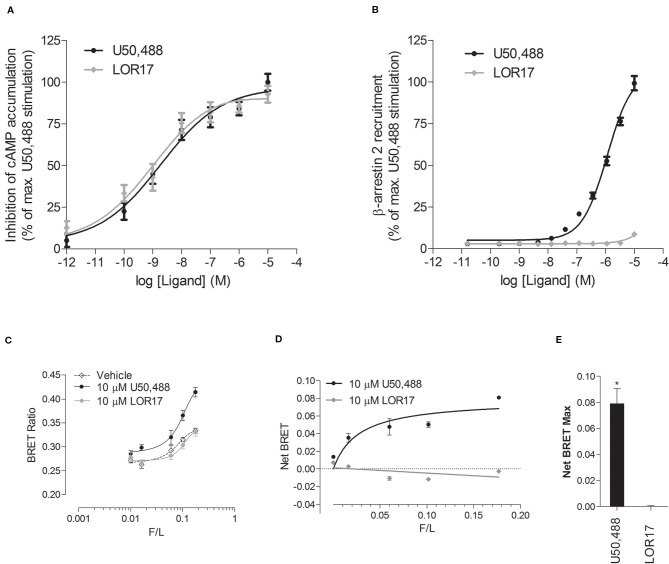
In vitro functional activity of LOR17 and U50,488. (A). Inhibition of forskolin-induced cAMP accumulation assessed via cAMP ELISA in HEK-293/hKOPr cells. The data were normalized to the maximum stimulation caused by U50,488 (100%) (n = 5 independent experiments). (B). Concentration–response curves of LOR17 and U50,488 for β-arrestin 2 recruitment to hKOPr expressed in U2OS–β-arrestin 2 cells using the PathHunter β-arrestin2 assay. Responses were normalized to the maximum effect of U50,488 (100%) (n = 3 independent experiments). All data are presented as the mean ± SD. (C–E). BRET-based assays to assess the interaction of increasing amounts of arrestin 3-YFP with luciferase-tagged human KOPr. (C). BRET ratio in the presence of U50,488, LOR17 or vehicle in HEK-293 cells co-expressing varying amounts of arrestin 3-YFP with RLuc-tagged KOPr; means ± S.D. of six repeats in a representative experiment (of five performed) are shown. (D). Agonist-induced increase in BRET as a function of arrestin 3-YFP expression normalized by RLuc luminescence (F/L); Means ± S.D. of six repeats in a representative experiment (of five performed) are shown. (E). Net BRET Max values calculated from U50,488 or LOR17 response curves plotted in panel D. *p < 0.05 vs LOR17 (t test).
Figure 3
Figure 3
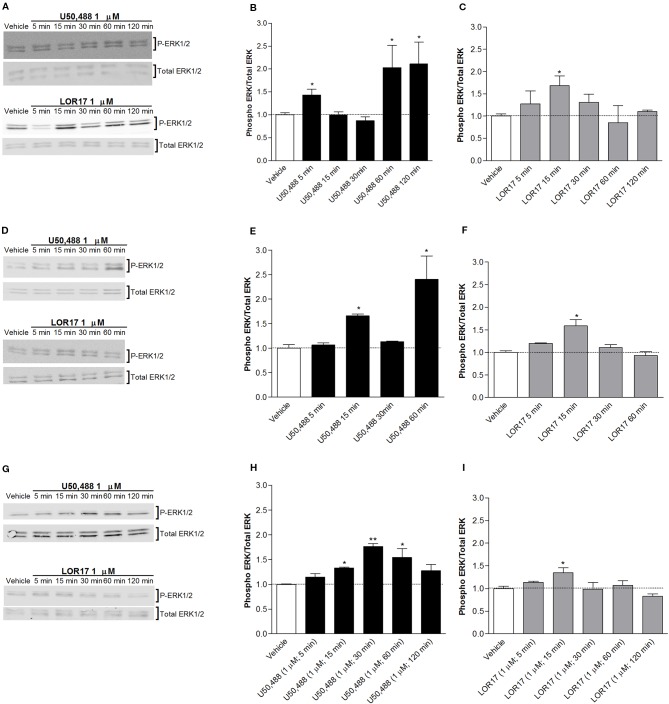
U50,488- and LOR17-mediated phospho-ERK1/2 (P-ERK1/2) increase in HEK-293/hKOPr cells, U87-MG astrocytoma cells and normal human astrocytes. (A). Representative blots of HEK-293/hKOPr cells exposed to 1 µM U50,488, 1 µM LOR17 or vehicle. (B, C). Quantification of P-ERK levels in HEK-293/hKOPr cells exposed to 1 µM U50,488, 1 µM LOR17 or vehicle; data are presented as the mean ± SD of 6 independent experiments. *p < 0.05 vs vehicle (Newman-Keuls test after ANOVA). (D). Representative blots of U87-MG human astrocytoma cells exposed to 1 µM U50,488, 1 µM LOR17 or vehicle. (E, F). Quantification of P-ERK levels in U87-MG human astrocytoma cells exposed to 1 µM U50,488, 1 µM LOR17 or vehicle; data are presented as the mean ± SD of 6 independent experiments. *p < 0.05 vs vehicle (Newman-Keuls test after ANOVA). (G). Representative blots of normal human astrocytes exposed to 1 µM U50,488, 1 µM LOR17 or vehicle. (H, I). Quantification of P-ERK levels in normal human astrocytes exposed to 1 µM U50,488, 1 µM LOR17 or vehicle; data are presented as the mean ± SD of 6 independent experiments. *p < 0.05 vs vehicle; **p < 0.01 vs vehicle (Newman-Keuls test after ANOVA).
Figure 4
Figure 4
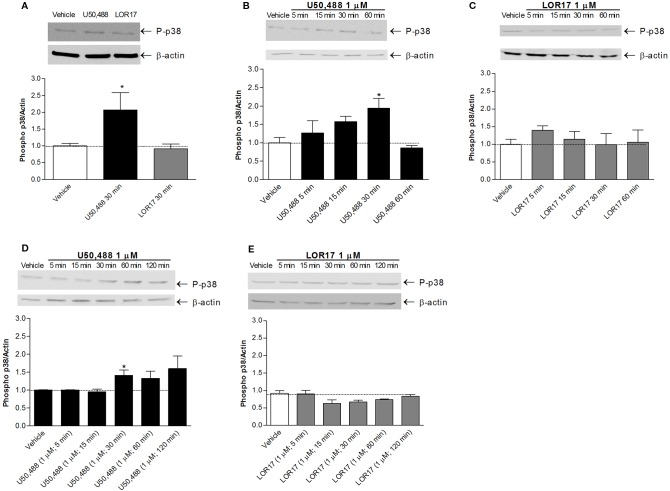
U50,488 and LOR17-mediated phospho-p38MAPK (P-p38) increase in HEK-293/hKOPr cells, U87-MG astrocytoma cells and normal human astrocytes. (A). Representative blots and quantification of P-p38 levels in HEK-293/hKOPr cells exposed to U50,488 (1 µM; 30 min), LOR17 (1 µM; 30 min) or vehicle; data are presented as the mean ± SD of 6 independent experiments. *p < 0.05 vs vehicle (Newman-Keuls test after ANOVA). (B, C). Representative blots and quantification of P-p38 levels in U87-MG human astrocytoma cells exposed to 1 µM U50,488, 1 µM LOR17 or vehicle; data are presented as the mean ± SD of 6 independent experiments. *p < 0.05 vs vehicle (Newman-Keuls test after ANOVA). (D, E). Representative blots and quantification of P-p38 levels in normal human astrocytes exposed to 1 µM U50,488, 1 µM LOR17 or vehicle; data are presented as the mean ± SD of 6 independent experiments. *p < 0.05 vs vehicle (Newman-Keuls test after ANOVA).
Figure 5
Figure 5
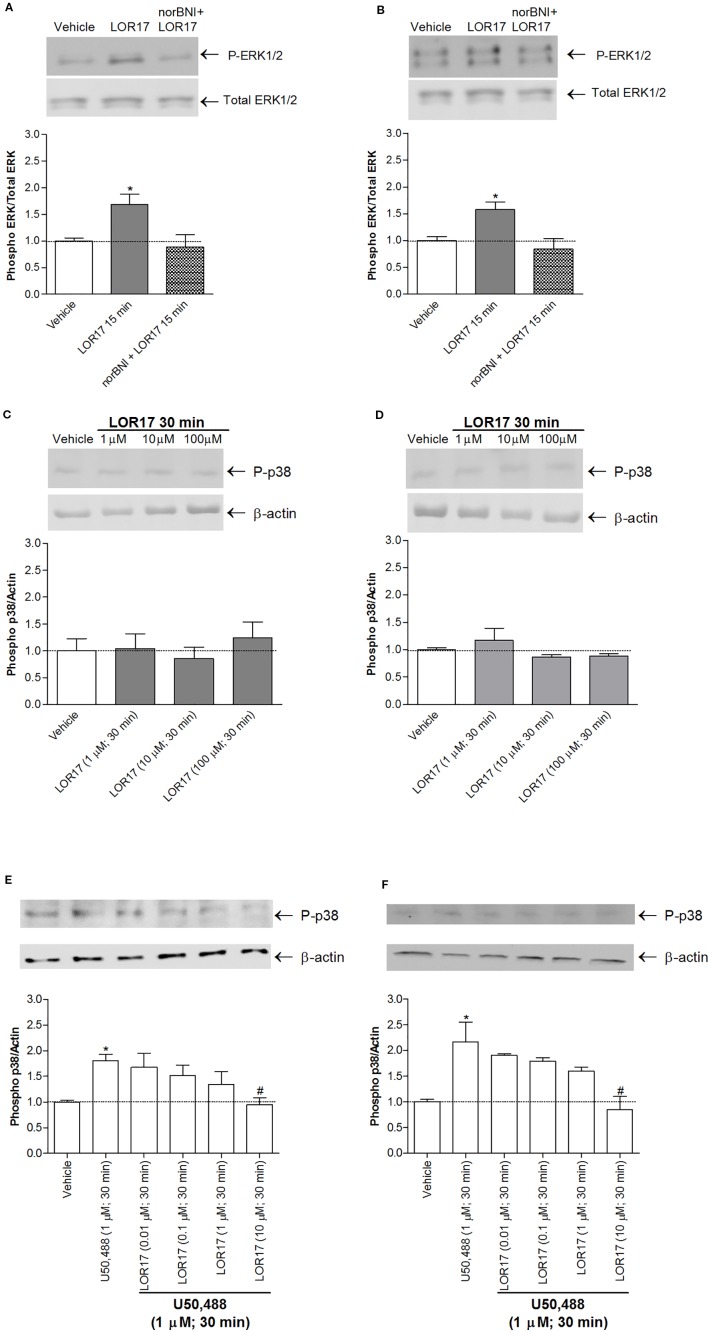
LOR17 increased P-ERK levels in a KOPr-dependent way and did not increase P-p38 levels in HEK-293/hKOPr and U87-MG cells, even when administered at concentrations up to 100 μM. (A). Representative blots and quantification of P-ERK levels in HEK-293/hKOPr cells exposed to norBNI (10 µM; 30 min prior to LOR17) and LOR17 (1 µM; 15 min), LOR17 (1 μM; 15 min) alone or vehicle; data are presented as the mean ± SD of 6 independent experiments.*p < 0.05 vs vehicle (Newman-Keuls test after ANOVA). (B). Representative blots and quantification of P-ERK levels in U87-MG cells exposed to norBNI (10 µM; 30 min prior to LOR17) and LOR17 (1 µM; 15 min), LOR17 (1 μM; 15 min) alone or vehicle; data are presented as the mean ± SD of 6 independent experiments. *p < 0.05 vs vehicle (Newman-Keuls test after ANOVA). (C). Representative blots and quantification of P-p38 levels in HEK-293/hKOPr cells exposed to LOR17 (1-100 µM; 30 min) or vehicle; data are presented as the mean ± SD of 6 independent experiments. (D). Representative blots and quantification of P-p38 levels in U87-MG cells exposed to LOR17 (1-100 µM; 30 min) or vehicle; data are presented as the mean ± SD of 6 independent experiments. (E). Representative blots and quantification of P-p38 levels in HEK-293/hKOPr cells exposed to vehicle, U50,488 (1 µM; 30 min) alone or co-administered with LOR17 (0.01-10 µM; 30 min); data are presented as the mean ± SD of 6 independent experiments. (F). Representative blots and quantification of P-p38 levels in U87-MG cells exposed to vehicle, U50,488 (1 µM; 30 min) alone or co-administered with LOR17 (0.01-10 µM; 30 min); data are presented as the mean ± SD of 6 independent experiments. *p < 0.05 vs vehicle; #p < 0.05 vs U50,488 (Newman-Keuls test after ANOVA).
Figure 6
Figure 6
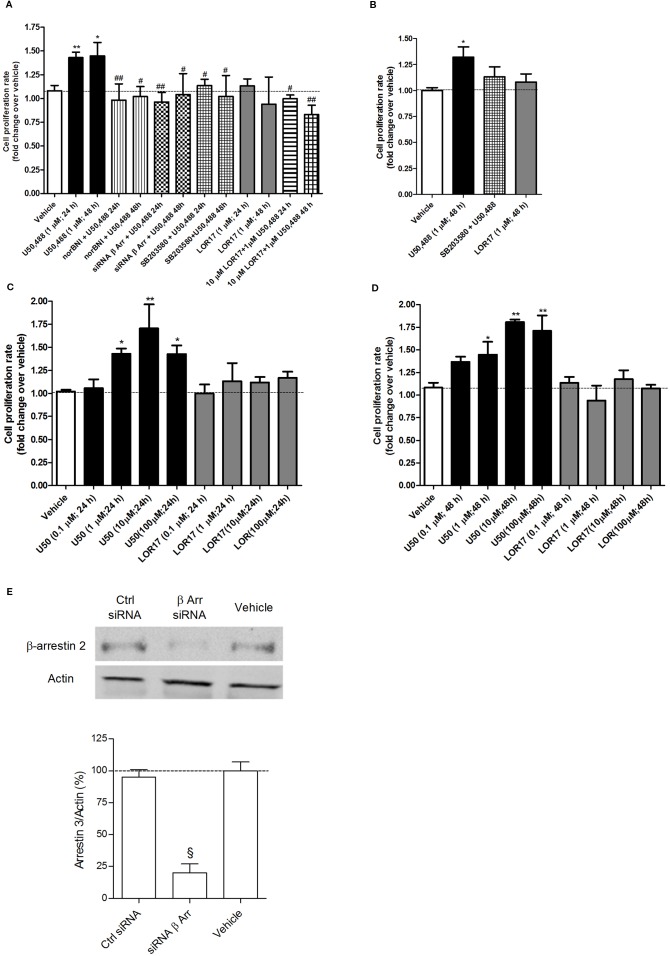
U50,488- and LOR17-mediated effects on cell proliferation of U87-MG human astrocytoma cells and normal human astrocytes. (A). U50,488 (1 µM) produced a KOPr-dependent, β-arrestin 2- and p38MAPK-mediated increase in the U87-MG cell proliferation rate, whereas LOR17 did not; LOR17 counteracted U50,488-mediated induction of U87-MG cell proliferation. Data are presented as the mean ± SD of 8 independent experiments. *p< 0.05 vs vehicle, LOR17 (1 µM; 24 h) and LOR17 (1 µM; 48 h); **p< 0.01 vs vehicle, LOR17 (1 µM; 24 h) and LOR17 (1 µM; 48 h); #p< 0.05 vs U50,488 (1 µM; 24 h) and U50,488 (1 µM; 48 h); ##p< 0.01 vs U50,488 (1 µM; 24 h) and U50,488 (1 µM; 48 h) (Newman-Keuls test after ANOVA). (B). U50,488 (1 µM) resulted in a p38MAPK-mediated increase in the normal human astrocyte cell proliferation rate, whereas LOR17 did not. Data are presented as the mean ± SD of 8 independent experiments. *p < 0.05 vs vehicle, LOR17 (1 µM; 48 h) and SB203580 + U50,488 (Newman-Keuls test after ANOVA). (C, D). U50,488 (0.1-100 µM) produced a concentration-dependent increase in the U87-MG cell proliferation rate at both 24 and 48 h of exposure, whereas LOR17 (0.1-100 µM) did not. Data are presented as the mean ± SD of 8 independent experiments. *p< 0.05 vs vehicle; **p < 0.01 vs vehicle (Newman-Keuls test after ANOVA). (E). Knock-down of beta-arrestin 2 expression in U87-MG cells by means of selective siRNA. Data are presented as the mean ± SD of 6 independent experiments. §p < 0.001 vs Vehicle and Ctr siRNA (Newman-Keuls test after ANOVA).
Figure 7
Figure 7
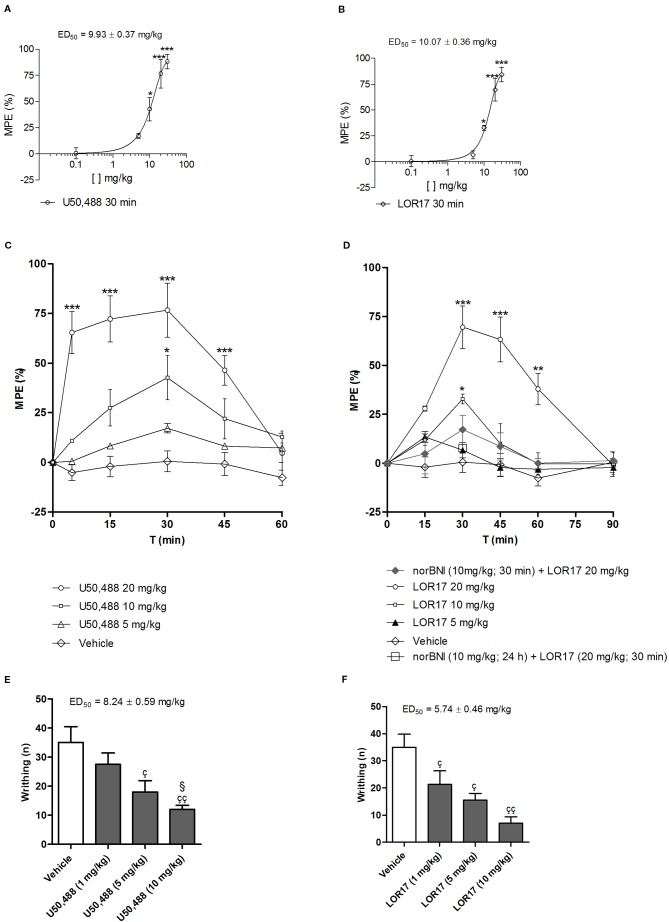
Antinociceptive effects mediated by U50,488 and LOR17 in mice; vehicle (saline for U50,488 and 1:1 mixture of propylene glycol and saline for LOR17), U50,488 or LOR17 were administered i.p. (A). Dose-response curve of the antinociceptive effect induced in the warm-water tail-withdrawal test by i.p. administered U50,488. Data are presented as the mean ± SD of 10 mice. *p < 0.05 vs vehicle and U50,488 5 mg/kg; ***p < 0.001 vs vehicle and U50,488 5 mg/kg (Newman-Keuls test after ANOVA). (B). Dose-response curve of the antinociceptive effect induced in the warm-water tail-withdrawal test by i.p. administered LOR17. Data are presented as the mean ± SD of 10 mice. *p < 0.05 vs vehicle and LOR17 5 mg/kg; ***p < 0.001 vs vehicle and LOR17 5 mg/kg (Newman-Keuls test after ANOVA). (C). U50,488 produced a time- and dose-dependent antinociception in the warm-water tail-withdrawal test. Data are presented as the mean ± SD of 10 mice. *p < 0.05 vs vehicle and U50,488 5 mg/kg; ***p < 0.001 vs vehicle and U50,488 5 mg/kg (Newman-Keuls test after ANOVA). (D). LOR17 determined a time- and dose-dependent, KOPr-mediated antinociception in the warm-water tail-withdrawal test. Data are presented as the mean ± SD of 10 mice. *p < 0.05 vs vehicle and LOR17 5 mg/kg; **p < 0.01 vs vehicle; ***p < 0.001 vs vehicle, LOR17 5 mg/kg, norBNI 10 mg/kg + LOR17 20 mg/kg and norBNI (10 mg/kg; 24 h) + LOR17 (20 mg/kg; 30 min**p < 0.01 vs vehicle) (Newman-Keuls test after ANOVA). (E). U50,488 dose-dependently reduced the number of abdominal writhes induced in mice after i.p. injection of 0.6% acetic acid. Data are presented as the mean ± SD of 10 mice. çp < 0.05 vs vehicle; ççp < 0.01 vs vehicle; §p< 0.05 vs 1 mg/kg (Newman-Keuls test after ANOVA). (F). LOR17 dose-dependently reduced the number of abdominal writhes induced in mice after an i.p. injection of 0.6% acetic acid. Data are presented as the mean ± SD of 10 mice. çp < 0.05 vs vehicle; ççp < 0.01 vs vehicle (Newman-Keuls test after ANOVA).
Figure 8
Figure 8
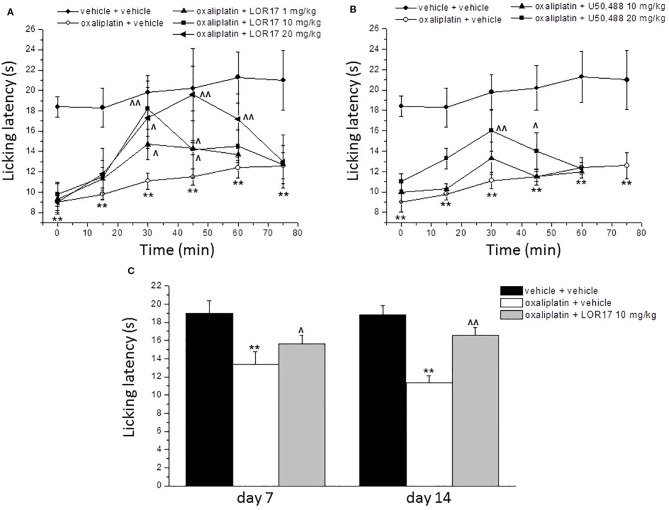
Effect of LOR17 on oxaliplatin-induced neuropathic pain. (A). Acute treatment: on day 14 of oxaliplatin administration (2.4 mg/kg, i.p., administered daily), LOR17 (1 – 20 mg/kg) was administered s.c. The response to a thermal non-noxious stimulus was evaluated over time by the cold plate test measuring the latency to pain-related behaviors (lifting or licking of the paw). (B). LOR17 effects were compared with those induced by the acute administration of U50,448 (10 and 20 mg/kg, s.c.). (C). Repeated treatment: LOR17 (10 mg/kg) was administered s.c. daily starting the first day of oxaliplatin treatment. Cold hypersensitivity (cold plate test) was performed on days 7 and 14. Each value represents the mean ± S.E.M. of 12 mice performed in 2 different experimental set. **P < 0.01 versus vehicle + vehicle treated animals; ^ P < 0.05 versus oxaliplatin + vehicle; ^^ P < 0.01 versus oxaliplatin + vehicle (Bonferroni test after ANOVA).

References

    1. Aita M., Byers M. R., Chavkin C., Xu M. (2010). Trigeminal injury causes kappa opioid-dependent allodynic, glial and immune cell responses in mice. Mol. Pain. 29, 6–8. 10.1186/1744-8069-6-8 - DOI - PMC - PubMed
    1. Azzam A. A. H., McDonald J., Lambert D. G. (2019). Hot topics in opioid pharmacology: mixed and biased opioids. Br. J. Anaesth. 122, e136–e145. 10.1016/j.bja.2019.03.006 - DOI - PubMed
    1. Baiula M., Galletti P., Martelli G., Soldati R., Belvisi L., Civera M., et al. (2016). New β-lactam derivatives modulate cell adhesion and signaling mediated by rgd-binding and leukocyte integrins. J. Med. Chem. 59, 9721–9742. 10.1021/acs.jmedchem.6b00576 - DOI - PubMed
    1. Bedini A., Spampinato S. M. (2018). Innovative opioid peptides and biased agonism: novel avenues for more effective and safer analgesics to treat chronic pain. Curr. Med. Chem. 25 (32), 3895–3916. 10.2174/0929867324666170216095233 - DOI - PubMed
    1. Bedini A., Baiula M., Spampinato S. (2008). Transcriptional activation of human mu-opioid receptor gene by insulin-like growth factor-I in neuronal cells is modulated by the transcription factor REST. J. Neurochem. 105, 2166–2178. 10.1111/j.1471-4159.2008.05303.x - DOI - PubMed