


Impact of therapies on bowel damage in Crohn's disease
- PMID: 32213030
- PMCID: PMC7226700
- DOI: 10.1177/2050640620908696
Impact of therapies on bowel damage in Crohn's disease
Erratum in
-
Corrigendum.United European Gastroenterol J. 2020 Jul;8(6):749. doi: 10.1177/2050640620935374. United European Gastroenterol J. 2020. PMID: 32628895 Free PMC article. No abstract available.
Abstract
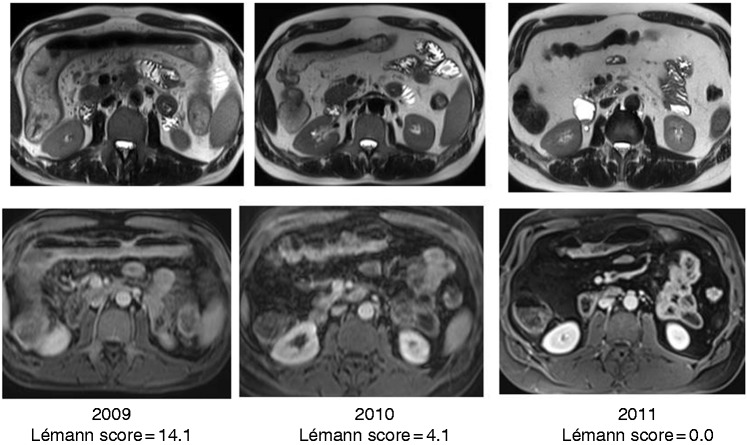
Crohn's disease (CD) is a chronic inflammatory bowel disease that usually progresses to bowel damage, defined as strictures, fistulas and abscesses. These complications require intestinal resection and lead to further irreversible structural damage. Cross-sectional imaging, such as magnetic resonance imaging, computed tomography and ultrasound, are accurate in assessing intestinal damage at a definite time point and the progression of damage over time. Recently, an imaging-based index, the Lémann Index, has been proposed and developed in order to quantify bowel damage in CD patients; emerging data confirm that this Index can measure the structural damage with good sensitivity to change. One challenge remains to understand whether existing or future treatments might be able to stop bowel-damage progression or even reverse intestinal damage, improving the prognosis and changing the natural history of CD. We reviewed the current data available in the literature focused on the measure of structural damage in CD patients, mainly focusing on the impact on therapies in reversing bowel damage. We also explored some further perspectives on measuring and targeting intestinal damage in clinical research and in clinical practice as an ultimate therapeutic target.
Keywords: Crohn’s disease; IBD; Ulcerative colitis; gastroenterology; inflammatory bowel disease.
Figures
References
-
- Fiorino G, Peyrin-Biroulet L, Danese S. Bowel damage assessment in Crohn’s disease by magnetic resonance imaging. Curr Drug Targets 2012; 13: 1300–1307. - PubMed
-
- Panes J, Bouzas R, Chaparro M, et al. Systematic review: the use of ultrasonography, computed tomography and magnetic resonance imaging for the diagnosis, assessment of activity and abdominal complications of Crohn’s disease. Aliment Pharmacol Ther 2011; 34: 125–145. - PubMed
-
- Simon M, Cosnes J, Gornet JM, et al. Endoscopic detection of small bowel dysplasia and adenocarcinoma in Crohn’s disease: a prospective cohort-study in high-risk patients. J Crohns Colitis 2017; 11: 47–52. - PubMed
-
- Fiorino G, Morin M, Bonovas S, et al. Prevalence of bowel damage assessed by cross-sectional imaging in early Crohn’s disease and its impact on disease outcome. J Crohns Colitis 2017; 11: 274–280. - PubMed
-
- Fiorino G, Bonifacio C, Allocca M, et al. Bowel damage as assessed by the Lémann Index is reversible on anti-TNF therapy for Crohn’s disease. J Crohns Colitis 2015; 9: 633–639. - PubMed
Publication types
MeSH terms
Substances
LinkOut - more resources
Full Text Sources
Medical
