Review
. 2020 Mar 25;19(1):66.
doi: 10.1186/s12943-020-01189-3.

Exosomal noncoding RNAs in Glioma: biological functions and potential clinical applications

Affiliations
Review

Exosomal noncoding RNAs in Glioma: biological functions and potential clinical applications

Jian Cheng et al. Mol Cancer. .

Abstract

Gliomas are complex and heterogeneous brain tumors with poor prognosis. Glioma cells can communicate with their surroundings to create a tumor-permissive microenvironment. Exosomes represent a new means of intercellular communication by delivering various bioactive molecules, including proteins, lipids and nucleic acids, and participate in tumor initiation and progression. Noncoding RNAs (ncRNAs) including microRNA, long-noncoding RNA, and circular RNA, account for a large portion of human transcriptome and play important roles in various pathophysiological processes, especially in cancers. In addition, ncRNAs can be selectively packaged, secreted and transferred between cells in exosomes and modulate numerous hallmarks of glioma, such as proliferation, invasion, angiogenesis, immune-escape, and treatment resistance. Hence, the strategies of specifically targeting exosomal ncRNAs could be attractive therapeutic options. Exosomes are able to cross the blood brain barrier (BBB), and are readily accessible in nearly all types of human biofluids, which make them the promising biomarkers for gliomas. Additionally, given the biocompatibility of exosomes, they can be engineered to deliver therapeutic factors, such as RNA, proteins and drugs, to target cells for therapeutic applications. Here, we reviewed current research on the roles of exosomal ncRNAs in glioma progression. We also discussed their potential clinical applications as novel biomarkers and therapeutics.

Keywords: Cancer diagnosis; Cancer therapy; Exosome; Extracellular vesicles; Glioma; Noncoding RNA.


Conflict of interest statement

The authors declare that they have no competing interests.

Figures
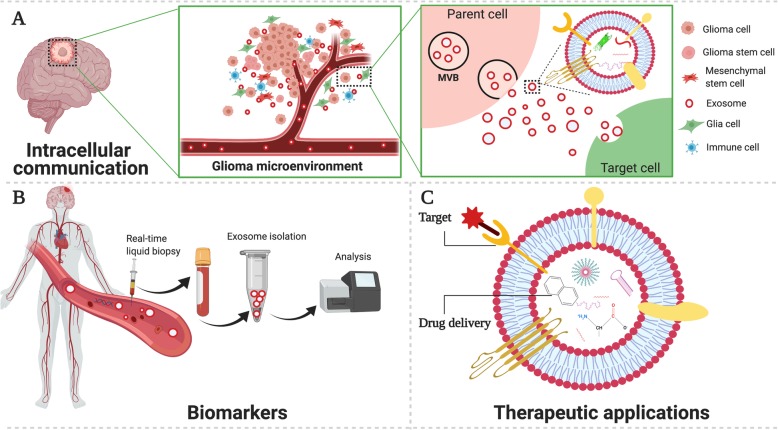
Fig. 1
Fig. 1
Roles of exosomes in glioma. a exosomes participate in cell-to-cell communication by delivering various bioactive molecules, including proteins, lipids and nucleic acids, in the tumor microenvironment. b exosomes serve as promising biomarkers. c exosomes have novel therapeutic applications
Fig. 2
Fig. 2
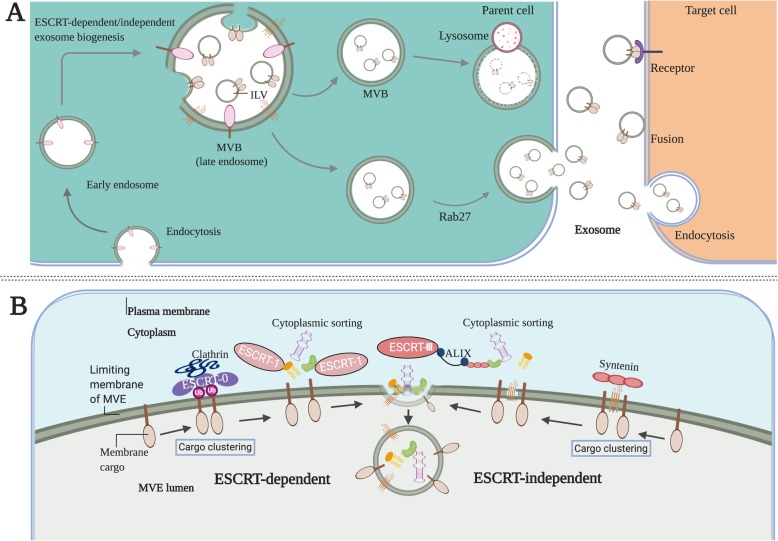
The main process of exosome biogenesis and release. a The biogenesis of exosome begins at endosome formation through endocytosis at the plasma membrane, and then early endosomes maturate to multivesicular bodies (MVB). Exosomes are formed as intraluminal vesicles (ILV) in MVBs though endosomal sorting complexes required for transport (ESCRT) dependent or independent pathway. Generally, MVBs either fuse with the lysosome for degradation or fuse with the plasma membrane, which results in ILVs (exosomes) secretion. After secretion, exosomes uptake by target cells is mediated by endocytosis, fusion with the plasma membrane or ligand/receptor interaction. b Both the ESCRT- dependent and independent pathway are implicated in controlling the cargos sorting of exosomes
Fig. 3
Fig. 3
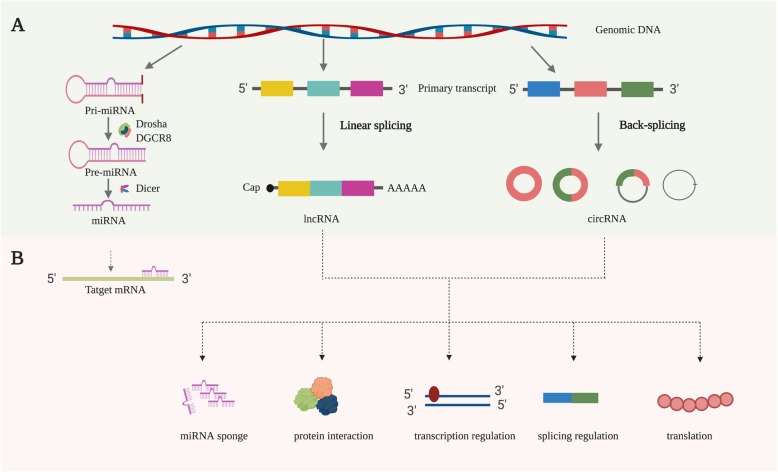
The biogenesis (a) and potential functions (b) of miRNA, lncRNA and circRNA
Fig. 4
Fig. 4
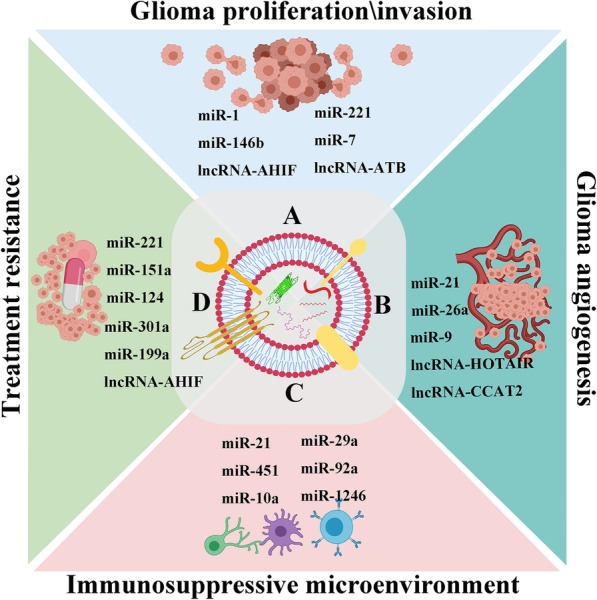
Exosomal ncRNAs play important roles in regulating glioma proliferation/invasion (a), angiogenesis (b), immune-escape (c), and treatment resistance (d)

References

    1. Molinaro AM, Taylor JW, Wiencke JK, Wrensch MR. Genetic and molecular epidemiology of adult diffuse glioma. Nat Rev Neurol. 2019;15(7):405–417. doi: 10.1038/s41582-019-0220-2. - DOI - PMC - PubMed
    1. Stupp R, Mason WP, van den Bent MJ, Weller M, Fisher B, Taphoorn MJ, et al. Radiotherapy plus concomitant and adjuvant temozolomide for glioblastoma. N Engl J Med. 2005;352(10):987–996. doi: 10.1056/NEJMoa043330. - DOI - PubMed
    1. Alifieris C, Trafalis DT. Glioblastoma multiforme: pathogenesis and treatment. Pharmacol Ther. 2015;152:63–82. doi: 10.1016/j.pharmthera.2015.05.005. - DOI - PubMed
    1. Quail DF, Joyce JA. The microenvironmental landscape of brain tumors. Cancer Cell. 2017;31(3):326–341. doi: 10.1016/j.ccell.2017.02.009. - DOI - PMC - PubMed
    1. Godlewski J, Krichevsky AM, Johnson MD, Chiocca EA, Bronisz A. Belonging to a network--microRNAs, extracellular vesicles, and the glioblastoma microenvironment. Neuro-Oncology. 2015;17(5):652–662. doi: 10.1093/neuonc/nou292. - DOI - PMC - PubMed

Publication types

LinkOut - more resources