


Staghorn renal stones: what the urologist needs to know
- PMID: 32213203
- PMCID: PMC7527092
- DOI: 10.1590/S1677-5538.IBJU.2020.99.07
Staghorn renal stones: what the urologist needs to know
Abstract
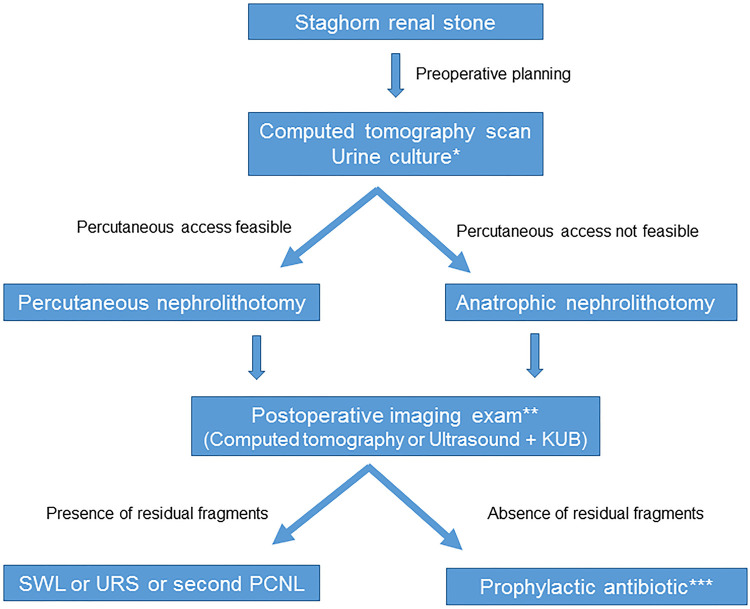
Patients with staghorn renal stones are challenging cases, requiring careful preoperative evaluation and close follow-up to avoid stone recurrence. In this article we aim to discuss the main topics related to staghorn renal stones with focus on surgical approach. Most of staghorn renal stones are composed of struvite (magnesium ammonium phosphate) and are linked to urinary tract infection by urease-producing pathogens. Preoperative computed tomography scan and careful evaluation of all urine cultures made prior surgery are essential for a well-planning surgical approach and a right antibiotics choice. Gold standard surgical technique is the percutaneous nephrolithotomy (PCNL). In cases of impossible percutaneous renal access, anatrophic nephrolithotomy is an alternative. Shockwave lithotripsy and flexible ureteroscopy are useful tools to treat residual fragments that can be left after treatment of complete staghorn renal stone. PCNL can be performed in supine or prone position according to surgeon's experience. Tranexamic acid can be used to avoid bleeding. To check postoperative stone-free status, computed tomography is the most accurate imaging exam, but ultrasound combined to KUB is an option. Intra-operative high-resolution fluoroscopy and flexible nephroscopy have been described as an alternative for looking at residual fragments and save radiation exposure. The main goals of treatment are stone-free status, infection eradication, and recurrence prevention. Long-term or short-term antibiotic therapy is recommended and regular control imaging exams and urine culture should be done.
Keywords: Infections; Kidney; Urinary Calculi.
Copyright® by the International Brazilian Journal of Urology.
Conflict of interest statement
None declared.
Figures
References
-
- 1. Flannigan R, Choy WH, Chew B, Lange D. Renal struvite stones--pathogenesis, microbiology, and management strategies. Nat Rev Urol. 2014;11:333-41. Erratum in: Nat Rev Urol. 2014;11:page after 341. - PubMed
- Flannigan R, Choy WH, Chew B, Lange D. Renal struvite stones--pathogenesis, microbiology, and management strategies. Nat Rev Urol. 2014;11:333–341. Erratum in: Nat Rev Urol. 2014;11:page after 341. - PubMed
