


Digital Mental Health and COVID-19: Using Technology Today to Accelerate the Curve on Access and Quality Tomorrow
- PMID: 32213476
- PMCID: PMC7101061
- DOI: 10.2196/18848
Digital Mental Health and COVID-19: Using Technology Today to Accelerate the Curve on Access and Quality Tomorrow
Abstract
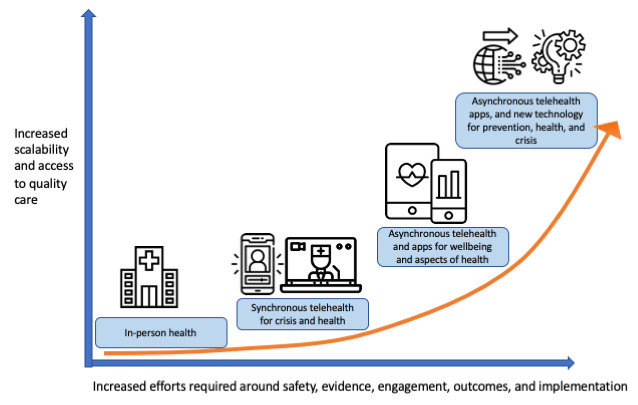
As interest in and use of telehealth during the COVID-19 global pandemic increase, the potential of digital health to increase access and quality of mental health is becoming clear. Although the world today must "flatten the curve" of spread of the virus, we argue that now is the time to "accelerate and bend the curve" on digital health. Increased investments in digital health today will yield unprecedented access to high-quality mental health care. Focusing on personal experiences and projects from our diverse authorship team, we share selected examples of digital health innovations while acknowledging that no single piece can discuss all the impressive global efforts past and present. Exploring the success of telehealth during the present crisis and how technologies like apps can soon play a larger role, we discuss the need for workforce training, high-quality evidence, and digital equity among other factors critical for bending the curve further.
Keywords: apps; digital health; emergency response; telehealth.
©John Torous, Keris Jän Myrick, Natali Rauseo-Ricupero, Joseph Firth. Originally published in JMIR Mental Health (http://mental.jmir.org), 26.03.2020.
Conflict of interest statement
Conflicts of Interest: JT reports unrelated research support from Otsuka. The views and opinions expressed in this article are those of the authors and do not reflect those of any employer, granting agency, hospital, health care system, government, or official policy.
Figures
Comment in
- https://mental.jmir.org/2020/4/e19547/ doi: 10.2196/19547
- JMIR Ment Health. 7:e23023. doi: 10.2196/23023
References
-
- Wind T, Rijkeboer M, Andersson G, Riper H. The COVID-19 pandemic: The ‘black swan’ for mental health care and a turning point for e-health. Internet Interventions. 2020 Mar;:100317. doi: 10.1016/j.invent.2020.100317. Accepted manuscript. Published online March 19, 2020 https://www.sciencedirect.com/science/journal/aip/22147829. - DOI - PMC - PubMed
-
- Ben-Zeev D, Buck B, Kopelovich S, Meller S. A technology-assisted life of recovery from psychosis. NPJ Schizophr. 2019 Sep 18;5(1):15. doi: 10.1038/s41537-019-0083-y. http://europepmc.org/abstract/MED/31534139 - DOI - PMC - PubMed
-
- Wong QJ, Werner-Seidler A, Torok M, van Spijker B, Calear AL, Christensen H. Service Use History of Individuals Enrolling in a Web-Based Suicidal Ideation Treatment Trial: Analysis of Baseline Data. JMIR Ment Health. 2019 Apr 02;6(4):e11521. doi: 10.2196/11521. https://mental.jmir.org/2019/4/e11521/ - DOI - PMC - PubMed
-
- Matcham F, Barattieri di San Pietro C, Bulgari V, de Girolamo G, Dobson R, Eriksson H, Folarin AA, Haro JM, Kerz M, Lamers F, Li Q, Manyakov NV, Mohr DC, Myin-Germeys I, Narayan V, Bwjh Penninx, Ranjan Y, Rashid Z, Rintala A, Siddi S, Simblett SK, Wykes T, Hotopf M, RADAR-CNS consortium Remote assessment of disease and relapse in major depressive disorder (RADAR-MDD): a multi-centre prospective cohort study protocol. BMC Psychiatry. 2019 Feb 18;19(1):72. doi: 10.1186/s12888-019-2049-z. https://bmcpsychiatry.biomedcentral.com/articles/10.1186/s12888-019-2049-z - DOI - PMC - PubMed
Publication types
Grants and funding
LinkOut - more resources
Full Text Sources
Medical
Miscellaneous
