. 2020 Mar;8(1):e000898.
doi: 10.1136/bmjdrc-2019-000898.

Mouse model of metformin-induced diarrhea

Affiliations

Mouse model of metformin-induced diarrhea

Hiroshi Takemori et al. BMJ Open Diabetes Res Care. 2020 Mar.

Abstract

Objective: Metformin, an oral medication used for type 2 diabetes mellitus, is the most commonly prescribed drug with less economic burden of patients. Although metformin's efficacy and safety have long been recognized, approximately 5% of the patients treated with this drug develop severe diarrhea as an adverse effect and have to abandon treatment. Because there is no animal model to study metformin-induced diarrhea, it is hard to develop methods to maintain quality of life of patients prescribed with metformin.

Research design and methods: Using mouse models, we tried to develop an evaluation system for metformin-induced diarrhea to improve diarrheal symptoms in patients with diabetes. Healthy (C57BL/6J) and diabetic obese (db/db) mice were subjected to a stepwise dose escalation of metformin (250 mg/kg/day (125 mg/kg twice daily oral dose)-1000 mg/kg/day (500 mg/kg twice daily oral dose)), and fecal moisture contents and their score were monitored. To evaluate anti-diarrheal medications, wood creosote (a traditional medicine) was tested. Several groups of enterobacteria in fresh feces were examined by using PCR.

Results: 1000 mg/kg/day (four times maximal effective dose) of metformin significantly increased fecal moisture content. Although no symptoms of diarrhea were observed in healthy C57BL/6J mice, the same dose of metformin induced severe diarrhea in diabetic obese db/db mice. A reduction in PCR signals for the Firmicutes group was associated with metformin-induced diarrhea. Wood creosote reduced diarrhea (high water-content) without affecting metformin's efficacy or enterobacterial flora levels.

Conclusions: We have created the first animal model of metformin-induced diarrhea using db/db mice, which will provide better quality of life for patients suffering from diarrhea caused by metformin.

Keywords: diarrhea; metformin; mouse model(s); oral antidiabetics.


Conflict of interest statement

Competing interests: We declare that MI, MT, HM, TM, KO, and TS are employed by Taiko Pharmaceutical Co., Ltd. AH and KI have nothing to declare.

Figures
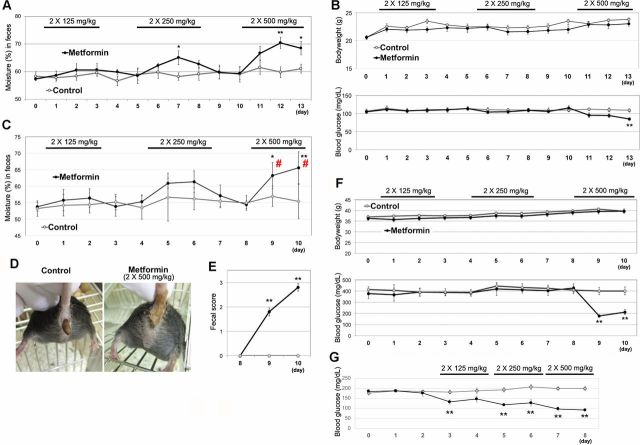
Figure 1
Figure 1
Metformin induces severe diarrhea in diabetic obese mice. (A) Ten-week-old male C57BL/6J mice (n=5) were orally administered metformin with a stepwise increase in dose from 125 mg/kg twice daily to 500 mg/kg twice daily, for 3 days with 2-days interval (without administration). Wet weight of feces, collected into sample tubes, was measured. The feces were dehydrated (90°C for overnight), and the dry weight was measured to determine the feces moisture content. Data are shown as means±SEM. *P<0.05, **p<0.01 between the control group (saline alone) and the metformin group. (B) Bodyweight (upper) and blood glucose (lower) changes of 10-week-old male C57BL/6J mice (in figure 1A) were monitored. P<0.05, **p<0.01 between the metformin group and the co-treatment group. (C) Ten-week-old male db/db mice (n=6) also received metformin with a stepwise increase in dose from 125 mg/kg twice daily to 500 mg/kg twice daily, for 2 days with 2-days interval. # indicates that the values (feces moisture content) are not accurate, due to severe diarrhea. (D) Representative image of the severe diarrhea. (E) Fecal score (at day 8–10) was calculated as follows. 0: normal, 1: stick to forceps, 2: collapsed by forceps, 3: unformed feces. (F) Bodyweight (upper) and blood glucose (lower) changes of 10-week-old male db/db mice (in figure 1B) were monitored. (G) Blood glucose levels after a 3-hour fast were monitored in a different group of db/db mice (10-week-old male mice, n=5).
Figure 2
Figure 2
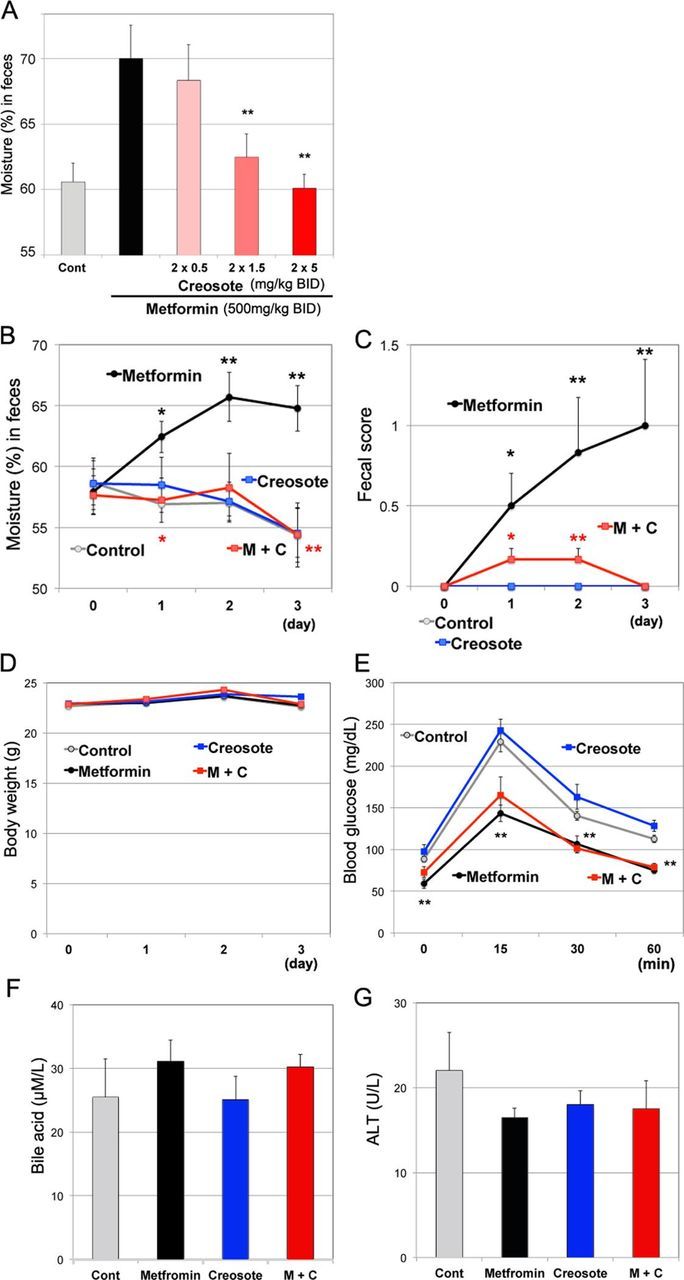
Effects of wood creosote on healthy mice treated with metformin. (A) Ten-week-old male C57BL/6J mice (n=4) were orally administered metformin (500 mg/kg twice daily) and different dose of wood creosote (<5 mg/kg twice daily). At 8 hours after the second treatment, feces were collected into sample tubes. Bars indicate mean fecal moisture (%)±SEM. *P<0.05, **p<0.01 between the metformin group and the co-treatment group. Ten-week-old male C57BL/6J mice (n=6) received metformin (500 mg/kg twice daily) with or without wood creosote (5 mg/kg twice daily) for 3 days. The changes of fecal moisture (B), fecal score (C), and body weight (D) were monitored. (E) Mice were fasted for 3 hours after the final treatment. One g/kg glucose was administrated via orally. One to 2 µL of blood was collected via tail vein at indicated time points, and blood glucose was measured using GlucoSensor. At day 4, blood was collected from the ventricle from anesthetized animals. The levels of serum bile acids (F) and alanine aminotransferase (ALT) (G) were measured. M+C, metformin+creosote.
Figure 3
Figure 3
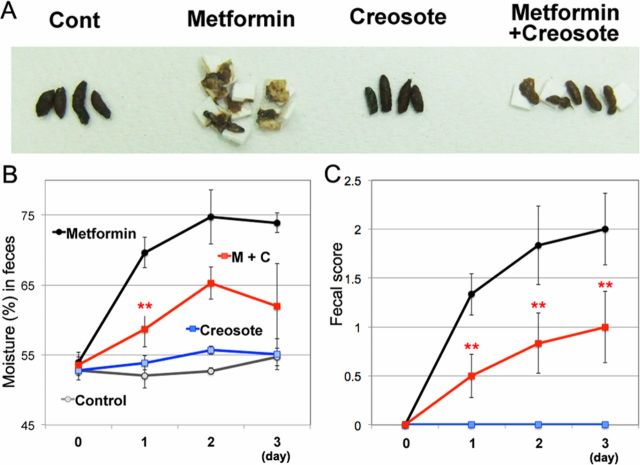
Wood creosote reduces diarrhea induced by metformin in obese diabetic mice. (A) Collected feces from the different experimental groups. (B) Effects of metformin (500 mg/kg twice daily) and wood creosote (5 mg/kg twice daily) co-administration on feces moisture content was examined (n=6). Red ** indicates p<0.01 between the metformin group and the co-administered group (M+C). (C) Fecal score. Data are shown as mean±SEM. *P<0.05, **p<0.01 between the control group (saline alone) and the metformin group. M+C, metformin+creosote.
Figure 4
Figure 4
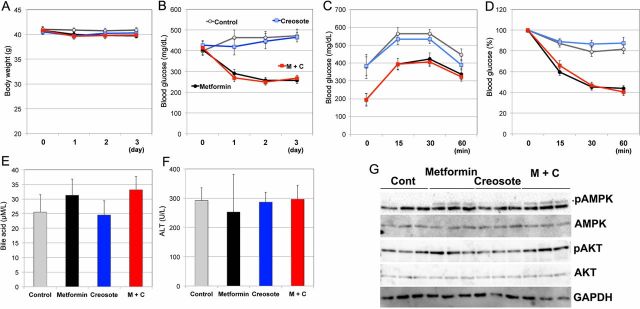
Effects of wood creosote on diabetic obese mice treated with metformin. Wood creosote does not affect efficacy of metformin. Weight change (A) and blood glucose levels (fed condition) (B) were examined during the experiment in figure 3. Data are shown as means±SEM. No significant differences between the metformin group and the metformin with wood creosote (M+C) group were observed. Mice were fasted for 3 hours after the final administration of drugs. (C) One g/kg glucose was administrated via oral gavage. One to 2 µL blood was collected via tail vein at indicated time points, and blood glucose was measured by using GlucoSensor. (D) At day 4 of figure 3, mice were fasted for 2 hours and then injected intraperitoneally with 36 µg/kg insulin. Blood glucose levels are shown as % initial. At day 5 in figure 3, blood was collected and measured serum bile acid levels (E) and alanine aminotransferase (F) were measured. (G) Western blots were carried out using liver protein (50 µg) to detect levels of phospho-AMPK and phoshopho-AKT. AKT, Protein Kinase B; AMPK, AMP-activated kinase.
Figure 5
Figure 5
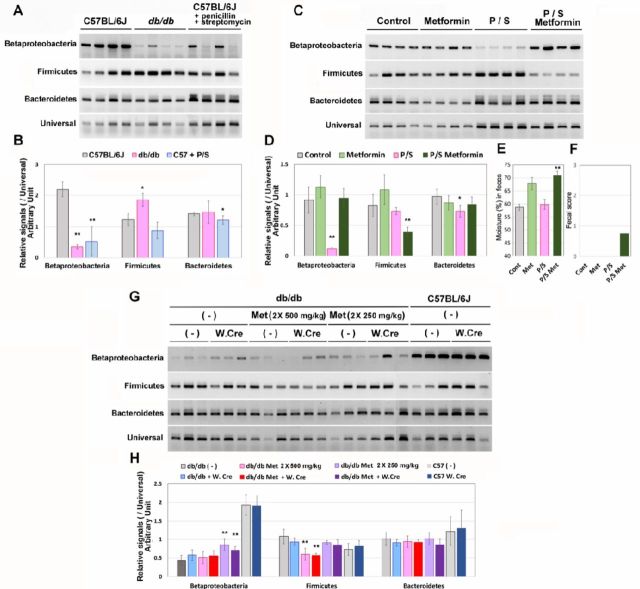
Difference in enterobacterial flora in db/db mice and metformin-treated mice. Enterobacterial DNA was prepared from the fresh feces of healthy (C57BL/6J), db/db, and healthy mice treated with antibiotics (penicillin and streptomycin) treatment for 3 days (10-week-old male mice, n=4, each). The DNA was analyzed by PCR, gel electrophoresis (A), and qPCR (B). The bars indicate the SD; * and ** indicate p<0.05 and p<0.01, respectively. C57BL/6J mice (n=4) that had been treated with the antibiotics (P/S: penicillin/streptomycin) for 3 days were treated with or without metformin (500 mg/kg twice daily) for 2 days with the antibiotics. The enterobacterial flora were analyzed by PCR (C and D). Fecal moisture (E) and score (F) were also analyzed on the final day. db/db mice (10-week-old male mice, n=6) were treated with metformin (Met: 250 mg/kg twice daily for 2 days followed by 500 mg/kg twice daily for 2 days) with or without wood creosote (W. CRE: 5 mg/kg twice daily). (-) indicates without metformin or without wood creosote, as appropriate. Diarrhea was observed in db/db mice treated only with metformin (500 mg/kg twice daily). (G) and (H) show the results of PCR analyses of the enterobacterial flora.

References

    1. Bailey CJ. Metformin: historical overview. Diabetologia 2017;60:1566–76. 10.1007/s00125-017-4318-z - DOI - PubMed
    1. Zhou G, Myers R, Li Y, et al. . Role of AMP-activated protein kinase in mechanism of metformin action. J Clin Invest 2001;108:1167–74. 10.1172/JCI13505 - DOI - PMC - PubMed
    1. Bouchoucha M, Uzzan B, Cohen R. Metformin and digestive disorders. Diabetes Metab 2011;37:90–6. 10.1016/j.diabet.2010.11.002 - DOI - PubMed
    1. Appleby RN, Moghul I, Khan S, et al. . Non-Alcoholic fatty liver disease is associated with dysregulated bile acid synthesis and diarrhea: a prospective observational study. PLoS One 2019;14:e0211348 10.1371/journal.pone.0211348 - DOI - PMC - PubMed
    1. Ji L, Liu J, Yang J, et al. . Comparative effectiveness of metformin monotherapy in extended release and immediate release formulations for the treatment of type 2 diabetes in treatment-naïve Chinese patients: analysis of results from the consent trial. Diabetes Obes Metab 2018;20:1006–13. 10.1111/dom.13190 - DOI - PubMed

Publication types