


Triad hybridization via a conduit species
- PMID: 32213581
- PMCID: PMC7148562
- DOI: 10.1073/pnas.2000388117
Triad hybridization via a conduit species
Abstract
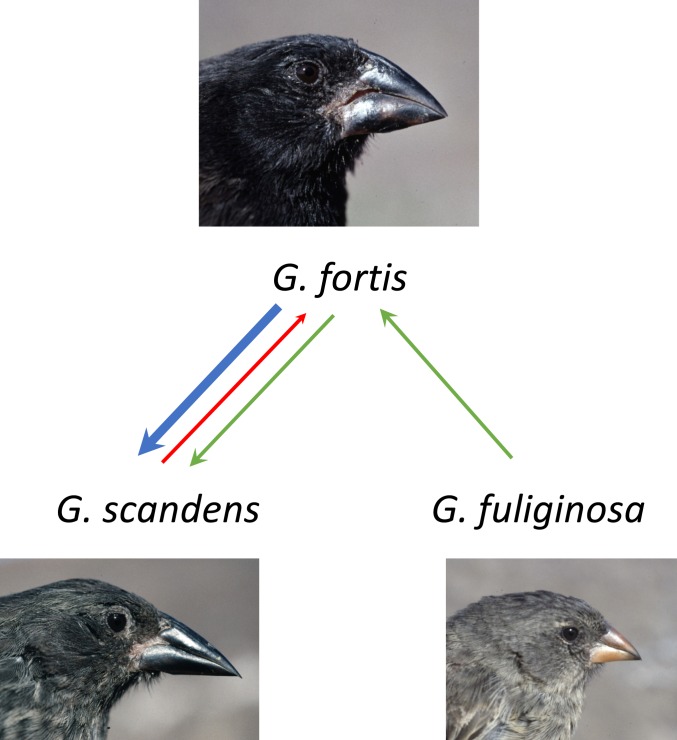
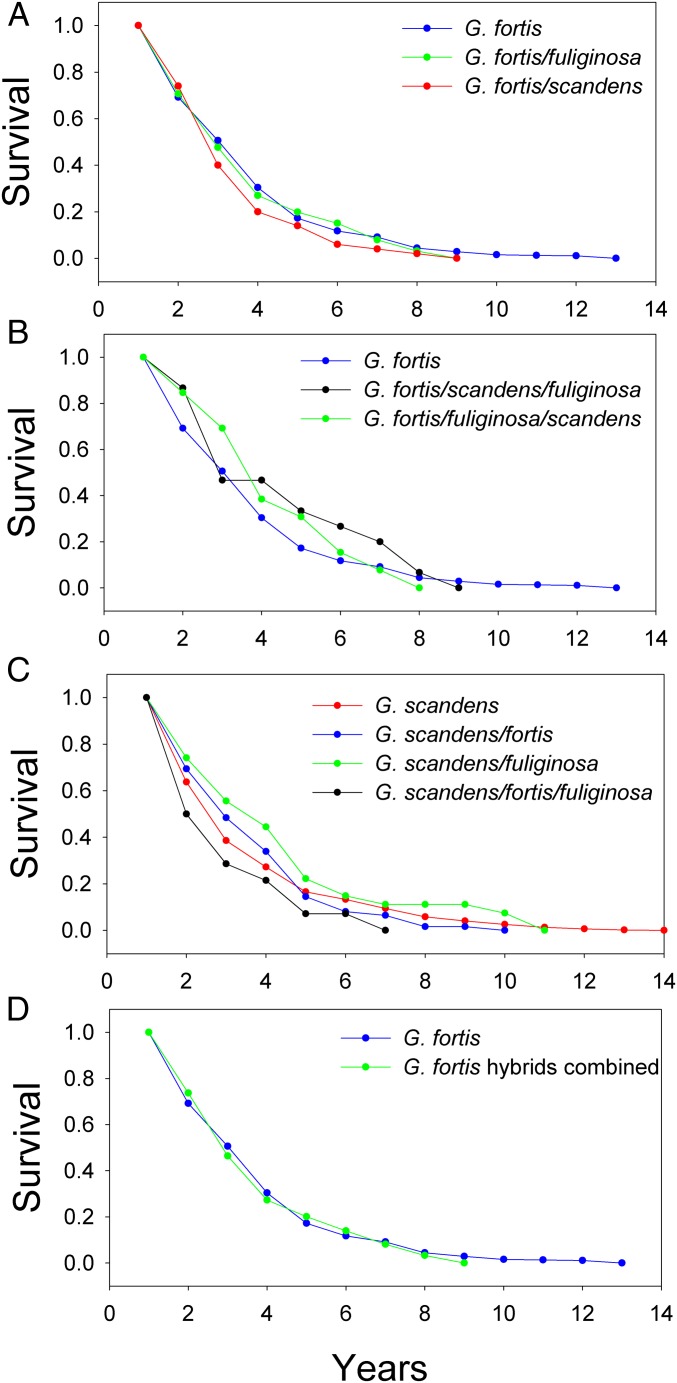
Introgressive hybridization can affect the evolution of populations in several important ways. It may retard or reverse divergence of species, enable the development of novel traits, enhance the potential for future evolution by elevating levels of standing variation, create new species, and alleviate inbreeding depression in small populations. Most of what is known of contemporary hybridization in nature comes from the study of pairs of species, either coexisting in the same habitat or distributed parapatrically and separated by a hybrid zone. More rarely, three species form an interbreeding complex (triad), reported in vertebrates, insects, and plants. Often, one species acts as a genetic link or conduit for the passage of genes (alleles) between two others that rarely, if ever, hybridize. Demographic and genetic consequences are unknown. Here we report results of a long-term study of interbreeding Darwin's finches on Daphne Major island, Galápagos. Geospiza fortis acted as a conduit for the passage of genes between two others that have never been observed to interbreed on Daphne: Geospiza fuliginosa, a rare immigrant, and Geospiza scandens, a resident. Microsatellite gene flow from G. fortis into G. scandens increased in frequency during 30 y of favorable ecological conditions, resulting in genetic and morphological convergence. G. fortis, G. scandens, and the derived dihybrids and trihybrids experienced approximately equal fitness. Especially relevant to young adaptive radiations, where species differ principally in ecology and behavior, these findings illustrate how new combinations of genes created by hybridization among three species can enhance the potential for evolutionary change.
Keywords: convergence; fitness; introgression; speciation; trihybrids.
Conflict of interest statement
The authors declare no competing interest.
Figures
References
-
- Abbott R., et al. , Hybridization and speciation. J. Evol. Biol. 26, 229–246 (2013). - PubMed
-
- Taylor S. A., Larson E. L., Insights from genomes into the evolutionary importance and prevalence of hybridization in nature. Nat. Ecol. Evol. 3, 170–177 (2019). - PubMed
-
- Mateos M., Vrijenhoek R. C., Ancient versus reticulate origin of a hemiclonal lineage. Evolution 56, 985–992 (2002). - PubMed
-
- Bogart J. P., Bi K., Fu J., Noble D. W., Niedzwiecki J., Unisexual salamanders (genus Ambystoma) present a new reproductive mode for eukaryotes. Genome 50, 119–136 (2007). - PubMed
Publication types
MeSH terms
LinkOut - more resources
Full Text Sources
