


Impact of air pollution on breast cancer incidence and mortality: a nationwide analysis in South Korea
- PMID: 32214155
- PMCID: PMC7096411
- DOI: 10.1038/s41598-020-62200-x
Impact of air pollution on breast cancer incidence and mortality: a nationwide analysis in South Korea
Abstract
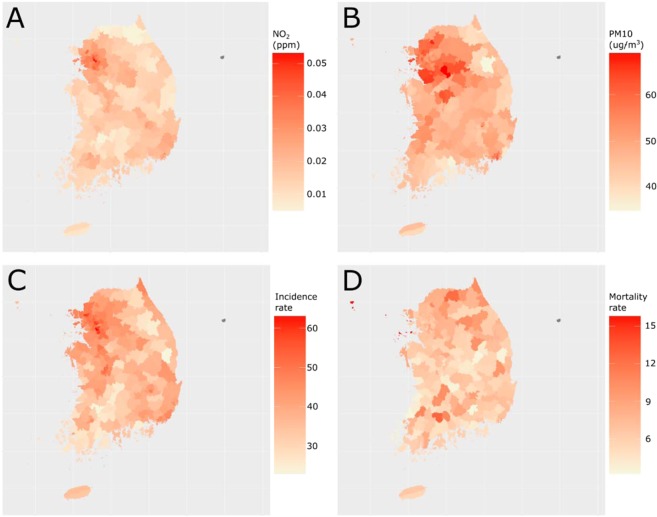
Breast cancer is one of the major female health problems worldwide. Although there is growing evidence indicating that air pollution increases the risk of breast cancer, there is still inconsistency among previous studies. Unlike the previous studies those had case-control or cohort study designs, we performed a nationwide, whole-population census study. In all 252 administrative districts in South Korea, the associations between ambient NO2 and particulate matter 10 (PM10) concentration, and age-adjusted breast cancer mortality rate in females (from 2005 to 2016, Nmortality = 23,565), and incidence rate (from 2004 to 2013, Nincidence = 133,373) were investigated via multivariable beta regression. Population density, altitude, rate of higher education, smoking rate, obesity rate, parity, unemployment rate, breastfeeding rate, oral contraceptive usage rate, and Gross Regional Domestic Product per capita were considered as potential confounders. Ambient air pollutant concentrations were positively and significantly associated with the breast cancer incidence rate: per 100 ppb CO increase, Odds Ratio OR = 1.08 (95% Confidence Interval CI = 1.06-1.10), per 10 ppb NO2, OR = 1.14 (95% CI = 1.12-1.16), per 1 ppb SO2, OR = 1.04 (95% CI = 1.02-1.05), per 10 µg/m3 PM10, OR = 1.13 (95% CI = 1.09-1.17). However, no significant association between the air pollutants and the breast cancer mortality rate was observed except for PM10: per 10 µg/m3 PM10, OR = 1.05 (95% CI = 1.01-1.09).
Conflict of interest statement
The authors declare no competing interests.
Figures
References
MeSH terms
Substances
LinkOut - more resources
Full Text Sources
Medical
