


The Short Health Anxiety Inventory: Psychometric Properties and Construct Validity in a Non-clinical Sample
- PMID: 32214558
- PMCID: PMC7088052
- DOI: 10.1007/s10608-006-9058-1
The Short Health Anxiety Inventory: Psychometric Properties and Construct Validity in a Non-clinical Sample
Abstract
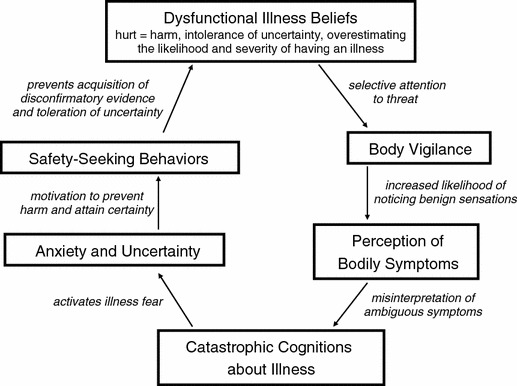
Contemporary conceptualizations of hypochondriasis (HC) as severe health anxiety have led to the development of cognitive-behavioral approaches to understanding, assessing, and treating this problem. The Short Health Anxiety Inventory (SHAI) is a new instrument that measures cognitive factors associated with HC. In the present study, we examined the psychometric properties and factor structure of the SHAI in a large sample of medically healthy university students. We also examined the scale's convergent, divergent, and predictive validity. Results indicated that the SHAI has good psychometric properties and contains three factors that assess the perceived likelihood and perceived severity of becoming ill, and body vigilance. Facets of health anxiety uniquely predicted increased safety-seeking behavior and medical utilization, behaviors that are commonly observed in HC. Results are discussed in terms of the cognitive-behavioral model of HC.
Keywords: Anxiety; Cognitive-behavioral model; Health anxiety; Hypochondriasis.
© Springer Science+Business Media, Inc. 2006.
Figures
References
-
- Abramowitz J. S., Schwartz S. A., Whiteside S. P. A contemporary conceptual model of hypochondriasis. Mayo Clinic Proceedings. 2002;77:1323–1330. - PubMed
-
- American Psychological Association . Diagnostic and statistical manual of mental disorders (4th edition, text revision) Washington DC: Author; 2000.
-
- Barsky A., Wyshak G., Klerman G. Hypochondriasis: An evaluation of the DSM-III-R criteria in medical outpatients. Archives of General Psychiatry. 1986;43:493–500. - PubMed
LinkOut - more resources
Full Text Sources
Medical