Review
. 2019 Oct 23;7(2):185-198.
doi: 10.1016/j.gendis.2019.10.007. eCollection 2020 Jun.

Metabolic reprogramming in tumors: Contributions of the tumor microenvironment

Affiliations
Review

Metabolic reprogramming in tumors: Contributions of the tumor microenvironment

Andrew N Lane et al. Genes Dis. .

Abstract

The genetic alterations associated with cell transformation are in large measure expressed in the metabolic phenotype as cancer cells proliferate and change their local environment, and prepare for metastasis. Qualitatively, the fundamental biochemistry of cancer cells is generally the same as in the untransformed cells, but the cancer cells produce a local environment, the TME, that is hostile to the stromal cells, and compete for nutrients. In order to proliferate, cells need sufficient nutrients, either those that cannot be made by the cells themselves, or must be made from simpler precursors. However, in solid tumors, the nutrient supply is often limiting given the potential for rapid proliferation, and the poor quality of the vasculature. Thus, cancer cells may employ a variety of strategies to obtain nutrients for survival, growth and metastasis. Although much has been learned using established cell lines in standard culture conditions, it is becoming clear from in vivo metabolic studies that this can also be misleading, and which nutrients are used for energy production versus building blocks for synthesis of macromolecules can vary greatly from tumor to tumor, and even within the same tumor. Here we review the operation of metabolic networks, and how recent understanding of nutrient supply in the TME and utilization are being revealed using stable isotope tracers in vivo as well as in vitro.

Keywords: 2OG, 2-oxoglutarate; ACO1,2, aconitase 1,2; CP-MAS, Cross polarization Magic Angle Spinning; Cancer metabolism; DMEM, Dulbeccos Modified Eagles Medium; ECAR, extracellular acidification rate; ECM, extracellular matrix; EMP, Embden-Meyerhof Pathway; IDH1,2, isocitrate dehydrogenase 1,2 (NADP+dependent); IF, interstitial fluid; ME, malic enzyme; Metabolic flux; Nutrient supply; RPMI, Roswell Park Memorial Institute; SIRM, Stable Isotope Resolved Metabolomics; Stable isotope resolved metabolomics; TIL, tumor infiltrating lymphocyte; TIM/TPI, triose phosphate isomerase; TME, Tumor Micro Environment; Tumor microenvironment.


Conflict of interest statement

The authors declare no conflict of interest.

Figures
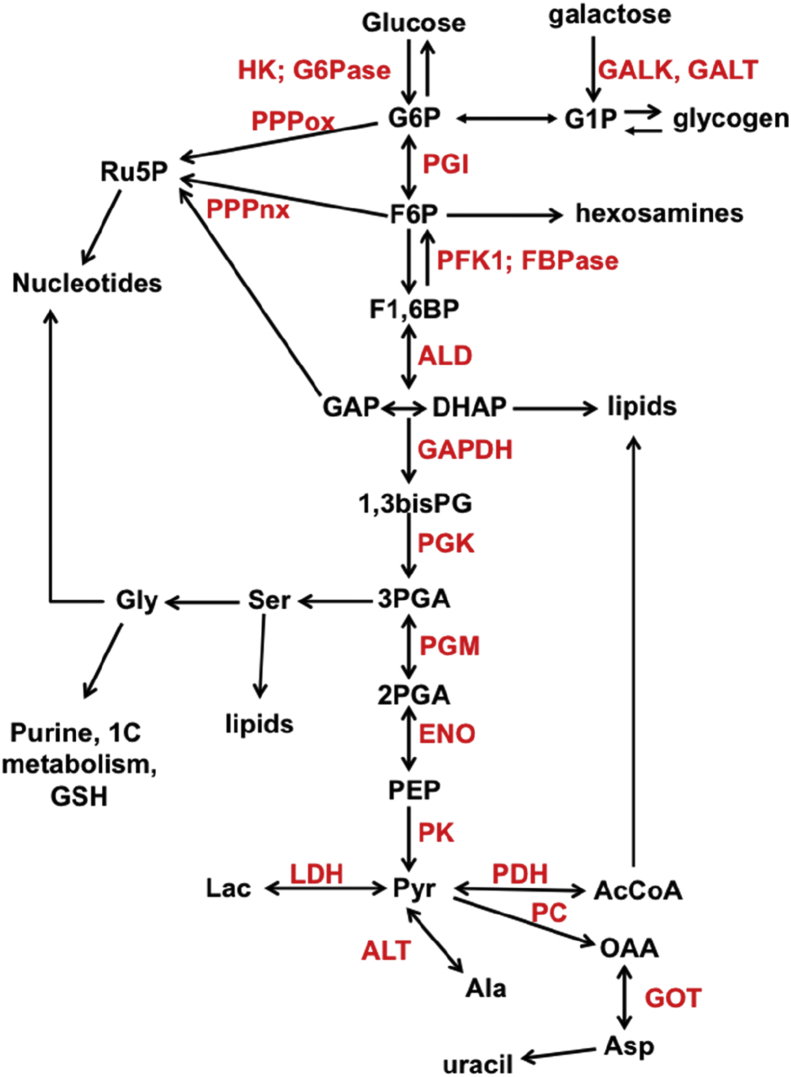
Figure 1
Figure 1
Metabolic subnetwork centered on glucose metabolism. Double headed arrows represent reversible reactions catalyzed by the same enzyme; two arrows represent reactions catalyzed by different enzymes. Enzyme names are in red. G6P: glucose-6-phosphate; F6P fructose-6-phosphate; F1,6BP fructose-1,6-bisphosphate; GAP glyceraldehyde-3-phosphate; DHAP dihydroxyacetone phosphate; 1,3bisPG 1,3-bisphosphoglycerate; 2PGA 2-phosphogycerate; PEP phosphoenolpyruvate; Pyr pyruvate; OAA oxaloacetate; AcCoA acetyl CoA; Lac lactate; Ru5P ribose-5-phosphate; GSH reduced glutathione; GALK galactose 1 kinase; GALT galcaose-1-phosphate uridyltransferase; HK hexokinase; G6Pase glucose-6-phosphatase; PGI phosphoglucose isomerase; PFK1 phosphofructokinase 1; FBPase fructose 1,6 bisphosphatase; ALD aldolase; GAPDH glyceraldehyde-3- phosphate dehydrogenase; PGK phosphoglycerate kinase; PGM phosphoglycerate mutase; ENO enolase; PK pyruvate kinase; LDH lactate dehydrogenase; ALT alanine aminotransferase; PC pyruvate carboxylase; PDH pyruvate dehydrogenase; GOT glutamate oxaloacetate aminotransferase; PPPox oxidative branch of the pentose phosphate pathway; PPPnx non-oxidative branch of the pentose phosphate pathway.
Figure 2
Figure 2
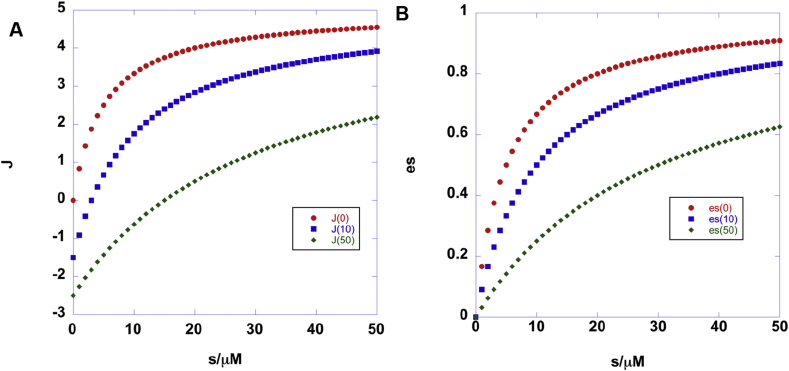
Flux simulations for a reversible enzyme. J is the flux calculated as a function of substrate concentration s from different concentrations of product p (0, 10, 50 μM) from Eq. (1A), (1B), (1C), (1D) using the following values: KS = 5 μM, Kp = 10 μM, k2 = 5 s−1 k-2 = 3 s−1. Keq = 3.33333. es is the corresponding concentration of the ES complex calculated according to Eq. (1D). (A). Net flux for p = 0,10,20 μM (et = 1). (B). es for p = 0,10,20 μM (et = 1).
Scheme 1
Scheme 1
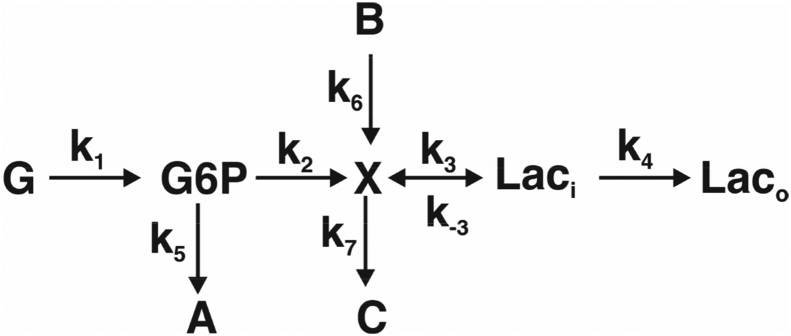
Simple branched kinetic pathway. ki are rate constants for the interconversions. The rate of G consumption then is –dg/dt = k1 g where lower case g genotes concentration of the metabolite G. Expressions for the rates of production of A, C and Lac are developed in the text.
Figure 3
Figure 3
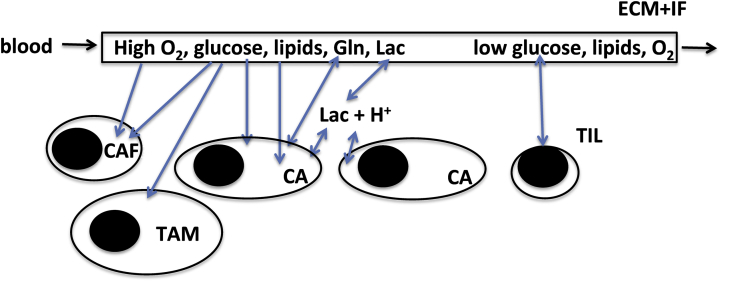
Tumor microenvironment and metabolism. Cancer cells compete with stromal cells for nutrients supplied by the blood, especially glucose, oxygen and lipids, and excrete compounds such as PD-L1 lactate and protons that are immunosuppressive, and which induce changes in macrophage polarization and thence TILs. Cancer cells may also engulf ECM and debris by macropinocyosis to fuel growth and survival (see text). CAF cancer associated fibroblast; TAM tumor associated macrophage; TIL tumor infiltrating lymphocyte; CA cancer cell. ECM + IF extracellular matrix + interstitial fluid.

References

    1. Weinberg R.A. Garland Science; New York: 2014. The Biology of Cancer.
    1. Crystal R.G., Randell S.H., Engelhardt J.F., Voynow J., Sunday M.E. Airway epithelial cells current concepts and challenges. Proc Am Thorac Soc. 2008;5:772–777. - PMC - PubMed
    1. Farese R.V., Jr., Walther T.C. Lipid droplets finally get a little R-E-S-P-E-C-T. Cell. 2009;139:855–860. - PMC - PubMed
    1. Crooks D., Maio N., Lane A. Acute loss of iron-sulfur clusters results in metabolic reprogramming and generation of lipid droplets in mammalian cells. J Biol Chem. 2018;293:8297–8311. - PMC - PubMed
    1. Tirinato L., Pagliari F., Limongi T. An overview of lipid droplets in cancer and cancer stem cells. Stem Cell Int. 2017 - PMC - PubMed

LinkOut - more resources