. 2020 Mar 25;9(4):243.
doi: 10.3390/pathogens9040243.

In Vitro Anti-NTHi Activity of Haemophilin-Producing Strains of Haemophilus haemolyticus

Affiliations

In Vitro Anti-NTHi Activity of Haemophilin-Producing Strains of Haemophilus haemolyticus

Brianna Atto et al. Pathogens. .

Abstract

Nontypeable Haemophilus influenzae (NTHi) is a leading causative organism of opportunistic respiratory tract infections. However, there are currently no effective vaccination strategies, and existing treatments are compromised by antibiotic resistance. We previously characterized Haemophilus haemolyticus (Hh) strains capable of producing haemophilin (HPL), a heme-binding protein that restricts NTHi growth by limiting its access to an essential growth factor, heme. Thus, these strains may have utility as a probiotic therapy against NTHi infection by limiting colonization, migration and subsequent infection in susceptible individuals. Here, we assess the preliminary feasibility of this approach by direct in vitro competition assays between NTHi and Hh strains with varying capacity to produce HPL. Subsequent changes in NTHi growth rate and fitness, in conjunction with HPL expression analysis, were employed to assess the NTHi-inhibitory capacity of Hh strains. HPL-producing strains of Hh not only outcompeted NTHi during short-term and extended co-culture, but also demonstrated a growth advantage compared with Hh strains unable to produce the protein. Additionally, HPL expression levels during competition correlated with the NTHi-inhibitory phenotype. HPL-producing strains of Hh demonstrate significant probiotic potential against NTHi colonization in the upper respiratory tract, however, further investigations are warranted to demonstrate a range of other characteristics that would support the eventual development of a probiotic.

Keywords: Haemophilus haemolyticus; Haemophilus influenzae; chronic obstructive pulmonary disease; heme; heme-binding protein; otitis media; respiratory infection; respiratory probiotic.


Conflict of interest statement

The authors declare no conflict of interest.

Figures

Figure 1
Figure 1
Baseline HPL expression. PCR-quantified expression of HPL for Haemophilus haemolyticus (Hh) strains containing identical HPL open reading frames (ORFs) (relative to Hh-BW1HPL-KO). Data points are represented as mean +/− SEM of four biological replicates, performed from duplicate RNA extractions.
Figure 2
Figure 2
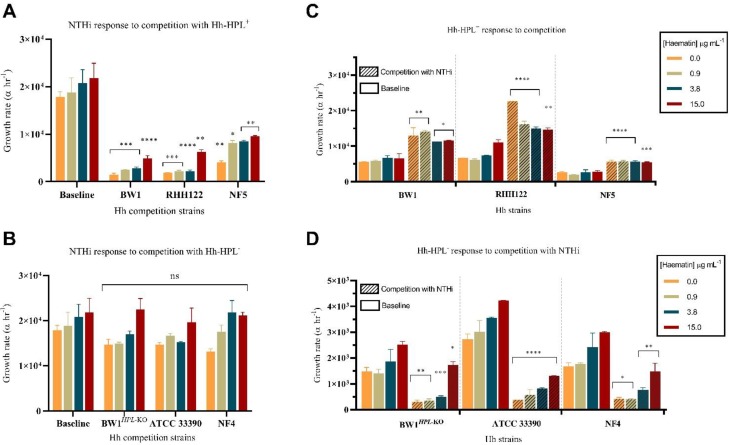
Short-term competition between Haemophilus influenzae (NTHi) and Hh. Calculated growth rates of NTHi in response to competition with (A) Hh-HPL+ or (B) Hh-HPL. The growth rate for each (C) Hh-HPL+ and (D) Hh-HPL strain was also determined. Data points represented as mean +/− SEM of three separate experiments, performed in triplicate; p < 0.05 *, p < 0.005 **, p < 0.0005 ***, p < 0.0001 ****.
Figure 3
Figure 3
HPL expression during competition. PCR-quantified expression of HPL during competition with NTHi relative to individual growth. Data points are represented as mean +/− SEM of four biological replicates, performed from duplicate RNA extractions.
Figure 4
Figure 4
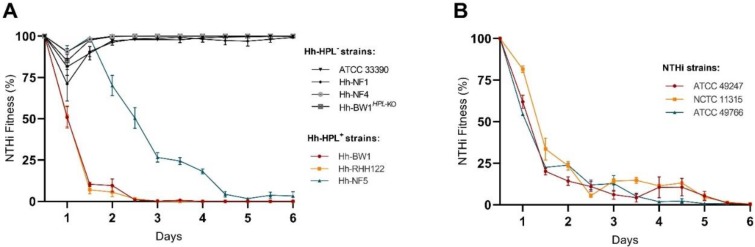
Fitness of NTHi strains during co-culture with Hh. Calculated fitness of NTHi in response to competition with Hh-HPL+ or Hh-HPL relative to growth of the competitor strain. (A) Competition between a single NTHi strain and multiple Hh, or (B) multiple NTHi against Hh-BW1. Data points represented as mean +/− SEM of three separate experiments, performed in quadruplicate.

References

    1. Mukundan D., Ecevit Z., Patel M., Marrs C.F., Gilsdorf J.R. Pharyngeal colonization dynamics of Haemophilus influenzae and Haemophilus haemolyticus in healthy adult carriers. J. Clin. Microbiol. 2007;45:3207–3217. doi: 10.1128/JCM.00492-07. - DOI - PMC - PubMed
    1. Van Eldere J., Slack M.P., Ladhani S., Cripps A.W. Non-typeable Haemophilus influenzae, an under-recognised pathogen. Lancet Infect. Dis. 2014;14:1281–1292. doi: 10.1016/S1473-3099(14)70734-0. - DOI - PubMed
    1. Murphy T.F. Vaccines for nontypeable Haemophilus influenzae: The future is now. Clin. Vaccine Immunol. 2015;22:459–466. doi: 10.1128/CVI.00089-15. - DOI - PMC - PubMed
    1. King P. Haemophilus influenzae and the lung (Haemophilus and the lung) Clin. Transl. Med. 2012;1:1–9. doi: 10.1186/2001-1326-1-10. - DOI - PMC - PubMed
    1. Langereis J.D., de Jonge M.I. Invasive disease caused by nontypeable Haemophilus influenzae. Emerg. Infect. Dis. 2015;21:1711. doi: 10.3201/eid2110.150004. - DOI - PMC - PubMed

LinkOut - more resources