Review
. 2020 Mar 25;21(7):2269.
doi: 10.3390/ijms21072269.

Alveolar Epithelial Type II Cells as Drivers of Lung Fibrosis in Idiopathic Pulmonary Fibrosis

Affiliations
Review

Alveolar Epithelial Type II Cells as Drivers of Lung Fibrosis in Idiopathic Pulmonary Fibrosis

Tanyalak Parimon et al. Int J Mol Sci. .

Abstract

: Alveolar epithelial type II cells (AT2) are a heterogeneous population that have critical secretory and regenerative roles in the alveolus to maintain lung homeostasis. However, impairment to their normal functional capacity and development of a pro-fibrotic phenotype has been demonstrated to contribute to the development of idiopathic pulmonary fibrosis (IPF). A number of factors contribute to AT2 death and dysfunction. As a mucosal surface, AT2 cells are exposed to environmental stresses that can have lasting effects that contribute to fibrogenesis. Genetical risks have also been identified that can cause AT2 impairment and the development of lung fibrosis. Furthermore, aging is a final factor that adds to the pathogenic changes in AT2 cells. Here, we will discuss the homeostatic role of AT2 cells and the studies that have recently defined the heterogeneity of this population of cells. Furthermore, we will review the mechanisms of AT2 death and dysfunction in the context of lung fibrosis.

Keywords: alveolar epithelial cells; epithelial cell dysfunction; pulmonary fibrosis; stem cell exhaustion.


Conflict of interest statement

The authors declare no conflict of interest.

Figures
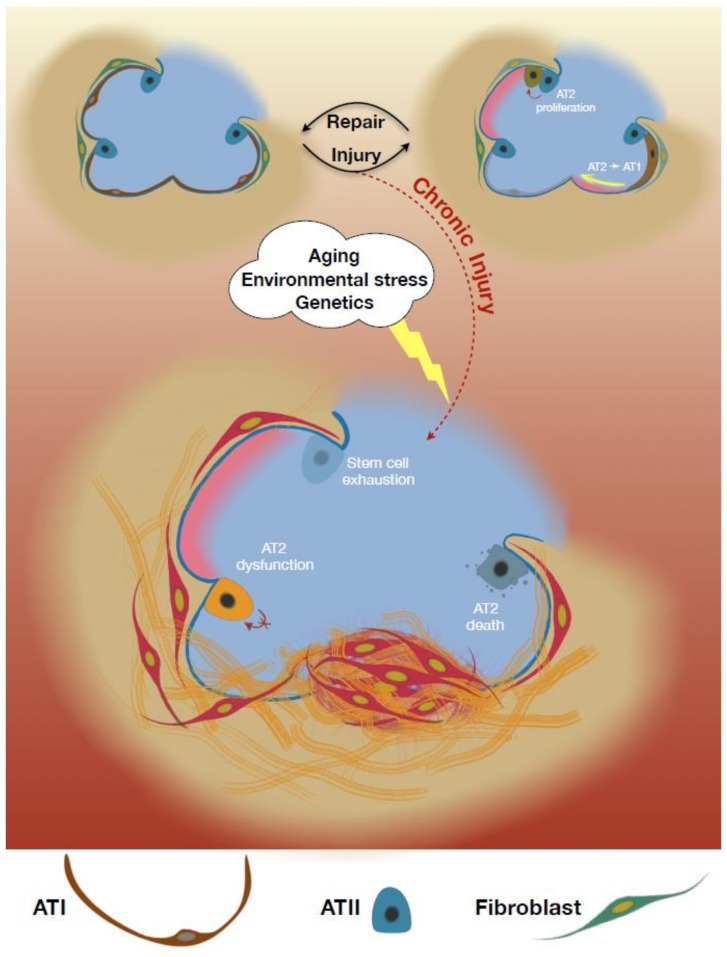
Figure 1
Figure 1
Alveolar epithelial type II cells (AT2) functions in lung fibrosis. An overview schematic illustration described functional roles of AT2 cells to maintain lung homeostasis during injuries and their profibrotic phenotypic changes that promote lung fibrosis upon the presence of risk factors e.g., aging, environmental stress, etc.
Figure 2
Figure 2
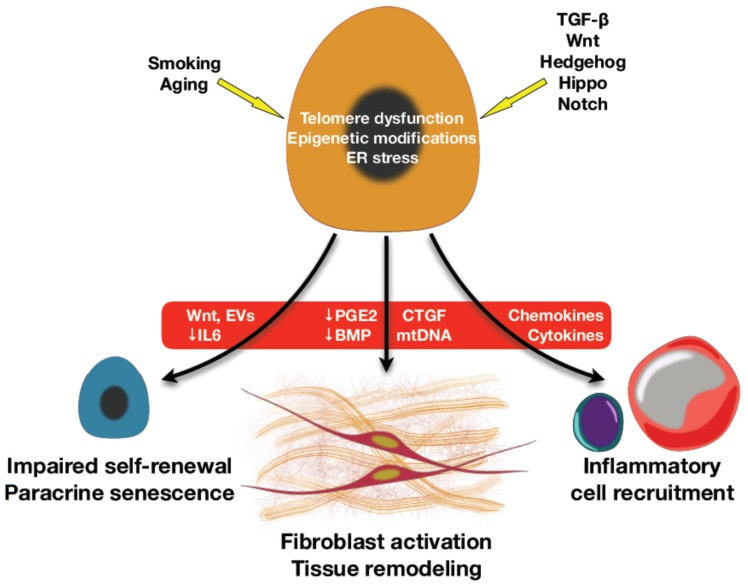
Mechanisms and regulatory signaling of alveolar type II epithelial cells (AT2) dysfunction in lung fibrosis. In lung fibrosis, environmental or intrinsic factors and several signaling regulatory pathways e.g., TGF-β, Wnt, Hedgehog, etc. stimulate AT2 senescence to release senescence-associated secretory phenotype (SASP) and other mediators that can directly activate fibroblasts and tissue remodeling. The indirect effects of SASP include inflammatory cell recruitment and AT2 self-renewal exhaustion through a paracrine effect.

References

    1. Ley B., Collard H.R., King T.E., Jr. Clinical course and prediction of survival in idiopathic pulmonary fibrosis. Am. J. Respir. Crit. Care Med. 2011;183:431–440. doi: 10.1164/rccm.201006-0894CI. - DOI - PubMed
    1. Hutchinson J., Fogarty A., Hubbard R., McKeever T. Global incidence and mortality of idiopathic pulmonary fibrosis: A systematic review. Eur. Respir. J. 2015;46:795–806. doi: 10.1183/09031936.00185114. - DOI - PubMed
    1. Hutchinson J.P., McKeever T.M., Fogarty A.W., Navaratnam V., Hubbard R.B. Increasing Global Mortality from Idiopathic Pulmonary Fibrosis in the Twenty-First Century. Ann. ATS. 2014;11:1176–1185. doi: 10.1513/AnnalsATS.201404-145OC. - DOI - PubMed
    1. Martinez F.J., Collard H.R., Pardo A., Raghu G., Richeldi L., Selman M., Swigris J.J., Taniguchi H., Wells A.U. Idiopathic pulmonary fibrosis. Nat. Rev. Dis. Primers. 2017;3:17074. doi: 10.1038/nrdp.2017.74. - DOI - PubMed
    1. Noble P.W., Barkauskas C.E., Jiang D. Pulmonary fibrosis: Patterns and perpetrators. J. Clin. Investig. 2012;122:2756–2762. doi: 10.1172/JCI60323. - DOI - PMC - PubMed

LinkOut - more resources